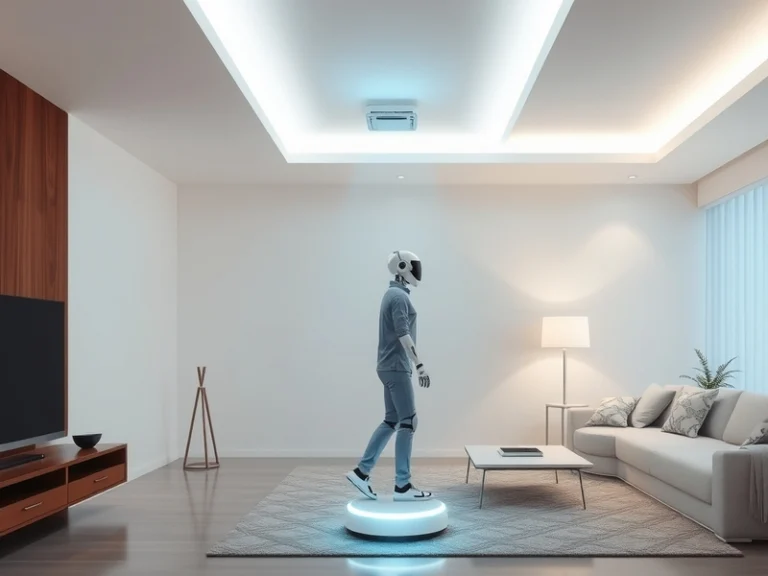
A new frontier in home automation is emerging with the conceptualization and early development of ceiling-mounted autonomous robots designed to follow users, enhancing both convenience and security within residential spaces.
Unlike stationary smart devices or floor-bound robotic vacuums, this nascent category of “ceiling robots” proposes a mobile, elevated platform that can traverse entire homes, offering omnipresent assistance and monitoring. The core idea revolves around a system that integrates into a home’s ceiling infrastructure, allowing a robotic unit to move freely above occupants, tracking their presence and responding to their needs or environmental changes.
Enabling Technologies: The AI and Robotics Underpinning
The realization of such a system hinges on a sophisticated blend of artificial intelligence and advanced robotics. Key technological components would include:
- Advanced Navigation and Mapping: For a robot to move intelligently and safely overhead, precise localization and mapping are paramount. This would likely involve Simultaneous Localization and Mapping (SLAM) algorithms, leveraging a combination of sensors such as LiDAR, depth cameras, and ultrasonic sensors to build and continuously update a 3D map of the home environment.
- Persistent User Tracking: Computer vision and machine learning models trained for human pose estimation and object recognition would be crucial for identifying and tracking specific individuals. This enables the robot to “follow” a user, anticipating their movement and presence in different rooms.
- Robust Robotic Mobility: The physical movement mechanism could vary, from integrated rail systems embedded within the ceiling structure to more advanced, perhaps magnetic levitation-based systems for smoother, quieter operation. Power delivery would also need to be integrated, potentially through conductive rails or wireless power transfer, to ensure continuous operation without frequent recharging.
- Edge AI for Real-time Processing: To minimize latency and enhance privacy, much of the perceptual processing—such as identifying faces, recognizing gestures, or detecting anomalies—would ideally occur on the device itself, utilizing specialized AI accelerators.
- Natural Language Processing: For seamless interaction, voice interfaces powered by sophisticated NLP would allow users to issue commands and queries naturally, transforming the robot into a truly interactive assistant.
Convenience Elevated
The potential for enhanced convenience through a ceiling robot is substantial. Imagine:
- Adaptive Lighting and Climate Control: The robot could dynamically adjust lighting levels and HVAC settings based on a user’s presence and preferences in specific areas of the home, moving with them from room to room.
- Hands-Free Assistance: For instance, it could project recipes onto a kitchen counter, provide real-time instructions during a DIY project, or even retrieve small, lightweight items from designated storage points using an integrated manipulator arm, if equipped.
- Proactive Support: By understanding routines and contexts, the robot could anticipate needs, such as dimming lights when a movie starts or suggesting a reminder for an upcoming appointment.
A New Paradigm for Home Security
Beyond convenience, the elevated perspective and mobility of a ceiling robot offer unique advantages for home security:
- Comprehensive Monitoring: Unlike fixed security cameras, a mobile ceiling robot could offer full coverage of a home’s interior, moving to investigate unusual sounds or motion.
- Intruder Detection and Deterrence: Equipped with high-resolution cameras, thermal sensors, and microphones, it could detect unauthorized entry, identify faces, and even trigger alarms or communicate with security services. Its visible presence might also serve as a deterrent.
- Elderly and Child Monitoring: For caregivers, it could provide discreet, continuous monitoring of vulnerable residents, alerting to falls, unusual inactivity, or a child entering an off-limits area.
- Environmental Anomaly Detection: Beyond human presence, it could monitor for smoke, carbon monoxide, water leaks, or other environmental hazards, providing early warnings.
Challenges and Considerations
Despite its promise, the development and adoption of ceiling robots face significant hurdles:
- Privacy Concerns: The constant, pervasive monitoring capability raises profound privacy questions. Robust data governance, on-device processing, and clear user controls would be essential to foster trust.
- Safety and Infrastructure: Integrating robotic mobility into existing home structures presents engineering challenges, including ensuring structural integrity, preventing collisions with occupants or objects, and managing noise levels. The installation process itself could be complex and costly.
- Cost and Accessibility: The sophisticated technology and custom installation requirements suggest a high initial price point, potentially limiting early adoption to niche markets.
- Social Acceptance: The psychological comfort level of having an autonomous, moving entity overhead continuously monitoring activities will vary widely among individuals and could be a significant barrier to widespread acceptance.
- Technical Robustness: Ensuring reliable operation in diverse and often unpredictable home environments, handling power outages, and maintaining software updates securely are ongoing challenges for any home robotics platform.
The concept of a ceiling robot represents an ambitious vision for the future of smart homes, moving beyond discrete devices to an integrated, adaptive, and omnipresent intelligent assistant. While the technological building blocks are largely present, the journey from concept to widespread consumer product will require careful navigation of complex engineering, ethical, and societal considerations.