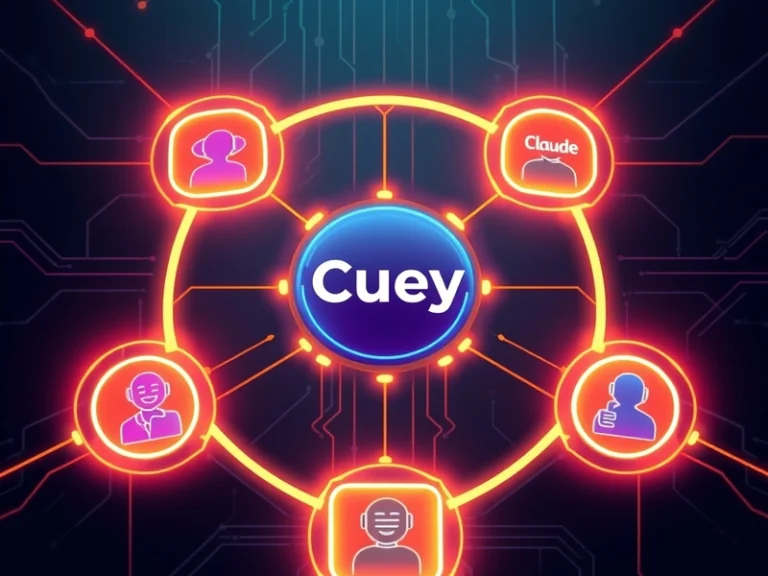
A new solution named Cuey is addressing a common frustration for users of large language models: the loss of conversational context when switching between different AI assistants.
In today’s rapidly evolving AI landscape, users frequently interact with multiple AI platforms, such as OpenAI’s ChatGPT, Anthropic’s Claude, Google’s Gemini, or various open-source models. Each platform often excels in different areas, whether it’s creative writing, complex coding, detailed analysis, or specific factual recall. However, moving an ongoing conversation from one assistant to another typically means starting from scratch, re-explaining the background, parameters, and accumulated information – a significant drain on productivity and efficiency.
Cuey aims to bridge this gap by enabling seamless context transfer. The core idea is to capture the essence of a user’s interaction with one AI and make it readily available when initiating a new conversation with a different AI, preserving continuity and saving users from repetitive setup.
The Challenge of Context Transfer
The difficulty in transferring context isn’t merely a user interface oversight; it stems from fundamental differences in how AI models process and retain information. Each AI platform typically maintains its own proprietary conversational state, often tied to a user’s session or account within that specific service. Key challenges include:
- Varying Data Formats: Different models and platforms might represent conversational history, user intent, and extracted entities in dissimilar internal structures.
- Proprietary APIs: While many platforms offer APIs, they are designed for interaction within their ecosystem, not necessarily for easy context export or import in a standardized format consumable by competitors.
- Defining “Context”: What constitutes “context” can vary. Is it just the last few turns of dialogue, the overall topic, specific named entities, user preferences, or inferred goals? A truly effective transfer mechanism needs to intelligently distill the most relevant information.
- Privacy and Security: Transferring potentially sensitive conversational data between platforms raises significant privacy and security considerations, requiring robust consent and data handling protocols.
How Cuey Aims to Bridge the Gap
While specific technical implementations can vary, solutions like Cuey typically operate by acting as an intermediary layer. They would intelligently parse ongoing conversations, extract critical contextual elements, and then facilitate their injection into a new AI environment. This process might involve several steps:
- Context Extraction: Utilizing natural language processing (NLP) techniques to identify and summarize key topics, entities, constraints, and the user’s overarching goal from a conversation.
- Standardized Representation: Converting the extracted context into a platform-agnostic format that can be understood and processed by various AI models. This might involve a structured data representation that outlines the core elements of the interaction.
- Platform Integration: Leveraging existing APIs or browser-based integrations to feed the standardized context into the target AI assistant, effectively “priming” it with the necessary background before the user types their first prompt.
For users, the benefit is immediate and tangible. Imagine drafting a complex legal document with one AI, then needing a more creative turn of phrase. Instead of re-explaining the document’s purpose and existing content to a different, more creatively oriented AI, Cuey would allow a seamless hand-off, letting the second AI pick up precisely where the first left off.
Implications for the AI Ecosystem
The emergence of tools like Cuey signifies a growing demand for greater interoperability within the AI ecosystem. As AI models become more specialized and powerful, users will increasingly seek to combine their strengths. Solutions that enable this kind of fluid transition could have several broader impacts:
- Enhanced User Productivity: By minimizing repetitive tasks, users can focus more on problem-solving and less on managing AI interactions.
- Leveraging Model Strengths: Users can more effectively utilize the unique capabilities of different models without being locked into a single platform for an entire task.
- Driving Competition and Innovation: Platforms that facilitate context transfer could encourage AI developers to focus on specialized excellence, knowing their models can be part of a broader, integrated workflow.
- New Workflow Paradigms: The ability to chain AI interactions could lead to novel workflows, where multiple AI agents collaborate on a complex project, each contributing its expertise.
While the technical and logistical hurdles for widespread context transfer are considerable, the fundamental utility of such a capability is clear. As AI becomes more deeply embedded in daily work and personal life, the friction of platform switching will only become more pronounced, making solutions like Cuey increasingly vital for a truly integrated and efficient AI experience.