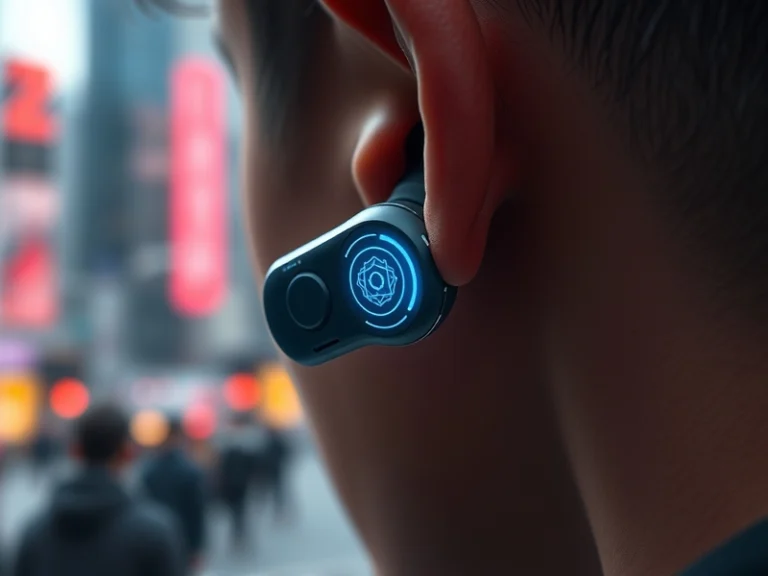
The latest generation of hearable technology is rapidly integrating advanced artificial intelligence, moving beyond simple voice commands to enable earbuds that can actively, contextually respond to user conversations and environmental cues. This shift represents a significant leap from merely smart listening devices to truly intelligent companions, exemplified by features such as Apple’s Adaptive Audio and Conversation Awareness on the AirPods Pro 2nd generation.
For years, “smart” earbuds primarily offered active noise cancellation (ANC), transparency modes, and direct access to voice assistants like Siri or Google Assistant. While revolutionary in their time, these functions largely operated in isolation or required explicit user invocation. The new wave of AI-powered earbuds, however, introduces a layer of environmental and conversational intelligence, allowing the devices to dynamically adjust their behavior based on real-time acoustic analysis and user interaction.
Beyond Passive Listening: Key AI Capabilities
The core of this evolution lies in on-device AI processing, which enables a suite of features designed to make listening experiences more seamless and personalized. These capabilities leverage sophisticated machine learning models to interpret audio landscapes and user intent.
- Contextual Audio Adaptation: Features like Apple’s Adaptive Audio blend Transparency mode and Active Noise Cancellation, dynamically adjusting the level of environmental sound allowed in based on the user’s surroundings. This means the earbuds can automatically quiet sudden loud noises while still allowing a user to hear important announcements or conversations.
- Conversation Awareness: Building on contextual adaptation, some earbuds can detect when a user begins speaking or when someone else is speaking directly to them. Apple’s Conversation Awareness, for instance, automatically lowers media volume and enhances voices in front of the user when speech is detected, then returns to the previous audio settings once the conversation ends. This removes the need to manually pause music or remove an earbud to engage in a quick chat.
- Proactive Assistance and Response: While traditional voice assistants respond to explicit commands, next-gen AI aims for more proactive interaction. This could manifest as the earbuds offering relevant information based on the context of a detected conversation (e.g., suggesting a restaurant when discussing dinner plans) or providing real-time translations during a spoken interaction, building on earlier capabilities seen in devices like the Google Pixel Buds.
- Personalized Sound Profiles: AI can analyze a user’s unique hearing profile and the acoustic properties of their environment to create highly personalized sound delivery. This extends beyond simple equalizer adjustments, potentially compensating for hearing deficiencies in specific frequency ranges or optimizing audio for unique ear canal shapes.
- Enhanced Noise Reduction for Calls: AI models can more intelligently isolate a user’s voice from background noise during phone calls, even in challenging environments. This goes beyond traditional beamforming microphones by using neural networks to filter out specific types of distractions while preserving voice clarity.
The Enabling Technology Stack
Achieving these sophisticated capabilities requires a robust combination of hardware and software innovations:
On-Device AI and Edge Computing
For these features to be truly responsive and preserve user privacy, much of the AI processing needs to happen directly on the earbuds themselves, rather than relying solely on cloud servers. This “edge AI” approach minimizes latency and reduces the need to transmit sensitive audio data over the internet. Chipmakers like Qualcomm are developing specialized System-on-Chips (SoCs), such as their Snapdragon Sound platforms (e.g., S5 Gen 2 and S7 Gen 2), which integrate dedicated AI engines designed for low-power, high-performance machine learning tasks in audio devices.
Advanced Sensors and Microphones
Modern earbuds are packed with an array of sensors far beyond simple audio transducers. Multiple microphones are crucial for spatial audio detection and noise cancellation, but accelerometers and gyroscopes also play a role in head tracking and understanding user movement. Bone conduction sensors can further enhance voice pickup by detecting vibrations directly from the user’s skull, improving clarity in noisy environments.
Sophisticated Machine Learning Models
At the heart of the AI functionality are complex machine learning models, often neural networks, trained on vast datasets of audio, speech, and environmental sounds. These models are designed to:
- Differentiate between human speech and other sounds.
- Identify the direction and proximity of sound sources.
- Understand the semantic content of spoken language for contextual actions.
- Adapt to individual user preferences and acoustic environments over time.
Challenges and Future Outlook
While the promise of AI-powered earbuds is immense, several challenges remain. Battery life is a constant concern, as on-device AI processing can be power-intensive. Accuracy and reliability are also critical; false positives in conversation detection or incorrect audio adjustments can be more annoying than helpful. Furthermore, privacy remains a paramount consideration, as these devices are constantly listening and processing ambient audio. Companies are addressing this by emphasizing on-device processing and clear data handling policies.
Looking ahead, the integration of more powerful, efficient AI models will likely lead to earbuds that offer even more nuanced contextual awareness and proactive assistance. Imagine earbuds that can not only detect a conversation but also summarize key points, remind you of forgotten details, or even provide real-time coaching during public speaking. As the computational capabilities of miniaturized devices continue to advance, AI-powered earbuds are poised to become indispensable tools, blurring the lines between personal audio and intelligent assistants.