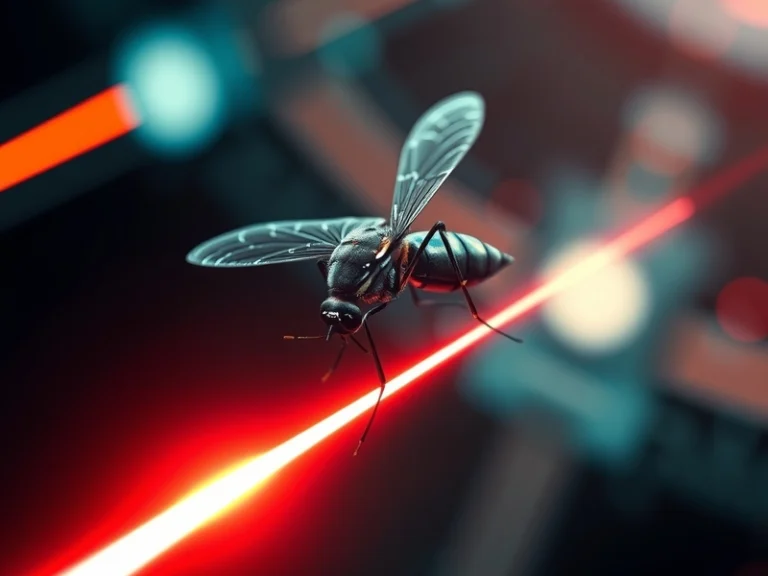
AI-driven laser technology is emerging as a novel, chemical-free solution for mosquito control, promising a highly targeted approach to mitigate vector-borne diseases and nuisance pests.
This innovative method leverages sophisticated artificial intelligence and precision optics to identify, track, and neutralize mosquitoes, offering a potential paradigm shift from traditional broad-spectrum insecticide applications. The core idea revolves around automating the elimination of individual insects, a stark contrast to area-wide chemical fogging or larvicides.
How AI Powers Precision Pest Control
At its core, an AI-powered mosquito laser system combines advanced computer vision with precision laser targeting. High-resolution cameras, often paired with infrared sensors, continuously scan a designated area. Machine learning models, trained on vast datasets of insect imagery and flight patterns, are crucial here. These models are designed to rapidly identify mosquitoes, distinguishing them from other flying insects like moths, bees, or even harmless midges. Crucially, some systems can even differentiate between male and female mosquitoes, or specific species, by analyzing wingbeat frequency, size, and flight characteristics.
The AI’s role extends beyond mere identification. Once a target is confirmed, the system’s algorithms track the mosquito’s trajectory in real-time, predicting its movement with high accuracy. This allows for the precise aiming of a low-power laser. The laser delivers a fatal but localized burst of energy, effectively incapacitating or killing the insect without the need for broad-spectrum insecticides. The energy is typically calibrated to be just enough to neutralize the mosquito, minimizing any risk to larger animals or the broader environment.
The Role of Computer Vision and Machine Learning
- Object Detection: Deep learning models, often convolutional neural networks (CNNs), are trained on millions of images to accurately identify mosquitoes in varying light conditions and against complex backgrounds.
- Species and Sex Classification: Advanced algorithms analyze subtle differences in wingbeat frequency (which can be thousands of beats per minute), body shape, and size to differentiate between mosquito species and sexes. Targeting only female mosquitoes, which are the blood-feeders and disease vectors, is a significant advantage.
- Trajectory Prediction: Once detected, AI continuously tracks the insect’s movement, predicting its flight path to ensure the laser beam intercepts it accurately, often within milliseconds.
Advantages Over Traditional Methods
The appeal of this technology stems from several significant advantages over traditional pest control methods, particularly concerning environmental impact and public health.
- Environmental Stewardship: By eliminating the need for chemical insecticides, laser systems prevent the introduction of potentially harmful substances into ecosystems. This protects beneficial insects like pollinators, aquatic life, and other non-target organisms that are often affected by chemical spraying.
- Targeted Efficacy: The ability to specifically target mosquitoes, and even differentiate between species or sexes, offers unparalleled precision. This means resources are not wasted on non-threatening insects, and efforts can be concentrated on vectors of specific diseases.
- Disease Prevention: Mosquitoes are vectors for some of the world’s most devastating diseases, including malaria, dengue fever, Zika virus, and West Nile virus. By directly reducing mosquito populations, particularly disease-carrying females, laser technology offers a direct and proactive approach to public health protection.
- Sustainability and Long-Term Operation: While initial setup costs may be high, the operational costs over the long term could be lower than continuous chemical applications. Systems can be powered by renewable energy sources, and they don’t require repeated purchases and deployments of chemical agents.
Challenges and Future Outlook
Despite its promise, the deployment of laser-based mosquito control faces several practical and economic hurdles that researchers and developers are actively addressing.
- Initial Investment: The sophisticated hardware, including high-resolution cameras, powerful processors for AI, and precision lasers, represents a substantial upfront cost. This can be a barrier for widespread adoption, especially in resource-limited regions where mosquito-borne diseases are most prevalent.
- Scalability and Coverage: A single system has a limited effective range. Covering large areas, such as entire cities or vast rural landscapes, would require a dense network of devices, raising questions about infrastructure and overall cost-effectiveness.
- Power Requirements: Continuous operation of cameras, AI processing units, and lasers demands a reliable power supply. Innovations in energy efficiency and integration with renewable energy sources are critical for practical deployment.
- Safety Protocols: While the lasers used are typically low-power and designed to be safe for larger organisms, rigorous safety testing and regulatory frameworks are essential to ensure they pose no risk to humans, pets, or non-target wildlife under various operational conditions.
- Public Acceptance and Perception: Introducing a new, high-tech solution like “laser fences” may encounter public skepticism or concern, necessitating clear communication about its safety, efficacy, and environmental benefits.
The concept of using directed energy for insect control is not entirely new, with research and development spanning several years. Notably, projects like the “Photonic Fence,” developed by Intellectual Ventures and supported by figures such as Bill Gates, have brought this innovative approach into the public consciousness. These early initiatives demonstrated the feasibility of using optics and AI to track and eliminate mosquitoes, laying groundwork for current advancements.
As AI capabilities continue to advance and hardware costs potentially decrease through mass production and technological refinement, laser-based mosquito control could transition from a high-tech novelty to a viable tool in global public health. Its potential to offer a sustainable, precise, and environmentally friendly alternative to chemical pesticides makes it a compelling area of ongoing research and development in the fight against mosquito-borne diseases.