Anthropic’s Claude large language model is being explored for its potential to revolutionize laboratory work, specifically by automating the control of microscopes and robotic arms, thereby reducing setup times and significantly increasing experimental efficiency.
The modern scientific laboratory is a hub of intricate processes, demanding precision, repetition, and often, significant manual intervention. From preparing samples and loading instruments to operating complex imaging devices, human researchers spend countless hours on tasks that, while critical, are often repetitive. This not only consumes valuable time but can also introduce variability and limit the scale of experiments. The integration of advanced AI, particularly large language models (LLMs) like Claude, offers a compelling solution to these long-standing challenges.
At its core, the application of Claude in lab automation hinges on its ability to understand and execute complex instructions given in natural language. Traditionally, programming laboratory robots and automated microscopes requires specialized coding skills and painstaking configuration for each new experiment. This creates a bottleneck, as scientists must either become proficient in automation scripting or rely on dedicated engineers, slowing down the pace of research.
Claude’s Role in Orchestrating Lab Hardware
By leveraging an LLM, researchers can communicate their experimental goals and protocols directly, using everyday language. Claude can then interpret these high-level instructions and translate them into the precise, step-by-step commands required by robotic systems and microscopes. This capability manifests in several key areas:
- Natural Language Programming: Scientists can describe desired actions, such as “prepare a 96-well plate with varying concentrations of compound X,” or “scan this tissue sample at 40x magnification, focusing on areas with cellular aggregates,” and Claude can generate or orchestrate the underlying code or command sequences for the hardware.
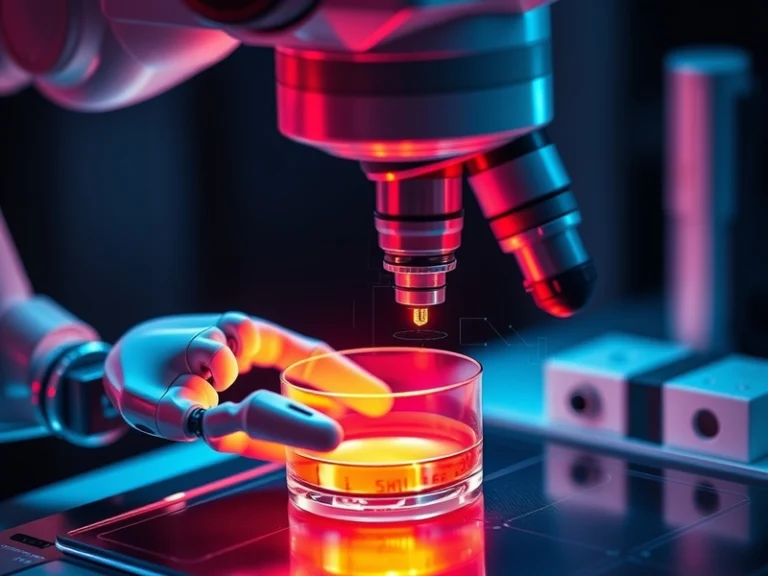
- Microscope Control: For automated microscopy, Claude could manage parameters like focus depth, magnification levels, stage movement (X-Y-Z coordinates), and image acquisition settings. This allows for high-throughput imaging campaigns where the AI system intelligently navigates samples, identifies regions of interest, and captures relevant data without constant human supervision.
- Robot Arm Manipulation: In robotics, Claude could direct articulated arms to perform a variety of tasks, including pipetting liquids with precise volumes, moving microtiter plates between different instruments, loading and unloading samples into incubators or sequencers, and applying specific reagents. The LLM acts as an intelligent intermediary, translating abstract experimental designs into concrete robotic movements.
Tangible Benefits for Scientific Research
The integration of an LLM like Claude into laboratory workflows promises a transformative shift in operational efficiency and research capabilities:
- Reduced Setup Time: The ability to program complex experiments through natural language drastically cuts down the time spent on writing and debugging automation scripts. Researchers can iterate on experimental designs more quickly, accelerating the discovery process.
- Increased Efficiency and Throughput: Automated systems can operate continuously, around the clock, without fatigue or the need for breaks. This dramatically increases the number of experiments that can be performed, leading to larger datasets and faster validation of hypotheses.
- Enhanced Reproducibility: Robotic execution, guided by precise AI instructions, minimizes human error and variability. Each experimental run can follow an identical protocol, leading to more consistent and reproducible results—a critical factor in scientific integrity.
- Democratization of Automation: By simplifying the interface to complex machinery, LLMs can make advanced laboratory automation accessible to a broader range of researchers who may not have specialized programming expertise.
- Focus on High-Value Tasks: Freeing scientists from repetitive manual labor allows them to dedicate more time to critical thinking, experimental design, data analysis, and the interpretation of results, pushing the boundaries of scientific inquiry.
While the concept holds immense promise, its practical implementation involves integrating LLM capabilities with existing lab automation platforms and ensuring robust safety protocols. This includes developing reliable APIs for communication between Claude and diverse hardware, and establishing validation frameworks to ensure the AI-driven experiments yield accurate and trustworthy data. Furthermore, the ethical considerations of AI in critical research environments, including data integrity and human oversight, remain paramount.
The ongoing development of LLMs like Claude represents a significant stride towards creating truly intelligent and autonomous laboratories. By bridging the gap between human scientific intent and machine execution, these AI systems are poised to accelerate the pace of discovery across fields ranging from drug development and materials science to fundamental biological research, ushering in a new era of scientific exploration.