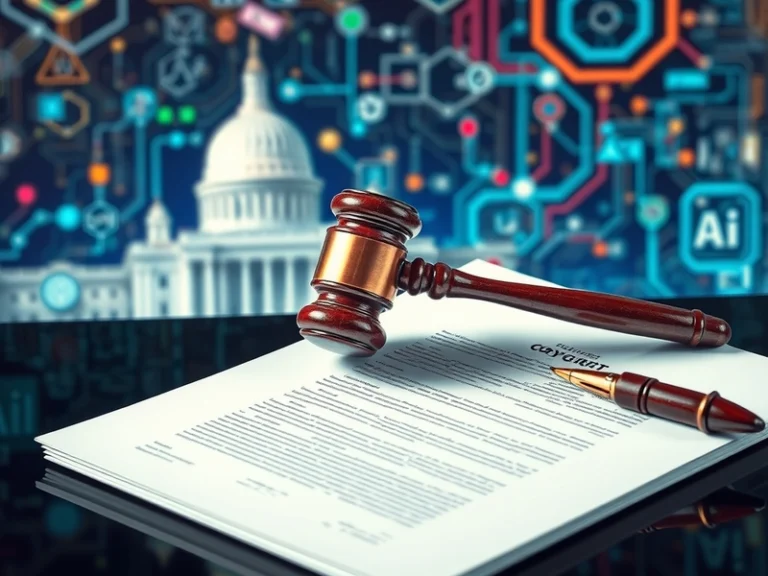
As generative AI developers like OpenAI face a growing wave of copyright infringement lawsuits, federal agencies are increasingly engaging with the complex legal questions surrounding AI training data and output, influencing the broader environment in which these disputes unfold. While direct, explicit government support for a specific company in private litigation is rare, the ongoing policy discussions and interpretive guidance from various U.S. government bodies are shaping the legal landscape in ways that could be seen as indirectly favorable to AI innovators.
The core of the legal debate revolves around the use of vast datasets, often containing copyrighted material, to train large language models (LLMs) and other generative AI systems. Lawsuits filed by entities such as The New York Times and a coalition of authors including Sarah Silverman, allege that OpenAI and Microsoft have infringed on their copyrights by ingesting their works without permission or compensation, and that the AI models sometimes reproduce or create derivative works from that copyrighted material.
The US Copyright Office’s Evolving Stance
A significant player in this discussion is the United States Copyright Office (USCO). The USCO has been actively soliciting public comments and publishing reports aimed at understanding the intersection of AI and copyright law. In March 2023, the Office released guidance stating that AI-generated works lacking human authorship are not copyrightable, underscoring the foundational principle of human creativity in U.S. copyright law. However, its engagement extends to the input side of AI as well.
The USCO’s Notice of Inquiry and subsequent reports have delved into whether the use of copyrighted works for AI training constitutes fair use under Section 107 of the Copyright Act. Fair use is a critical defense for AI developers, potentially allowing the use of copyrighted material without permission under certain conditions. The USCO has acknowledged that fair use is a fact-specific inquiry, but its discussions and framing of the issue often highlight the transformative nature of AI training and the public benefit of AI innovation. While not an endorsement of specific AI companies, the Office’s willingness to seriously consider fair use arguments provides a framework that AI developers can leverage in their defense.
Key areas of the USCO’s ongoing analysis that could influence the debate include:
- Scope of Fair Use: How existing fair use principles apply to the copying and ingestion of copyrighted works for AI training. The Office is examining the four fair use factors—purpose and character of the use, nature of the copyrighted work, amount and substantiality of the portion used, and effect of the use upon the potential market for or value of the copyrighted work—in the context of AI.
- Output Issues: The potential for AI outputs to infringe existing copyrights, especially if they are substantially similar to or directly reproduce original works.
- Legislative Recommendations: The possibility of new legislation or amendments to the Copyright Act to address gaps or ambiguities created by AI technologies.
Broader Government Engagement
Beyond the Copyright Office, other federal agencies are also contributing to the policy discourse, albeit without directly intervening in specific lawsuits:
- Department of Justice (DOJ): The DOJ, through its various divisions, monitors antitrust concerns and has a general interest in fostering innovation. While the DOJ is not typically involved in private copyright disputes, its broader policy positions on competition and innovation could indirectly influence how courts or future legislation approach these issues. The DOJ might file amicus briefs in cases of significant public interest, but to date, it has not filed one directly in favor of OpenAI in its copyright cases.
- National Telecommunications and Information Administration (NTIA): As part of the Department of Commerce, the NTIA has published reports and convened discussions on AI policy, including data privacy, accountability, and the implications of AI for various sectors. Their work often emphasizes the need to balance innovation with societal safeguards, a perspective that could be interpreted as broadly supportive of creating an environment conducive to AI development.
- National Institute of Standards and Technology (NIST): NIST develops technical standards and guidelines for AI, focusing on trustworthiness and risk management. While not directly related to copyright, NIST’s efforts to establish a robust and ethical AI ecosystem indirectly support the industry by fostering public trust and guiding responsible development.
Analyzing the Nature of “Support”
It is important to differentiate between direct intervention and the shaping of the legal and policy environment. The U.S. government has not explicitly “supported” OpenAI or any other AI company in their private copyright litigation. Such direct intervention would be unusual and potentially problematic. Instead, the “support” being analyzed here is more nuanced:
- Clarification of Legal Principles: Agencies like the USCO are actively working to clarify how existing copyright law, particularly fair use, applies to AI. This clarification, even if it doesn’t definitively rule in favor of AI developers, provides a structured legal framework for their arguments.
- Emphasis on Innovation: Many government discussions around AI highlight the transformative potential of the technology and the importance of fostering innovation. This broader policy goal can create a climate where courts and policymakers are encouraged to seek solutions that do not unduly stifle technological progress.
- Requests for Public Input: By soliciting extensive public and industry input, agencies ensure that the perspectives and challenges faced by AI developers are heard and considered in policy formulation.
This engagement reflects a complex balancing act. On one side, there’s a strong desire to protect the rights of creators and ensure they are compensated for their work. On the other, there’s an equally strong imperative to foster technological innovation and maintain U.S. leadership in AI. The government’s role is not to pick sides but to interpret existing law, consider potential legislative changes, and provide guidance that navigates these competing interests. The ongoing dialogue, particularly from the US Copyright Office regarding the applicability of fair use, offers AI developers like OpenAI crucial avenues for defense within the existing legal structure.