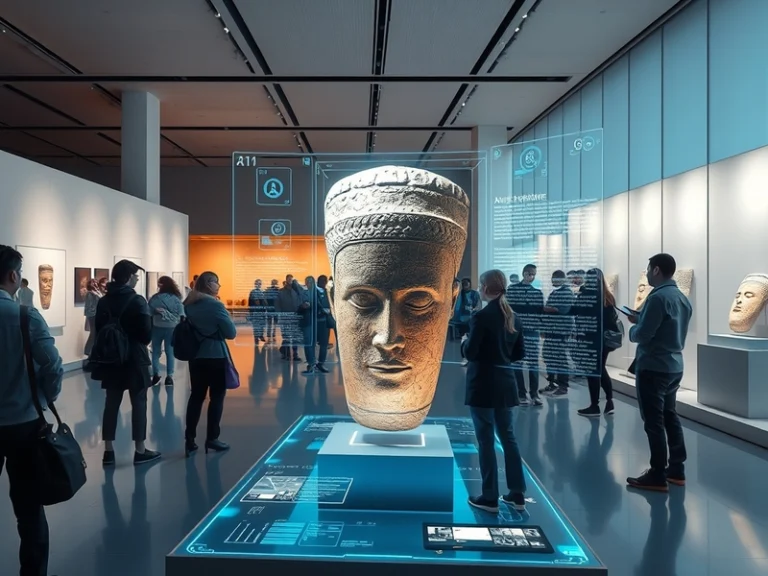
A recent survey indicates that museums globally are increasingly adopting artificial intelligence technologies across various administrative and educational functions, yet this integration often proceeds without cohesive, institution-wide strategic frameworks.
The findings highlight a landscape where AI tools are being enthusiastically piloted and implemented for specific projects, from enhancing visitor engagement to streamlining back-end operations. However, the broader vision for how AI aligns with an institution’s long-term goals, ethical guidelines, and existing digital infrastructure frequently remains undefined.
AI in Action: Enhancing Museum Operations
On the administrative front, museums are leveraging AI to tackle challenges related to their vast collections and operational complexities. These applications often aim to improve efficiency and reduce manual labor, freeing up human staff for more nuanced tasks.
-
Collections Management and Preservation
AI-powered computer vision and natural language processing (NLP) are assisting in the daunting task of cataloging and digitizing collections. For instance, image recognition algorithms can help identify objects, suggest descriptive tags, and even detect subtle changes in an artwork’s condition over time, aiding in predictive conservation. NLP models can process historical documents, curator notes, and acquisition records to extract metadata, link related items, and make vast archives more searchable and accessible for researchers.
-
Operational Efficiency and Security
Predictive analytics, a branch of AI, is being used to forecast visitor attendance, optimize staffing levels, and manage facility resources more effectively. This can lead to better energy management and resource allocation. In security, AI-driven surveillance systems can identify unusual patterns or anomalies in real-time, enhancing safety and protecting valuable artifacts without requiring constant human monitoring of every feed.
Revolutionizing the Visitor Experience and Education
Perhaps more visibly, AI is transforming how visitors interact with museum content and how institutions deliver educational programming.
-
Personalized Engagement and Accessibility
AI-powered recommendation engines, similar to those found in e-commerce or streaming services, can suggest personalized exhibition routes or related artworks based on a visitor’s interests or past interactions. Chatbots, often deployed via museum websites or dedicated apps, provide instant answers to common questions about operating hours, exhibit locations, or even deeper context about specific pieces. Furthermore, AI is making museums more accessible by generating automated audio descriptions for visually impaired visitors or providing real-time translation services for multilingual audiences.
-
Interactive Exhibits and Research
Augmented reality (AR) experiences, often underpinned by AI, allow visitors to overlay digital information onto physical objects, bringing historical contexts or scientific explanations to life. AI also supports educational outreach by helping to analyze vast datasets of historical and artistic information, uncovering new connections and insights that can inform exhibit development and scholarly research. Some institutions explore generative AI to assist in creating initial drafts of exhibit labels or educational materials, which are then refined by human experts.
The Strategic Chasm: A Patchwork Approach
Despite these promising applications, the survey highlights a significant challenge: the lack of comprehensive, institution-wide AI strategies. Many museums approach AI implementation on a project-by-project basis, driven by specific departmental needs or external funding opportunities, rather than a top-down strategic vision.
This fragmented adoption can lead to several issues:
- Siloed Initiatives: Different departments may invest in incompatible AI tools or develop redundant solutions, preventing economies of scale or cross-departmental data sharing.
- Lack of Expertise: Without a central strategy, institutions may struggle to attract and retain specialized AI talent or to provide adequate training for existing staff, limiting the full potential of AI tools.
- Ethical Oversight Gaps: A cohesive strategy is crucial for establishing clear ethical guidelines around data privacy, algorithmic bias, and the authentic representation of cultural heritage, especially when using AI for content generation or visitor profiling. Without such a framework, individual projects might inadvertently overlook critical ethical considerations.
- Integration Challenges: New AI systems often need to integrate with legacy museum databases and content management systems. A lack of strategic planning can result in complex, costly, and inefficient integration processes.
- Uncertain ROI: Without a clear strategy, it can be difficult to measure the return on investment (ROI) for individual AI projects, making it harder to secure sustained funding or scale successful initiatives across the institution.
The implications of this disjointed approach are significant. While individual projects may yield impressive results, the true transformative potential of AI—its ability to create seamless, intelligent ecosystems within museums that serve both visitors and staff—remains largely untapped. The current landscape suggests a reactive rather than proactive embrace of AI, driven by immediate needs rather than a holistic vision for the future of cultural institutions in a technologically evolving world.
As AI continues to mature, the challenge for museums will be to move beyond isolated experiments and develop robust, ethical, and integrated strategies that leverage these powerful tools to truly redefine engagement, preservation, and education for generations to come.