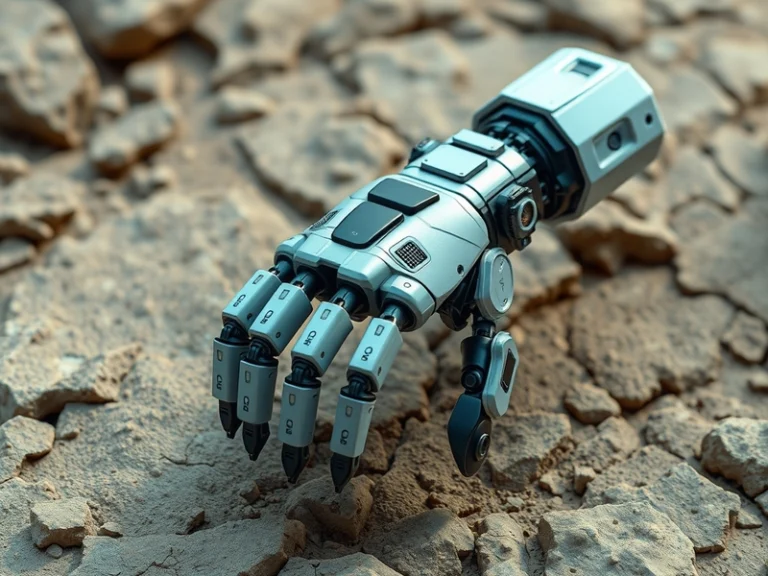
Recent advancements in robotic design are exploring novel paradigms for autonomous movement, most notably with the emergence of robotic hands capable of independent locomotion without a traditional attached body. This innovative approach challenges conventional robotics by integrating mobility directly into the manipulation mechanism, enabling a single unit to both navigate and interact with its environment.
Traditionally, robotic systems separate locomotion from manipulation: a mobile base (wheeled, tracked, or legged) carries a distinct robotic arm and gripper. The “walking robot hand” concept merges these functions, leveraging the hand’s inherent degrees of freedom (DOFs) and contact points—its fingers and palm—not just for grasping but also for propulsion and stability. Researchers are developing sophisticated control algorithms that allow these anthropomorphic or multi-fingered grippers to reconfigure their morphology, effectively using their digits as miniature legs or points of leverage to “walk,” “crawl,” or “inchworm” across surfaces.
The Mechanics of Self-Locomoting Hands
The fundamental principle behind a walking robot hand lies in its ability to dynamically change its contact points and center of mass. Instead of a fixed base, the hand itself becomes the mobile platform. This involves:
- Multi-modal Gait Generation: Algorithms coordinate the movement of individual fingers or segments of the hand to create a stable gait. This could involve sequences where some fingers act as anchors while others push or pull, similar to how an inchworm moves or how a human might use their hands to climb.
- Reconfigurable Morphology: The hand’s structure is not static during locomotion. It can splay its fingers wide for stability, curl them for pushing, or articulate them to grip irregular terrain, adapting its shape to the immediate environment.
- Integrated Sensing: Tactile sensors on the fingertips and palm, combined with proprioceptive sensors at each joint and potentially external vision systems, provide critical feedback for maintaining balance, detecting obstacles, and planning movement paths across varied surfaces.
This embodiment of locomotion within the manipulator itself represents a significant departure from rigid, pre-defined robot architectures, pushing towards more adaptable and versatile robotic agents.
Advantages in Confined and Complex Environments
The primary motivation for developing walking robot hands stems from their potential to operate in spaces inaccessible to larger, more conventional robots. Their unique capabilities offer several compelling advantages:
- Navigation in Tight Spaces: The compact nature of a hand-sized robot allows it to maneuver through narrow crevices, pipes, machinery interiors, or rubble where a full-bodied robot simply cannot fit.
- Enhanced Dexterity and Interaction: By using the same mechanism for both movement and manipulation, these robots can perform intricate tasks, such as grasping and repairing components, while simultaneously repositioning themselves or stabilizing their stance. They can “walk” an object into position or manipulate it while traversing.
- Reduced System Complexity (for specific tasks): For applications requiring both fine manipulation and navigation within a very constrained volume, a single walking hand unit might be simpler and lighter than a separate mobile base and arm.
- Access to Elevated or Irregular Surfaces: The ability to grip and climb using its fingers allows these robots to ascend vertical surfaces, traverse uneven terrain, or move along suspended cables, opening up new operational domains.
These advantages are particularly relevant for inspection, maintenance, rescue operations, and exploration in hazardous or unstructured environments where human access is difficult or impossible.
Engineering Hurdles and Future Directions
Despite the promise, the development of robust and practical walking robot hands presents considerable engineering challenges:
- Control Algorithm Complexity: Managing the high number of degrees of freedom simultaneously for both stable locomotion and precise manipulation requires sophisticated, real-time control systems that can handle dynamic contact forces and varying terrain.
- Power Management: The constant actuation of multiple joints for locomotion, combined with the power demands of manipulation, requires efficient energy storage and distribution systems, especially for untethered operation.
- Durability and Wear: Components designed for fine manipulation might not be robust enough for the stresses of locomotion, leading to potential issues with wear and tear on joints and tactile sensors.
- Perception and Mapping: Accurately perceiving the environment for both navigation and object interaction, especially in cluttered or low-light conditions, remains a significant hurdle.
Research continues to push the boundaries in these areas, exploring new materials, more efficient actuator designs, and advanced AI-driven control strategies. The concept of the walking robot hand is a testament to the ongoing evolution in robotics, moving towards more agile, adaptable, and integrated systems that blur the lines between traditional robotic functions. As these technologies mature, we may see compact, highly versatile robotic units capable of unprecedented autonomy and interaction in complex environments.