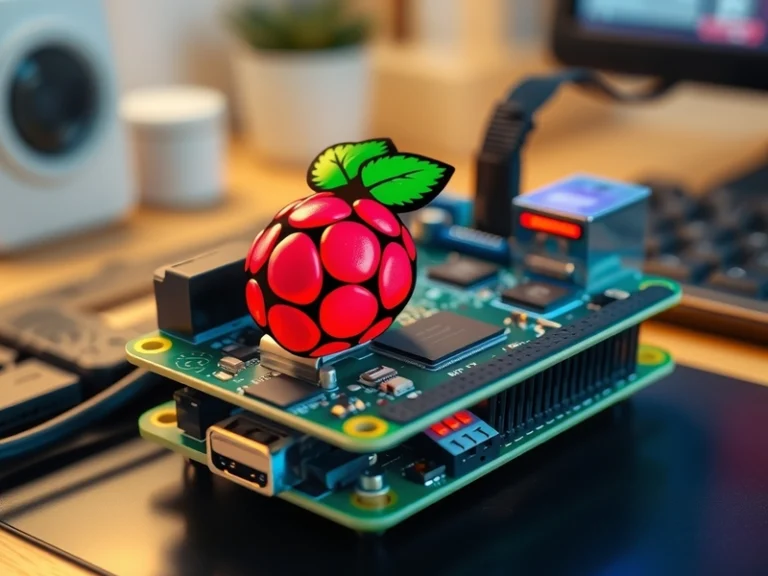
The emergence of specialized hardware like the AI HAT+ 2 is transforming the Raspberry Pi into a powerful platform for running local, private artificial intelligence applications directly at home. This development signals a significant shift towards democratizing edge AI, making sophisticated machine learning capabilities accessible to hobbyists, developers, and everyday users without relying on cloud infrastructure.
The AI HAT+ 2: A Gateway to Edge AI
The Raspberry Pi has long been celebrated for its versatility as a low-cost, low-power single-board computer, powering everything from smart home hubs to robotics projects. However, its general-purpose CPUs often struggle with the intensive computational demands of modern AI inference. This is where the AI HAT+ 2 comes into play. As a “Hardware Attached on Top” (HAT) board, it physically connects to the Raspberry Pi’s 40-pin GPIO header, augmenting its capabilities with dedicated AI acceleration.
At its core, the AI HAT+ 2 typically features a specialized neural processing unit (NPU) or a similar accelerator chip. Unlike the Raspberry Pi’s CPU, which is designed for general computing tasks, an NPU is engineered specifically to execute the mathematical operations common in neural networks with high efficiency and lower power consumption. By offloading these compute-intensive AI tasks, the AI HAT+ 2 enables a standard Raspberry Pi to perform complex AI inference—such as object detection, image classification, or natural language processing—at speeds and efficiencies previously unattainable on the platform alone. This means less reliance on the CPU, lower overall power draw for AI tasks, and significantly faster results.
Why Local AI Matters for Home and Hobbyists
The ability to run AI applications locally on a device like the Raspberry Pi, empowered by accelerators like the AI HAT+ 2, offers several compelling advantages, particularly for private and home-based deployments:
- Enhanced Privacy: One of the most significant benefits is data privacy. When AI inference happens on the device, sensitive data—like images from a security camera, voice commands, or personal analytics—never leaves the local network. This eliminates the need to transmit data to remote cloud servers for processing, significantly reducing privacy concerns and potential data breaches.
- Reduced Latency: Cloud-based AI services introduce inherent latency due to the round trip time for data transmission and processing. Local AI, however, processes data almost instantaneously on the device itself. This is crucial for applications requiring real-time responses, such as robotics control, immediate security alerts, or responsive voice assistants.
- Offline Functionality: AI applications running on the AI HAT+ 2 do not require a constant internet connection. This ensures continuous operation even during network outages, making local AI ideal for remote deployments, backup systems, or scenarios where internet access is unreliable or unavailable.
- Cost Efficiency: While cloud AI services offer scalability, they often come with recurring costs for inference and data transfer. Running AI locally on a Raspberry Pi with an AI HAT+ 2 is a one-time hardware investment, eliminating ongoing subscription fees and potentially offering long-term cost savings for consistent usage.
- Empowering Custom Solutions: For hobbyists and developers, local AI on the Raspberry Pi unlocks unprecedented opportunities for building highly customized and unique projects. It provides a tangible platform to experiment with machine learning models and integrate AI into bespoke hardware solutions.
Unlocking New Possibilities: Applications at Home
With the AI HAT+ 2, the Raspberry Pi can transform into a hub for sophisticated local AI applications across a range of home and personal uses:
- Smart Home Automation: Imagine a smart home system that locally recognizes family members, detects packages at the door, or responds to specific gestures, all without sending video streams to the cloud. Local AI enables more intelligent and context-aware automation, such as adjusting lighting based on activity patterns or triggering alerts only for specific events.
- Enhanced Security and Monitoring: For home security, the AI HAT+ 2 can power on-device object detection to differentiate between pets, delivery personnel, and potential intruders. This allows for more intelligent alerts and can significantly reduce false alarms compared to simpler motion detection systems.
- Personalized Assistants: Beyond basic keyword spotting, a Raspberry Pi with an AI HAT+ 2 could host a more capable local voice assistant, processing commands and even understanding context without ever transmitting audio recordings to external servers.
- Creative AI Projects: From interactive art installations that react to human presence and emotions to educational tools for teaching AI concepts, the combination of Raspberry Pi and the AI HAT+ 2 empowers a new generation of creative and experimental AI projects.
Technical Underpinnings and Ecosystem
The practicality of the AI HAT+ 2 largely depends on its software ecosystem. Most such accelerators are designed to be compatible with popular edge AI frameworks like TensorFlow Lite, PyTorch Mobile, and ONNX Runtime. These frameworks allow developers to deploy pre-trained machine learning models that have been optimized for resource-constrained devices. Typically, developers can leverage Python libraries to interface with the AI HAT+ 2, integrating its acceleration capabilities into existing Raspberry Pi projects with relative ease. The robust and active Raspberry Pi community further supports this, providing a wealth of tutorials, project examples, and collaborative problem-solving that lowers the barrier to entry for AI development.
The Broader Impact: Democratizing AI
The advent of accessible hardware like the AI HAT+ 2 for platforms like the Raspberry Pi marks a pivotal moment in the broader landscape of artificial intelligence. It represents a tangible step towards democratizing AI, moving powerful capabilities out of specialized labs and cloud data centers and into the hands of a wider audience. This shift fosters innovation, encourages experimentation, and promotes a future where intelligent systems are not only powerful but also private, responsive, and tailored to individual needs.