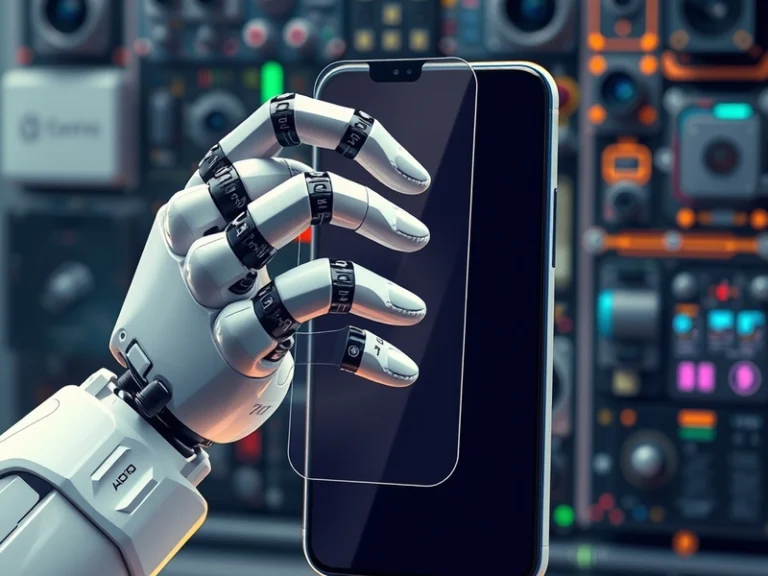
The increasing dexterity of AI-powered robotic hands is pushing the boundaries of what automated systems can achieve, exemplified by their growing ability to master delicate, high-precision tasks such as applying screen protectors to electronic devices. This seemingly simple everyday action, fraught with potential for misalignment, dust, and bubbles for human hands, presents a formidable challenge for conventional robotics, requiring a sophisticated blend of perception, manipulation, and adaptive control.
Applying a screen protector demands a level of precision and tactile sensitivity that has historically been the domain of human operators. The task involves several critical steps, each presenting a unique hurdle for robotic systems:
- Precision Alignment: Screen protectors must be aligned with sub-millimeter accuracy to avoid obscuring cameras, sensors, or edges, often on reflective glass surfaces that challenge standard computer vision.
- Handling Deformable Materials: The protectors themselves are thin, flexible, and often adhesive, making them prone to bending, creasing, or sticking prematurely – issues that rigid grippers struggle with.
- Dust and Bubble Prevention: The process requires a clean environment and uniform application pressure to prevent air bubbles and trapped dust particles, which necessitates careful manipulation and sensing.
- Adaptive Pressure Control: Applying the protector smoothly requires varying pressure across the surface, from initial placement to final adhesion, without damaging the underlying device.
- Surface Perception: Transparent or highly reflective surfaces can confuse traditional visual sensors, making accurate depth perception and object pose estimation difficult.
AI’s Role in Enhanced Perception and Manipulation
Artificial intelligence is at the core of enabling robots to overcome these challenges. Modern robotic systems leverage advanced AI techniques across multiple domains to achieve human-like dexterity.
Computer Vision for Pinpoint Accuracy
One of the primary enablers is sophisticated computer vision. Deep learning models, particularly convolutional neural networks (CNNs), are trained on vast datasets to accurately detect the precise position and orientation of the device and the screen protector. High-resolution cameras, often combined with structured light or time-of-flight (ToF) sensors, provide rich 3D data. This allows robots to:
- Identify Fiducial Markers: Even microscopic features or patterns on devices can serve as alignment points.
- Estimate Pose in Real-Time: AI algorithms continuously refine the estimated 6-DOF (degrees of freedom) pose of both the device and the protector as the robot moves, allowing for dynamic adjustments.
- Detect Imperfections: Vision systems can identify dust particles on surfaces before application, triggering cleaning protocols, or detect bubbles post-application for corrective action.
The ability to process visual information in noisy, real-world conditions, including varying lighting and reflective surfaces, is a testament to the generalization capabilities of these AI models.
Advanced Control and Tactile Feedback
Beyond vision, AI is critical for the physical execution of the task. Traditional industrial robots rely on rigid, pre-programmed trajectories. However, applying a screen protector requires adaptive, compliant motion.
“The challenge isn’t just seeing where to go, but feeling how to get there without damaging anything or making a mess,” notes a researcher in robotic manipulation, highlighting the importance of haptic feedback.
Robots are increasingly equipped with advanced grippers and end-effectors that incorporate force-torque sensors and even high-resolution tactile sensors. These sensors provide real-time feedback on contact forces and pressure distribution, which AI models, often trained via reinforcement learning, use to adjust their grip and motion. This allows the robot to:
- Gently Grasp Deformable Objects: By learning optimal gripping forces, robots can pick up thin, flexible screen protectors without crumpling them.
- Apply Even Pressure: AI-driven control algorithms can modulate joint torques to ensure uniform pressure during the application, crucial for preventing bubbles.
- Respond to Unexpected Contact: If the protector starts to stick incorrectly or encounters an unforeseen obstruction, the robot can detect the abnormal force profile and react appropriately, perhaps by retracting slightly and reattempting.
Learning and Generalization
The ultimate goal for such robotic systems is not just to perform one specific task but to generalize across variations. Here, AI’s learning capabilities shine. Techniques like imitation learning, where robots learn from human demonstrations, and reinforcement learning, where robots learn through trial and error in simulated or real environments, allow them to develop robust strategies.
Sim-to-real transfer, where policies learned in high-fidelity simulations are deployed on physical robots, significantly accelerates this learning process, reducing the need for extensive real-world training which can be time-consuming and prone to wear and tear. This allows a robot to adapt to different screen protector sizes, device models, or even slight manufacturing variations without needing to be entirely reprogrammed.
Beyond Screen Protectors: Broader Implications for Dexterous Robotics
While applying a screen protector might seem like a niche application, mastering such a task signifies a profound leap in robotic capabilities. The underlying AI and robotic technologies are transferable to a vast array of industries and challenges:
- Electronics Manufacturing: Precise assembly of intricate components, flexible circuit board handling, and quality inspection.
- Logistics and Warehousing: Handling a wider variety of items, including delicate or irregularly shaped goods, for picking and packing.
- Service Robotics: Enabling robots to perform complex tasks in healthcare, retail, or home environments that require fine motor skills and adaptability.
- Micro-assembly: The ability to manipulate thin films and apply precise pressure has implications for micro-electromechanical systems (MEMS) and other small-scale manufacturing.
The progress in enabling robots to reliably perform tasks like applying screen protectors underscores a broader trend: AI is transforming robots from rigid, repetitive machines into adaptable, perceptive, and dexterous collaborators. This evolution promises to unlock new levels of automation and efficiency across industries, tackling tasks once considered too delicate or complex for machines.