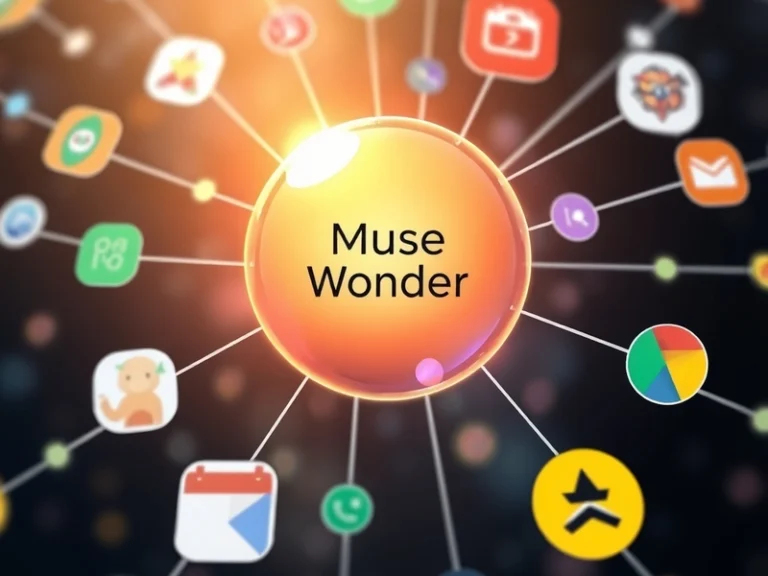
Meta has introduced Muse Wonder, a new AI model designed to tackle complex task management by orchestrating workflows and managing multiple operations across diverse applications.
The proliferation of digital tools has simultaneously empowered and overwhelmed modern professionals. From communication platforms like Slack and Microsoft Teams to project management suites such as Asana and Jira, and document collaboration tools like Google Workspace and Microsoft 365, the average knowledge worker juggles a multitude of applications daily. This fragmentation often leads to significant context switching, information silos, and a reduction in overall productivity. Muse Wonder aims to directly address this challenge by acting as an intelligent orchestrator, abstracting away the need for users to manually navigate between applications for interconnected tasks.
Addressing Digital Fragmentation with AI Orchestration
Muse Wonder’s core proposition lies in its ability to understand high-level user intent and translate it into a sequence of actionable steps executed across various software environments. Instead of a user having to, for instance, extract data from a spreadsheet, draft an email, attach a document, and schedule a follow-up meeting manually, Muse Wonder is envisioned to handle these multi-application sequences autonomously upon a single natural language command. This represents a significant step towards agentic AI systems that can not only process information but also perform actions in the digital world.
Key capabilities implied by Muse Wonder’s focus on complex, cross-application task management include:
- Intent Understanding: Leveraging advanced natural language processing (NLP), likely built upon large language models (LLMs) similar to Meta’s Llama series, to accurately interpret user requests, even if vaguely phrased or spanning multiple implied sub-tasks.
- Cross-Application Integration: The ability to interface with a wide array of third-party applications and services, likely through APIs, to read data, initiate actions, and update information seamlessly across platforms.
- Workflow Automation: Automating sequences of actions that typically require manual intervention across different tools, such as creating a project task, assigning it to a team member, notifying them via chat, and setting a calendar reminder.
- Contextual Awareness: Maintaining an understanding of the ongoing user’s work context, recent activities, and preferences to offer proactive suggestions or complete tasks with minimal explicit instruction.
- Task Decomposition: Breaking down large, ambiguous tasks into smaller, manageable sub-tasks and executing them in the correct logical order.
Underlying Technologies and Meta’s AI Ecosystem
While specific technical details of Muse Wonder have not been extensively disclosed, its capabilities point towards a sophisticated integration of several cutting-edge AI paradigms. It likely leverages advancements in:
- Large Language Models (LLMs): For understanding natural language instructions, generating appropriate responses, and potentially even synthesizing code or scripts to interact with application APIs.
- Reinforcement Learning (RL): To learn optimal sequences of actions and adapt to user preferences and varying application interfaces over time, improving its performance with more use.
- Agentic AI Frameworks: Enabling the model to act autonomously, plan multi-step operations, and execute them in dynamic environments, often with a feedback loop for self-correction.
- Multimodal AI: Potentially incorporating capabilities beyond text, such as understanding UI elements or processing visual information, to navigate applications more robustly.
Meta has a strong track record in AI research, exemplified by its open-source contributions like the Llama family of LLMs and the Segment Anything Model (SAM). Muse Wonder appears to build on this foundation, pushing the boundaries from generative AI to more agentic and action-oriented intelligence within the digital workspace.
Implications for Productivity and the Future of Work
The potential impact of Muse Wonder on individual and organizational productivity is significant. By offloading repetitive, multi-application tasks to an AI, users could experience:
- Reduced Cognitive Load: Freeing up mental resources previously spent on remembering steps, switching contexts, and managing disparate interfaces.
- Enhanced Focus: Allowing professionals to concentrate on higher-value, creative, and strategic work rather than administrative overhead.
- Streamlined Workflows: Creating more efficient and less error-prone processes for common organizational tasks.
- Improved Accessibility: Potentially simplifying complex digital environments for users with varying technical proficiencies.
However, the deployment of such an intelligent agent also raises important considerations regarding data privacy, security, and the level of control users retain over their digital actions. As Muse Wonder integrates deeply with personal and corporate applications, robust safeguards and transparent operational mechanisms will be crucial for widespread adoption and trust.
Muse Wonder represents Meta’s foray into a highly competitive and evolving segment of AI, where the promise of truly intelligent digital assistants moves closer to reality. Its success will likely hinge on its ability to offer seamless, secure, and genuinely helpful cross-application functionality that can adapt to the diverse and often idiosyncratic workflows of its users.