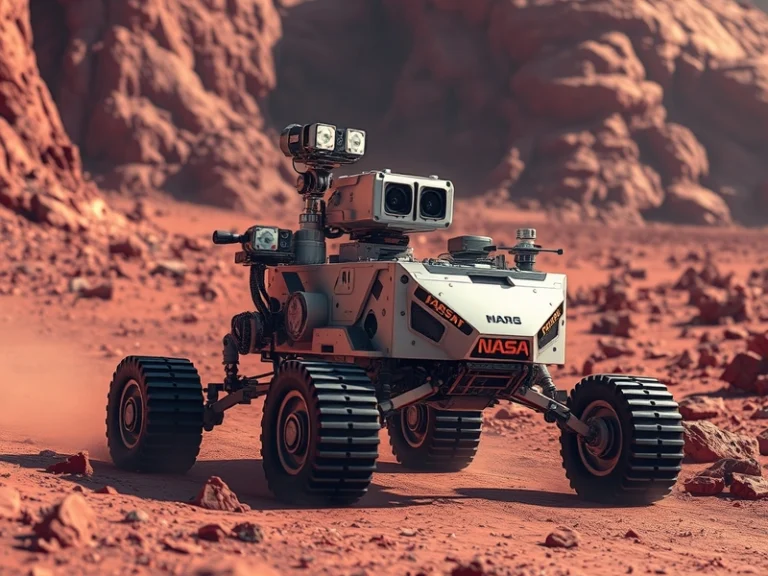
NASA’s Perseverance rover is leveraging advanced AI-driven navigation capabilities to set new benchmarks for autonomous exploration on the Martian surface, significantly accelerating its scientific mission in Jezero Crater.
Since its landing on February 18, 2021, the Perseverance rover, a core component of NASA’s Mars 2020 mission, has been tasked with an ambitious agenda: seeking signs of ancient microbial life, characterizing Mars’ geology and past climate, and collecting samples of Martian rock and regolith for potential return to Earth. To achieve these goals efficiently across a diverse and often challenging landscape, the rover relies heavily on its sophisticated autonomous navigation system, known as AutoNav.
The Evolution of Martian Autonomy: From Curiosity to Perseverance
Previous Mars rovers, such as Spirit, Opportunity, and even Curiosity, possessed some degree of autonomous navigation, but their capabilities were more limited. These earlier systems typically involved a “stop-and-go” method: the rover would drive a short distance, stop, take images, process them to identify hazards, and then receive new commands or plot the next short segment of its path. This method, while effective, was inherently slow and required significant human oversight from Earth, where commands could take several minutes to reach the rover due to the vast distance.
Perseverance’s AutoNav represents a generational leap. Developed by engineers at NASA’s Jet Propulsion Laboratory (JPL), this system allows the rover to make complex navigation decisions much more independently and continuously. It processes data from its cameras and other sensors in real-time, enabling it to drive for longer stretches and at higher speeds without needing to pause for human input or extensive onboard processing between short drives.
How AutoNav Propels Perseverance Forward
The core of AutoNav’s prowess lies in its ability to rapidly analyze its surroundings and plot safe, efficient routes. Here’s a closer look at its operational principles:
- Stereo Vision and 3D Mapping: Perseverance’s navigation cameras (Navcams) capture stereo pairs of images, which AutoNav uses to construct a detailed 3D map of the terrain directly in front of and around the rover. This map highlights obstacles like rocks, craters, and steep slopes.
- Hazard Detection and Avoidance: The system employs advanced algorithms to identify potential hazards within the 3D map. It can distinguish between safe, traversable terrain and areas that pose a risk to the rover’s wheels or chassis.
- Path Planning: Based on the identified hazards and the overall path dictated by mission scientists, AutoNav continuously calculates the optimal route. It can dynamically adjust its trajectory to steer around obstacles, finding the safest and most efficient way to its target waypoint. This occurs while the rover is in motion, allowing for more fluid and continuous driving.
- Increased Processing Power: Perseverance is equipped with more powerful computing hardware than its predecessors, providing the necessary computational muscle to run these complex algorithms in real-time. This significantly reduces the time spent waiting for onboard processing.
This enhanced autonomy means that Perseverance can cover significantly more ground in a single Martian day (sol) than previous rovers. While specific daily distances vary greatly depending on terrain and scientific objectives, AutoNav has consistently enabled the rover to achieve impressive traverses, extending its reach across Jezero Crater and allowing scientists to explore a wider range of geological features more quickly. This efficiency directly translates into more scientific data collected during the mission’s operational lifespan.
The Impact on Martian Exploration and Beyond
The record-setting navigation capabilities of Perseverance have profound implications for current and future space exploration:
- Accelerated Scientific Discovery: By driving faster and more autonomously, Perseverance spends less time navigating and more time conducting scientific investigations, such as drilling for samples or deploying the Ingenuity helicopter. This maximizes the scientific return of the mission.
- Reduced Operational Burden: Less direct human intervention is required for daily drive planning, freeing up mission teams on Earth to focus on higher-level scientific analysis and strategic planning.
- Enabling Future Missions: The lessons learned from AutoNav are invaluable for future missions to distant celestial bodies. For destinations like the moons of Jupiter or Saturn, where communication delays are even longer and bandwidth is limited, highly autonomous systems will be crucial for effective exploration. This technology also lays groundwork for human missions, where automated systems can assist astronauts with navigation in unfamiliar and hazardous environments.
- Exploring Challenging Terrain: AutoNav allows the rover to venture into more complex and scientifically interesting terrain that might have been deemed too risky or time-consuming for less autonomous systems.
Perseverance’s ongoing success demonstrates the critical role that advanced AI and machine learning play in pushing the boundaries of robotic exploration. Its ability to navigate Mars with unprecedented independence is not just a technical achievement; it is a fundamental shift in how humanity explores other worlds, paving the way for even more ambitious and autonomous missions in the years to come.