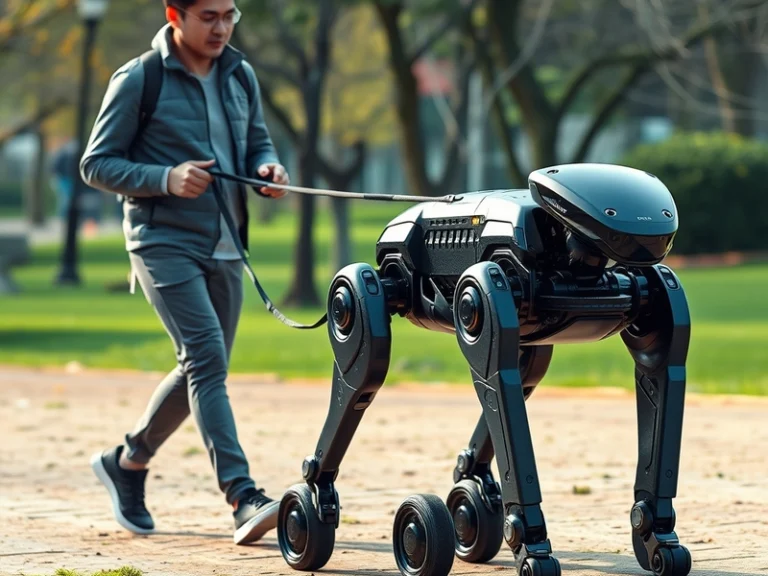
A novel approach to training quadrupedal robots is emerging, involving human “walkers” directly guiding and interacting with these robotic companions in real-world environments to accelerate their development and enhance their real-world capabilities. This method moves beyond traditional simulation and controlled laboratory settings, aiming to bridge the critical gap between simulated proficiency and robust, adaptable performance in dynamic, unpredictable human environments.
The Persistent Challenge of the “Sim-to-Real” Gap
For years, the development of sophisticated locomotion and navigation for robots, particularly advanced quadrupedal platforms like Boston Dynamics’ Spot or Ghost Robotics’ Vision series, has heavily relied on physics-based simulations and highly structured lab testing. These environments offer invaluable control, allowing engineers to iterate rapidly on control algorithms, test hardware limits, and collect vast amounts of data without risk to physical hardware or human safety.
However, the “sim-to-real” gap remains a formidable hurdle. Real-world environments are inherently messy: uneven terrain, unexpected obstacles, dynamic agents (people, animals, vehicles), varying lighting conditions, and unpredictable ground friction are difficult to model perfectly in simulation. Even the most advanced algorithms trained solely in virtual spaces often struggle when deployed in the physical world, exhibiting hesitant movements, tripping over minor obstacles, or failing to adapt to subtle environmental cues. While significant progress has been made in sim-to-real transfer learning, particularly with techniques like domain randomization, direct exposure to the complexities of the physical world alongside human guidance offers a unique pathway to robustness.
Human-Guided Learning: A New Training Paradigm
The “human walker” approach introduces a crucial human-in-the-loop element to robotic training. Instead of merely observing or remotely controlling robots, human walkers actively participate in the robot’s learning process. This can manifest in several ways:
- Physical Guidance and Correction: Much like training a service animal, humans can physically guide the robot, providing gentle nudges, restraining it from hazards, or leading it through challenging terrain. This direct physical interaction allows the robot’s proprioceptive sensors (force sensors in its legs, IMUs) to register the forces and movements associated with successful navigation in complex scenarios.
- Demonstration and Imitation Learning: Walkers can demonstrate desired behaviors, such as stepping over a curb, navigating a crowded path, or reacting to a sudden change in direction. The robot, equipped with cameras and other sensors, observes these demonstrations and attempts to imitate the actions, learning from the human’s nuanced movements and decision-making.
- Real-time Feedback for Reinforcement Learning: Humans can provide immediate, intuitive feedback – positive reinforcement for correct actions (e.g., smooth navigation, successful obstacle avoidance) and corrective feedback for errors. This human-generated reward signal can significantly accelerate reinforcement learning algorithms, allowing the robot to quickly identify and generalize effective strategies for real-world interaction and locomotion.
- Data Collection in Diverse Contexts: By accompanying robots through a wide array of environments – urban sidewalks, grassy parks, rocky trails, indoor spaces with varying floor types – human walkers ensure the collection of diverse, contextually rich sensor data. This data is invaluable for training machine learning models that can generalize across different conditions, improving the robot’s perception, mapping, and decision-making capabilities.
Advantages of Human-Centric Training
This hybrid approach offers several distinct advantages over purely autonomous or simulation-based training:
Enhanced Adaptability and Robustness: Direct exposure to the unpredictability of the real world, coupled with immediate human feedback, allows robots to develop more robust control policies. They learn to handle subtle terrain variations, sudden dynamic obstacles, and unexpected environmental changes that are difficult to simulate accurately.
Improved Human-Robot Interaction (HRI): Training alongside humans naturally fosters better human-robot interaction. Robots learn to interpret human cues, maintain appropriate distances, and navigate safely and politely in shared spaces. This is critical for applications where robots will operate in close proximity to people, such as last-mile delivery, security patrols, or assistive roles.
Accelerated Learning Cycles: While simulation offers speed, it often lacks fidelity. Human-guided training provides high-fidelity, real-world experience, potentially reducing the number of real-world trials needed to achieve desired performance levels by focusing the learning process with expert human input.
Technical Implications and Future Outlook
The success of human-guided robot training relies on sophisticated underlying technologies. Robots must be equipped with advanced sensor suites, including high-resolution cameras, LiDAR for depth perception, inertial measurement units (IMUs) for proprioception, and force/torque sensors in their limbs. Machine learning algorithms, particularly those in the domain of reinforcement learning and imitation learning, are crucial for processing the rich data streams and translating human guidance into adaptable control policies.
This methodology represents a promising direction for the development of truly autonomous and socially intelligent robotic systems. As quadrupedal robots become more common in public and industrial spaces, their ability to navigate safely and interact intuitively with humans will be paramount. The integration of human walkers into the training loop provides a practical, effective means to instill these complex behaviors, paving the way for robots that are not just technically capable, but also contextually aware and socially adept.