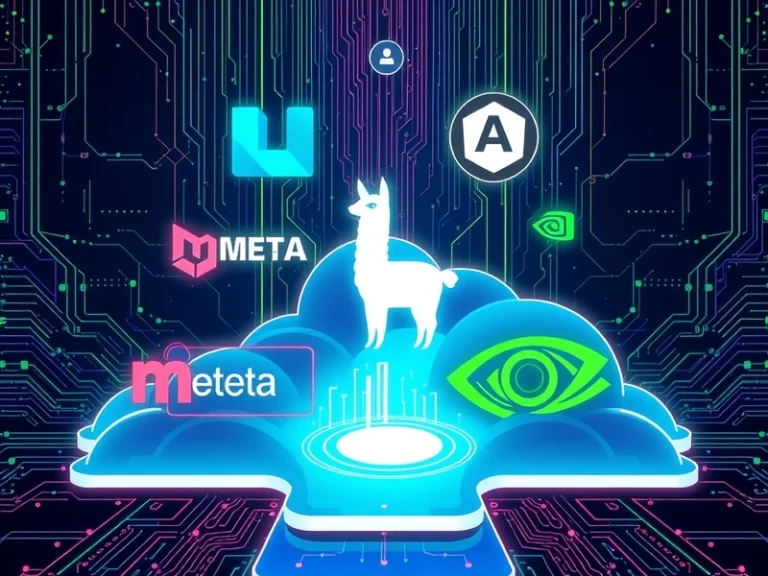
Nebius AI has announced the integration of models from Meta and NVIDIA into its Token Factory platform, aiming to streamline the development and deployment of artificial intelligence applications for its users. This move positions Nebius Token Factory as a more versatile hub for accessing and managing a diverse range of leading AI models, addressing a key challenge in the rapidly evolving AI landscape.
Simplifying Access to Diverse AI Models
The core premise of Nebius Token Factory is to provide a unified interface for interacting with various AI models, abstracting away the underlying complexities of different APIs, infrastructure requirements, and deployment pipelines. In an era where new foundational models are released frequently, and enterprises often need to leverage a mix of open-source and proprietary solutions, a platform that simplifies model switching and management becomes increasingly valuable.
The integration means that developers using Nebius Token Factory can now access prominent models like Meta’s Llama series alongside high-performance inference capabilities powered by NVIDIA’s ecosystem, all through a single point of interaction. This significantly reduces the overhead associated with integrating multiple AI services, managing different sets of credentials, and adapting codebases for each model provider.
Meta’s Open-Source Prowess
Meta has made significant contributions to the open-source AI community, most notably with its Llama family of large language models. Models such as Llama 2 and the more recent Llama 3 have become benchmarks for open-source LLM performance, offering developers substantial capabilities for a wide range of natural language processing tasks. Their open availability has fostered innovation and allowed for extensive fine-tuning and adaptation by the community.
By bringing Meta’s models into the Token Factory, Nebius AI enables its users to readily experiment with and deploy these powerful, community-driven models without the burden of setting up and managing the intricate infrastructure often required for their efficient operation. This is particularly beneficial for organizations looking for flexibility and transparency in their AI solutions, or those aiming to build custom applications on top of well-understood foundational models.
NVIDIA’s Performance Optimization
NVIDIA’s integration into the Nebius Token Factory primarily focuses on optimizing the performance and efficiency of AI model inference. NVIDIA has long been at the forefront of AI hardware and software, providing the GPU acceleration that underpins much of modern deep learning. Their ecosystem includes critical tools like CUDA for parallel computing, TensorRT for optimizing deep learning models for inference, and the Triton Inference Server for deploying AI models at scale.
The collaboration with NVIDIA suggests that models accessed through Nebius Token Factory, including potentially Meta’s Llama models, can benefit from these performance optimizations. This translates to faster inference speeds, lower latency, and more efficient utilization of computational resources, which are crucial for real-time applications and large-scale deployments. For developers, this means they can achieve higher throughput and potentially reduce operational costs without needing to manually configure complex NVIDIA software stacks.
Benefits for Developers and Enterprises
The strategic integration of these two AI powerhouses within Nebius Token Factory offers several tangible benefits:
- Streamlined Development Workflow: Developers can prototype and deploy AI applications faster by accessing a curated selection of models through a consistent API.
- Enhanced Model Flexibility: The ability to easily switch between Meta’s open-source models and NVIDIA-optimized solutions allows for greater experimentation and selection of the best model for a specific task or budget.
- Optimized Performance: Leveraging NVIDIA’s expertise in AI acceleration ensures that inference tasks are handled efficiently, critical for demanding applications.
- Reduced Operational Overhead: Centralized management of AI models and their associated infrastructure lowers the burden on MLOps teams.
- Access to Cutting-Edge AI: Users gain immediate access to some of the most advanced and widely adopted AI models available today.
This initiative by Nebius AI reflects a broader industry trend towards platforms that abstract away the complexities of the underlying AI infrastructure, allowing developers to focus more on application logic and less on MLOps intricacies. As the diversity of AI models continues to grow, such integration platforms will become increasingly vital for democratizing access to powerful AI capabilities and accelerating innovation across various sectors.