The world of toy racing cars is undergoing a significant transformation, driven by artificial intelligence that introduces adaptive learning capabilities directly onto the track.
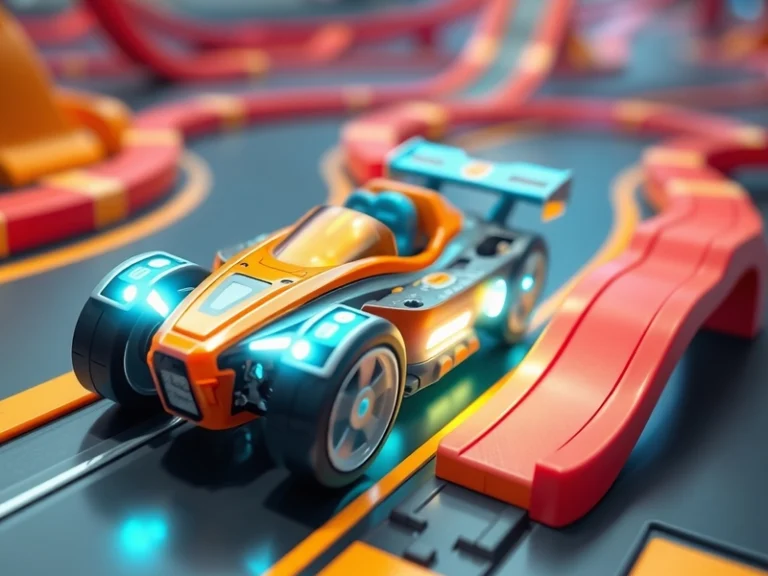
A prime example of this evolution was seen in products like Anki OVERDRIVE, which brought sophisticated AI to physical toy cars, allowing them to autonomously navigate tracks, strategize against opponents, and, crucially, learn from their experiences. Unlike traditional slot cars that simply follow a groove, these AI-powered vehicles operate on modular tracks, using onboard optical sensors to read unique patterns on the track surface. These patterns provide precise positional data, allowing the cars to know their exact location and orientation at all times.
The Mechanics of Adaptive Learning
At the core of these intelligent toy cars lies a blend of hardware and software working in concert to enable adaptive behavior. The process can be broken down into several key components:
- Perception: Optical sensors on the underside of the cars continuously scan the track for encoded information. This data stream allows the car’s onboard computer to pinpoint its position, track segments, and even identify specific zones like pit lanes or weapon activation areas.
- Decision Making: Using the perceived track data, an embedded AI algorithm makes real-time decisions regarding speed, lane positioning, and tactical maneuvers. This isn’t just about staying on the track; it’s about optimizing performance based on changing conditions and opponent behavior.
- Actuation: High-precision electric motors control the car’s speed and steering. The AI’s decisions are translated into precise commands for these motors, allowing for dynamic adjustments to maintain optimal racing lines or execute strategic moves.
- Learning Loop: This is where the “adaptive” aspect comes into play. As the cars race, they collect data on their performance: lap times, successful overtakes, collisions, and the effectiveness of different strategies. This data is fed back into the AI’s learning models. Over time, the AI can refine its parameters, adapting its driving style to become more efficient, faster, or more aggressive, depending on the game mode and desired behavior. This iterative process of observation, action, and feedback mimics fundamental principles found in reinforcement learning.
For instance, an AI opponent might initially drive a relatively conservative line. After several laps or races, if it consistently loses to a human player employing a specific strategy, the AI could adapt by:
- Adjusting its cornering speed to carry more momentum through turns.
- Modifying its acceleration and braking points for faster lap times.
- Learning to anticipate opponent movements and block or overtake more effectively.
This adaptive capability means that the AI opponents are not static challenges; they evolve, offering a perpetually fresh and engaging experience that responds to the player’s skill level and tactics.
Transforming the Play Experience
The integration of AI and adaptive learning fundamentally reshapes the user experience of toy racing. Instead of merely controlling a physical object, players interact with a dynamic system that offers:
- Intelligent Opponents: AI-driven cars can act as autonomous competitors, executing complex strategies, using virtual weapons, and adapting their performance to provide a challenging race. This allows for single-player experiences that feel as competitive as multi-player ones.
- Personalized Challenges: As the AI learns from each race, it can tailor the difficulty and style of competition to the player. A novice player might face a more forgiving AI, while an experienced racer would encounter a highly optimized and aggressive opponent.
- Bridging Physical and Digital Play: These systems often incorporate companion apps that serve as the control interface, scorekeeper, and hub for AI management. This digital layer enhances the physical play, adding elements like virtual power-ups, track modifications, and real-time statistics that are not possible with traditional toy cars.
- Dynamic Environments: Beyond just racing, AI can manage complex interactions, such as virtual weapon effects that temporarily disable opponents or modify their speed, adding a layer of strategic depth that goes beyond pure driving skill.
The computational power required for such real-time AI processing in small, battery-powered vehicles is a testament to advancements in embedded systems and efficient algorithm design. While the most prominent example, Anki, is no longer in operation, the technological precedents it set continue to influence the smart toy industry, demonstrating the profound potential of AI to create interactive, learning-enabled physical play experiences.
The principles of adaptive learning observed in these toy cars are not limited to entertainment. They mirror the foundational concepts used in autonomous driving research, robotics, and even industrial automation, providing a tangible and accessible demonstration of advanced AI in action. The ability of a small vehicle to perceive its environment, make intelligent decisions, and continuously improve its performance based on experience points to a future where intelligent, learning systems are integrated into an ever-wider array of everyday objects.