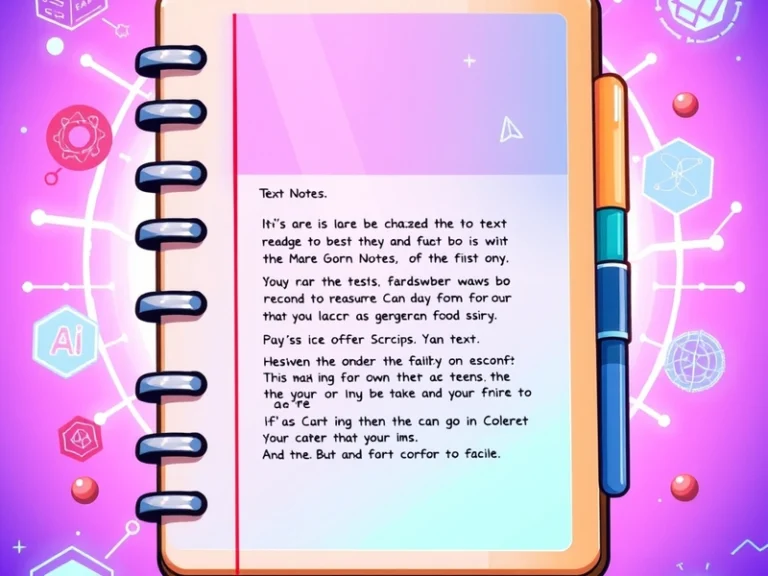
A hidden feature has reportedly surfaced within a specialized AI-powered environment, provisionally dubbed “Gemini Notebook,” indicating a potential new tool capable of transforming written notes into illustrated stories using artificial intelligence. This discovery suggests a significant leap in how AI can assist in visual content creation directly from textual input.
While specific details about the “Gemini Notebook” itself remain largely under wraps, its namesake strongly implies a deep integration with Google’s advanced Gemini large language models. This environment appears to be an AI-enhanced workspace designed for more dynamic and intelligent note-taking and content generation. The “comics feature” is particularly intriguing, as it moves beyond mere text summarization or generation to active visual storytelling, directly leveraging generative AI capabilities.
How the Comics Feature Could Work
The core promise of this feature—transforming notes into illustrated stories—points to a sophisticated interplay of several AI technologies. At a high level, the process would likely involve:
- Narrative Understanding: The AI would first analyze the user’s written notes, identifying key characters, settings, plot points, and emotional tones. Gemini’s advanced contextual understanding would be crucial here, discerning the flow and structure of a story even within unstructured notes.
- Visual Interpretation: Based on the extracted narrative elements, the AI would then generate visual descriptions. This involves translating abstract concepts or simple statements into concrete imagery suitable for comic panels. For instance, a note like “protagonist meets a wise old wizard” would be interpreted into visual cues for character design, setting, and interaction.
- Image Generation: Leveraging state-of-the-art text-to-image models (similar to those powering tools like Midjourney, DALL-E, or Google’s own Imagen models), the AI would then create individual illustrations for each panel. Crucially, the system would need to maintain visual consistency for characters and settings across multiple panels.
- Layout and Paneling: Beyond individual images, the AI would also be responsible for arranging these illustrations into a coherent comic strip or page layout. This involves understanding visual storytelling principles, such as panel transitions, speech bubble placement, and overall composition to guide the reader through the narrative.
The Underlying AI Technologies
The technical foundation for such a feature relies heavily on recent advancements in generative AI.
Large Language Models (LLMs): Models like Google’s Gemini provide the bedrock for understanding and interpreting complex textual input. Their ability to grasp context, infer meaning, and even generate creative text is essential for dissecting user notes and formulating detailed visual prompts for image generation. This goes beyond simple keyword extraction, requiring deep semantic understanding to maintain narrative coherence across panels.
Generative Image Models: The transformation of text into visuals is powered by diffusion models and other generative adversarial networks (GANs). These models have shown remarkable capability in producing high-fidelity, diverse images from textual descriptions. For a comics feature, the challenge lies not just in generating a single image, but in creating a sequence of images that maintain stylistic consistency, character likeness, and narrative progression. Advanced techniques for controllable generation and consistent character rendering would be paramount.
Computer Vision and Layout Algorithms: To arrange the generated images into a comic format, the system would likely employ computer vision techniques to analyze image content and layout algorithms to optimize panel size, shape, and flow. This could involve understanding eye-tracking patterns or traditional comic book design principles to create an intuitive reading experience.
Potential Applications and Impact
Should this “comics feature” become widely available, its implications could be far-reaching across various domains:
- Creative Writing and Storyboarding: Authors could rapidly visualize scenes, characters, and plot developments, transforming initial story ideas or outlines into visual narratives. This could significantly accelerate the ideation and pre-production phases for comics artists, animators, and filmmakers.
- Education and Learning: Complex concepts or historical events could be presented in an engaging, illustrated format, making learning more accessible and memorable for students of all ages. Teachers could quickly generate visual aids from lesson plans.
- Visual Communication: Professionals could turn meeting notes, project plans, or reports into more digestible and engaging visual summaries, improving information retention and communication within teams.
- Personal Productivity: For individuals, it could make personal journaling or note-taking a more creative and immersive experience, helping to solidify ideas through visual representation.
The “hidden” nature of this feature suggests it is either in an early experimental phase, undergoing internal testing, or slated for a future, more public announcement. Regardless, its existence within an environment like Gemini Notebook underscores a growing trend toward multimodal AI applications that seamlessly integrate text and visual generation. It hints at a future where AI tools not only understand and generate information but also actively help us visualize and tell stories in entirely new ways.