The convergence of artificial intelligence with low-code and no-code platforms is rapidly transforming custom application development, enabling individuals without traditional coding expertise to build sophisticated, personalized software solutions. This evolution is moving beyond simple drag-and-drop interfaces, as modern AI capabilities, particularly large language models (LLMs), increasingly act as intelligent co-pilots and even autonomous builders, translating user intent into functional applications.
How AI Powers No-Code Application Creation
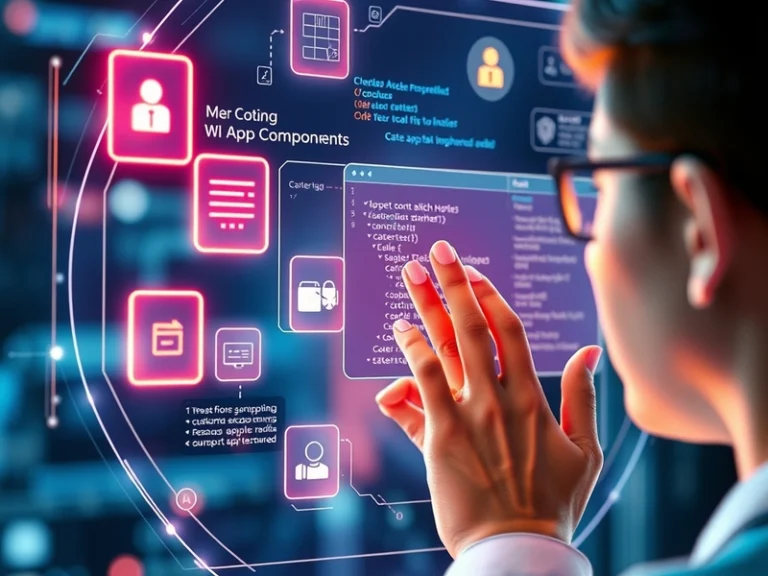
At its core, AI empowers non-developers by abstracting away the complexity of coding. Users can articulate their desired application functionality in natural language, and AI tools interpret these prompts to generate significant portions of the application. This process relies on several key mechanisms:
- Natural Language to Code/Components: AI models can translate textual descriptions of features, user interfaces, or data models into executable code snippets, database schemas, or pre-built UI components. For instance, a user might type, “Create a task management app with due dates, priorities, and user assignments,” and the AI would scaffold the basic structure, including data fields and initial interface elements.
- Generative UI/UX Design: Beyond basic structure, AI can propose interface layouts, color schemes, and interaction flows based on user input or common design patterns. Some tools can even generate mockups or working prototypes directly, significantly accelerating the design phase.
- Automated Backend Logic: AI can assist in generating API endpoints, data validation rules, and basic business logic, connecting disparate services or automating routine data operations, often through visual programming paradigms.
- Intelligent Suggestion and Optimization: AI can analyze user-generated logic or configurations within no-code platforms, suggesting improvements, identifying potential errors, or optimizing performance and database queries.
Real-World Integrations and Platforms
Several platforms are already integrating these AI capabilities, pushing the boundaries of what citizen developers can achieve:
- Microsoft Power Apps has notably integrated AI with its Copilot features, allowing users to describe desired apps in natural language to create data models, forms, and workflows. This significantly simplifies the process of building business applications that integrate with Microsoft 365 services.
- Google’s AppSheet leverages AI to help users build applications from spreadsheets and databases, offering features like intelligent data extraction and automation suggestions.
- Established no-code platforms like Bubble and Webflow are actively exploring or integrating AI features to accelerate design, content generation, and logic creation, moving beyond purely manual configuration.
- Specialized tools like Salesforce’s Einstein suite offer AI-powered automation and insights that can be integrated into custom applications built on their platform, enabling more intelligent processes without deep AI expertise from the user.
- More broadly, tools like OpenAI’s Code Interpreter (now Advanced Data Analysis within ChatGPT) demonstrate the potential for non-developers to process data and generate simple scripts or analyses through conversational AI, hinting at future direct app-building functionalities. Similarly, **GitHub Copilot**, while primarily for professional developers, showcases the power of LLMs in code generation, a concept directly transferable to low-code/no-code environments.
Benefits for Diverse User Segments
The implications of this shift are profound, offering significant advantages across various user segments:
- Democratization of Creation: Individuals, small businesses, and domain experts who lack traditional coding skills can now translate their unique ideas into functional applications, fostering innovation beyond traditional tech hubs.
- Accelerated Prototyping: The speed at which an idea can go from concept to a working prototype is drastically reduced, allowing for rapid iteration and validation of solutions.
- Cost-Effectiveness: For many internal tools or niche applications, the need to hire expensive developers or agencies is diminished, making custom solutions more accessible and budget-friendly.
- Enhanced Personalization: Users can build applications precisely tailored to their specific workflows, data structures, and user experiences, rather than relying on off-the-shelf software that may not fit perfectly.
Challenges and Considerations
Despite the immense promise, AI-driven app development is not without its limitations:
- Complexity Ceiling: While AI excels at scaffolding and automating routine tasks, highly complex applications requiring intricate custom logic, deep system integrations, or advanced security protocols often still demand human developer expertise.
- “Hallucinations” and Errors: AI models can sometimes generate incorrect logic or make assumptions that lead to functional errors, requiring users to understand enough about the underlying mechanics to debug or refine the AI’s output.
- Scalability and Performance: Applications built primarily through AI prompts on no-code platforms might face challenges in scaling efficiently or maintaining optimal performance under heavy load without expert optimization.
- Vendor Lock-in and Portability: Relying heavily on a specific AI-powered platform can lead to vendor lock-in, making it difficult to migrate the application or its underlying logic to a different environment.
- Security Implications: AI-generated code or configurations must be carefully reviewed for potential security vulnerabilities, especially when dealing with sensitive data or critical business processes.
The Road Ahead
As large language models become more sophisticated, multimodal, and context-aware, their ability to understand nuanced user intent and generate robust application components will only improve. We can anticipate more seamless integrations of AI into existing low-code platforms and the emergence of new tools that push the boundaries of what non-developers can create. The future likely involves AI acting not just as an assistant but as an increasingly capable agent, taking higher-level instructions and autonomously building, testing, and even deploying applications, further blurring the lines between user, designer, and developer.