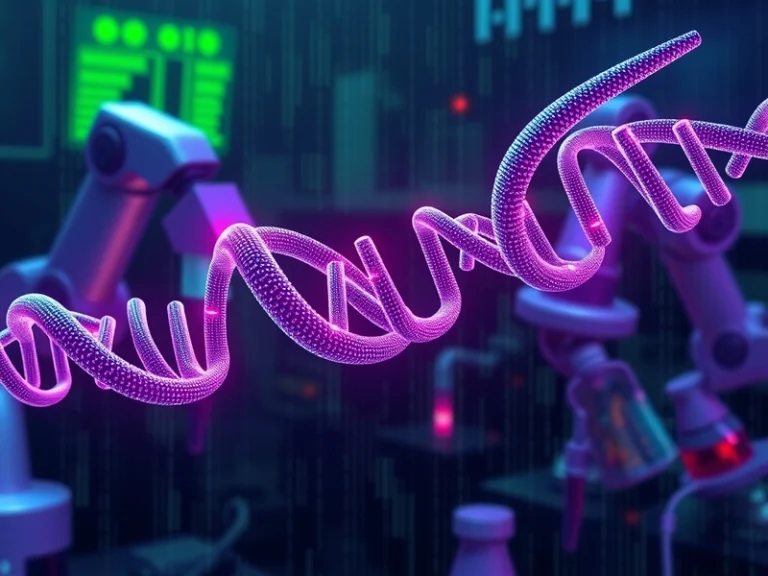
The convergence of artificial intelligence and synthetic biology is enabling AI agents to autonomously manage the complex processes of writing and reading digital messages encoded within DNA molecules. This represents a significant advancement not only in the burgeoning field of DNA data storage but also in the broader application of AI for automated scientific discovery and experimental execution.
The Promise of DNA as a Data Medium
The concept of using deoxyribonucleic acid (DNA) for digital data storage has gained considerable traction due to its unparalleled information density and remarkable longevity. A single gram of DNA can theoretically store hundreds of petabytes of data, and under ideal conditions, DNA can preserve information for thousands to tens of thousands of years, far surpassing the lifespan of traditional magnetic or optical media. However, transforming this theoretical potential into practical application requires overcoming substantial technical hurdles, particularly concerning the speed, cost, and accuracy of encoding and decoding information.
AI in “Writing” Data to DNA: Encoding and Synthesis
The process of “writing” data to DNA involves two primary steps: encoding digital bits into DNA sequences and then physically synthesizing those DNA strands.
AI-Optimized Encoding Algorithms
Traditional digital data, composed of binary 0s and 1s, must be translated into the four-base language of DNA: Adenine (A), Guanine (G), Cytosine (C), and Thymine (T). This encoding is not a simple one-to-one mapping; effective encoding algorithms must account for several biological and technical constraints:
- Homopolymers: Long stretches of identical bases (e.g., AAAAA) can cause errors during synthesis and sequencing.
- GC Content: Maintaining a balanced ratio of Guanine-Cytosine to Adenine-Thymine is crucial for stable DNA and efficient polymerase chain reaction (PCR) amplification.
- Error Correction: Redundancy must be built into the sequences to allow for robust data recovery despite synthesis and sequencing errors.
AI algorithms, particularly those leveraging machine learning and combinatorial optimization techniques, are proving invaluable here. They can analyze vast numbers of potential encoding schemes, identifying optimal strategies that minimize problematic motifs, ensure balanced GC content, and integrate advanced error-correcting codes (like Reed-Solomon codes or fountain codes adapted for DNA) with higher efficiency and lower redundancy than human-designed approaches. These AI-driven optimizations are critical for maximizing storage density and data integrity.
AI-Driven DNA Synthesis Automation
The physical synthesis of DNA strands is typically achieved through phosphoramidite chemistry, a highly precise but sequential and reagent-intensive process. This involves adding one nucleotide at a time to a growing DNA chain. While highly effective, it is prone to errors, especially for longer strands, and remains relatively slow and expensive at scale.
AI agents are beginning to control and optimize the entire synthesis workflow. Instead of human operators manually programming each step or overseeing robotic systems, an AI agent can:
- Design Synthesis Protocols: Based on the desired DNA sequences and available reagents, the AI can generate precise instructions for automated oligonucleotide synthesizers.
- Control Robotic Platforms: Integrating with laboratory automation systems, the AI can orchestrate liquid handlers, plate readers, and synthesizers to execute complex, multi-step synthesis reactions with high precision and throughput.
- Monitor and Adapt: Real-time sensor data from the synthesis process (e.g., reagent levels, reaction parameters) can be fed back to the AI, allowing it to detect potential issues, adjust parameters, or flag batches for quality control, thereby reducing human intervention and improving yield and purity.
This autonomous execution by AI agents moves beyond simple automation; it represents a closed-loop system where the AI actively manages and optimizes the physical experiment.
AI in “Reading” Data from DNA: Sequencing and Decoding
Retrieving information stored in DNA involves sequencing the synthesized strands and then decoding those sequences back into digital data. This process is also fraught with challenges that AI is actively addressing.
AI-Enhanced DNA Sequencing Analysis
Next-generation sequencing technologies generate raw data that needs extensive computational processing. Errors can occur during DNA extraction, amplification, and the sequencing reaction itself, leading to miscalled bases or missing information.
Machine learning models are now standard tools in bioinformatics pipelines for:
- Base Calling: AI algorithms can interpret raw signal data from sequencers (e.g., optical signals, current changes) to accurately identify individual bases, often outperforming traditional statistical methods, especially in ambiguous regions.
- Error Correction: AI models can be trained on known error profiles of specific sequencing platforms to identify and correct sequencing errors more effectively, leveraging contextual information across multiple redundant reads.
- Sequence Assembly and Alignment: For fragmented DNA data, AI can assist in piecing together overlapping sequences and aligning them to reference data, crucial for reconstructing the original message.
The speed and accuracy improvements offered by AI in these analytical steps are vital for the practical viability of DNA data storage.
AI-Driven Sequencing Automation
Similar to synthesis, the physical preparation and sequencing of DNA samples can be automated under the control of AI agents. From sample preparation (e.g., DNA extraction, library preparation) to loading onto sequencing instruments, AI can design and execute entire workflows. This minimizes human error, standardizes experimental conditions, and allows for high-throughput processing, which is essential for reading large volumes of stored DNA data.
The Autonomous Lab: AI Agents Executing Experiments
The true innovation lies in the concept of AI agents not just as analytical tools, but as autonomous entities capable of designing, executing, and interpreting complex laboratory experiments. This involves:
- Hypothesis Generation and Experimental Design: An AI agent can formulate hypotheses about optimal encoding or decoding strategies and design specific wet-lab experiments to test them.
- Robotic Control and Execution: The AI translates these designs into executable commands for robotic platforms, controlling pipetting, temperature cycling, centrifugation, and other lab processes.
- Data Analysis and Learning: After execution, the AI analyzes the generated sequencing data, evaluates the experiment’s outcome against its hypothesis, and uses this learning to refine future experimental designs, creating a closed-loop scientific discovery cycle.
This level of autonomy accelerates the iterative process of scientific research, potentially leading to breakthroughs in DNA data storage and other areas of synthetic biology at speeds far beyond human capabilities.
Challenges and the Path Forward
Despite these advancements, significant challenges remain. The cost of DNA synthesis, while decreasing, is still prohibitive for widespread data storage applications compared to traditional media. Read/write speeds are also orders of magnitude slower. Furthermore, the reliability and scalability of fully autonomous AI-driven lab systems are still under active development. However, the continuous improvement in DNA synthesis technologies, coupled with the rapid evolution of AI and robotics, suggests a future where DNA data storage, managed by intelligent agents, could become a viable solution for archival-scale information preservation.