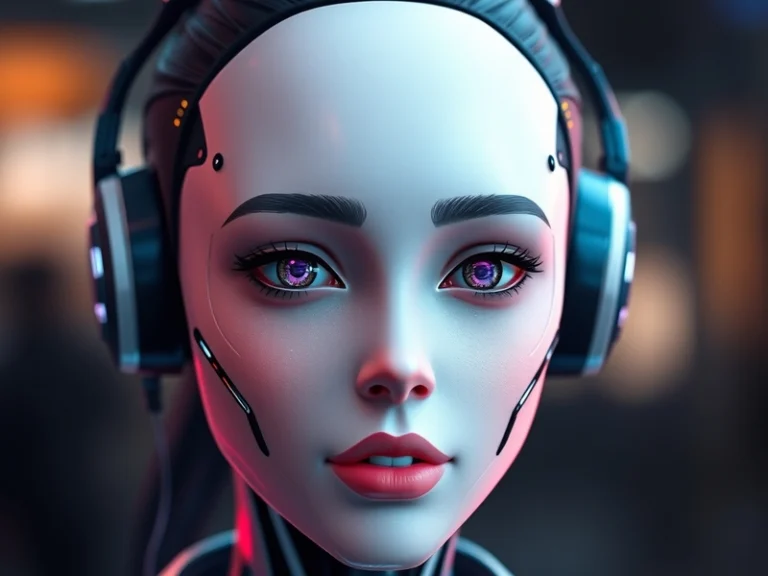
Meta has unveiled a significant advancement in human-AI interaction with its Muse agent, which now integrates sophisticated voice interaction capabilities with animated facial expressions designed to enhance user engagement. This development moves beyond purely auditory or text-based AI interfaces, aiming to create more natural and intuitive digital interactions.
The integration of animated facial expressions with real-time voice interaction represents a crucial step toward more empathetic and relatable AI agents. Traditional voice assistants, while functional, often lack the non-verbal cues that are fundamental to human communication. Facial expressions convey emotion, intent, and subtle nuances that can significantly impact how a message is received and understood. For an AI agent, generating contextually appropriate expressions in sync with spoken dialogue can foster a deeper sense of connection and improve the clarity of communication.
The Significance of Non-Verbal Communication in AI
Humans are inherently tuned to interpret facial expressions. From a young age, we learn to decode smiles, frowns, surprise, and confusion. When interacting with an AI that can mimic these expressions, the experience becomes less transactional and more conversational. This is particularly vital for:
- Emotional Resonance: An AI that can reflect understanding or empathy through its expressions can build greater trust and rapport with users.
- Clarity and Nuance: Facial cues can disambiguate spoken words, adding layers of meaning that might otherwise be lost. A raised eyebrow might signal skepticism, while a nod could confirm understanding.
- Reduced Cognitive Load: Users may find it easier to process information and engage with an AI when visual cues reinforce auditory input, making interactions feel more natural and less like conversing with a machine.
- Enhanced Engagement: The human-like quality of an expressive agent can make interactions more captivating and enjoyable, encouraging longer and more frequent use.
The technical challenge behind such a system is substantial. It requires a multimodal AI architecture capable of processing spoken language, understanding its semantic and emotional content, and then generating corresponding facial animations in real time. This involves complex synchronization to ensure that expressions are not only appropriate but also fluid and natural, avoiding the “uncanny valley” effect where near-human realism can evoke discomfort rather than connection.
Meta’s Broader Vision for Expressive AI
This development with the Muse agent aligns directly with Meta’s long-term strategic investments in the metaverse, virtual reality (VR), and augmented reality (AR). The company envisions future digital spaces populated by highly realistic and interactive avatars and AI agents. For these virtual environments to feel truly immersive and engaging, the digital inhabitants must be capable of rich, natural communication, including both verbal and non-verbal cues.
Meta has consistently demonstrated a commitment to advancing the state of the art in realistic digital humans and AI-powered conversational agents. Projects across Meta AI often explore how to bridge the gap between human interaction and digital interfaces, whether through advanced neural rendering for avatars or sophisticated language models. The Muse agent’s ability to combine voice and expressive animation is a clear step towards creating the kind of lifelike AI companions and virtual assistants that could populate future digital ecosystems.
Industry Context and Future Implications
The pursuit of more human-like AI assistants is a broader industry trend. Companies across the tech landscape are investing heavily in making AI interactions more intuitive and less robotic. Early voice assistants like Amazon Alexa or Google Assistant primarily relied on auditory feedback. More recent advancements have incorporated visual elements on screens, but often these are static images or simple animations. The real-time, dynamic facial expressions demonstrated by Meta’s Muse agent represent a qualitative leap.
Beyond the metaverse, the implications of such expressive AI agents could extend to various sectors:
- Customer Service: More empathetic and clear virtual agents could handle complex customer queries with greater nuance.
- Education: AI tutors capable of expressing understanding or confusion could provide more personalized and engaging learning experiences.
- Healthcare: Digital health assistants could offer support and information in a more reassuring and relatable manner.
- Entertainment: Virtual characters in games or interactive stories could exhibit richer emotional depth, enhancing narrative engagement.
While the Muse agent appears to be a research-oriented demonstration, it showcases the direction in which Meta and the broader AI community are heading: towards AI systems that do not just process information but also understand and express the subtle complexities of human communication. The journey to perfectly replicate human-level expressiveness in AI is ongoing, but developments like these signal significant progress in making digital interactions feel profoundly more human.