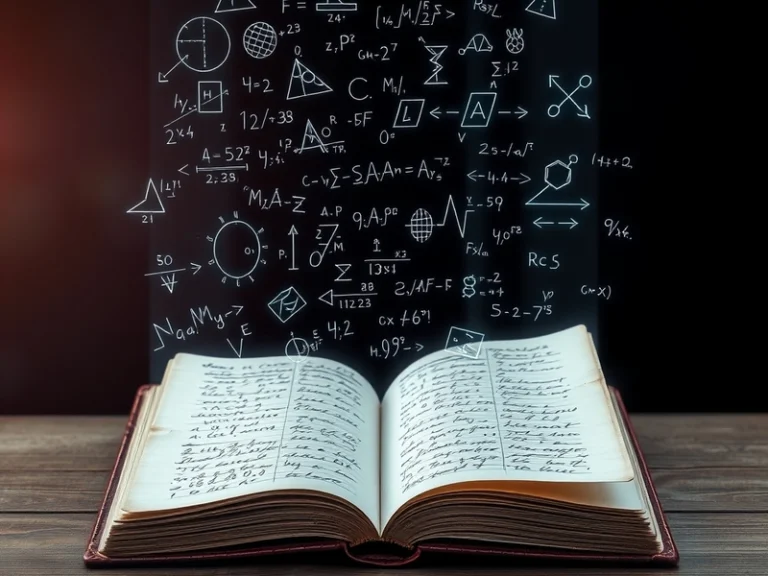
The aspiration to leverage advanced AI models, such as Anthropic’s Claude, to uncover previously hidden mathematical insights within the complex, handwritten notebooks of historical figures like Kurt Gödel is rapidly moving from theoretical possibility to a tangible research frontier. This represents a significant shift in how scholars approach the vast, often impenetrable archives of intellectual history, promising to unlock knowledge previously confined by human limitations in scale and speed.
Kurt Gödel, one of the most significant logicians of the 20th century, left behind an extensive collection of notebooks, correspondence, and unpublished manuscripts. These documents are a treasure trove for historians of mathematics and philosophy, but they present formidable challenges:
- Handwritten Complexity: Gödel’s notes are often in a personal shorthand, mixing German (including Kurrentschrift, an old German cursive), English, and mathematical symbols. His handwriting can be notoriously difficult to decipher, even for trained paleographers.
- Density and Volume: The sheer volume of material, combined with its dense, highly technical content, makes comprehensive human analysis an arduous, multi-decade endeavor. Connections and overarching themes can easily be missed amidst the granular detail.
- Incomplete Ideas: Many entries represent preliminary thoughts, half-formed proofs, or philosophical musings that are not fully elaborated, requiring deep contextual understanding to interpret.
- Multilingual and Multidisciplinary: The content spans logic, set theory, philosophy of mathematics, and even physics, requiring expertise across several domains.
These characteristics make Gödel’s notebooks an ideal, albeit challenging, proving ground for advanced AI systems. The goal is not simply to digitize the text, but to enable the AI to understand, contextualize, and identify novel patterns or connections that might elude human researchers working within traditional constraints.
How AI Approaches the Challenge
Leveraging AI for this kind of historical text analysis involves a multi-stage process that combines several advanced techniques:
- Advanced Optical Character Recognition (OCR) and Paleography: The first hurdle is transcribing the handwritten text. While standard OCR struggles with historical manuscripts and complex layouts, specialized AI models are being trained on vast datasets of historical handwriting, including specific scripts like Kurrentschrift. These models learn to recognize individual characters, words, and even contextual cues to accurately convert images of pages into digital text. This process often involves iterative refinement, where human experts correct initial AI transcriptions, feeding improved data back into the model for further training.
-
Natural Language Processing (NLP) and Understanding: Once transcribed, the text needs to be understood. This is where large language models (LLMs) like Anthropic’s Claude come into play. Claude’s sophisticated NLP capabilities allow it to:
- Semantic Analysis: Interpret the meaning of complex mathematical and philosophical arguments, even when expressed in unconventional or abbreviated forms.
- Contextual Reasoning: Understand the relationships between different entries, cross-referencing ideas across hundreds or thousands of pages, a task where Claude’s long context windows are particularly advantageous.
- Multilingual Processing: Seamlessly handle the shifts between German and English within the same document or even sentence, leveraging its training on diverse linguistic datasets.
- Domain Adaptation: With fine-tuning on Gödel’s published works and related mathematical texts, Claude can develop a deeper understanding of the specific terminology, notation, and logical structures prevalent in his writing.
- Pattern Recognition and Anomaly Detection: Beyond mere comprehension, AI can be tasked with identifying subtle patterns, recurring themes, or even logical inconsistencies that might indicate evolving thoughts or overlooked connections. This could involve recognizing implicit references to other mathematicians’ work, identifying the genesis of a particular proof, or tracing the development of Gödel’s philosophical positions over time.
- Mathematical and Logical Reasoning: While LLMs are not formal theorem provers, their increasing capacity for logical reasoning allows them to process mathematical statements, identify premises and conclusions, and even suggest potential gaps or alternative interpretations within informal proofs. This capability, combined with NLP, can help highlight passages where Gödel might have been grappling with a problem that was later solved, or where his insights predated widely accepted concepts.
The long context window offered by models like Claude 3 Opus, which can process up to 200,000 tokens (roughly 150,000 words), is a game-changer for this type of research. It allows the model to “read” entire notebooks or significant portions of them simultaneously, maintaining a coherent understanding of the content without constant re-feeding of information. This enables it to draw connections across disparate pages that a human researcher might only identify after months or years of meticulous work.
The Role of Human-AI Collaboration
While AI offers unprecedented analytical power, it does not replace human scholarship. Instead, it fosters a powerful collaborative paradigm. AI acts as an accelerator, performing the labor-intensive tasks of transcription, initial analysis, and pattern identification. Human experts then provide the critical oversight, contextual knowledge, and nuanced interpretation that AI currently lacks.
- Verification and Correction: Human scholars review AI-generated transcripts and analyses, correcting errors and validating findings.
- Hypothesis Generation: AI can highlight interesting anomalies or connections, prompting human researchers to formulate new hypotheses for deeper investigation.
- Contextual Depth: Human historians bring an understanding of the broader intellectual and historical landscape in which Gödel operated, allowing them to interpret AI findings within a richer framework.
Broader Implications for Digital Humanities
The application of advanced AI to figures like Gödel is indicative of a broader revolution in digital humanities. Similar projects are underway or being explored for other historically significant, often inaccessible, archives. From deciphering ancient scrolls to analyzing vast collections of historical correspondence, AI promises to:
- Democratize Access: Make complex historical documents more accessible to a wider range of scholars and the public.
- Accelerate Discovery: Significantly reduce the time required for foundational research, allowing scholars to focus on higher-level analysis and interpretation.
- Uncover Lost Knowledge: Potentially reveal entirely new insights from materials long considered exhausted or too difficult to fully explore.
The journey to fully unlock Gödel’s mathematical secrets with AI is ongoing, fraught with technical and interpretative challenges. However, the rapidly advancing capabilities of models like Claude demonstrate a clear path forward, heralding an era where AI becomes an indispensable partner in the exploration of humanity’s written heritage.