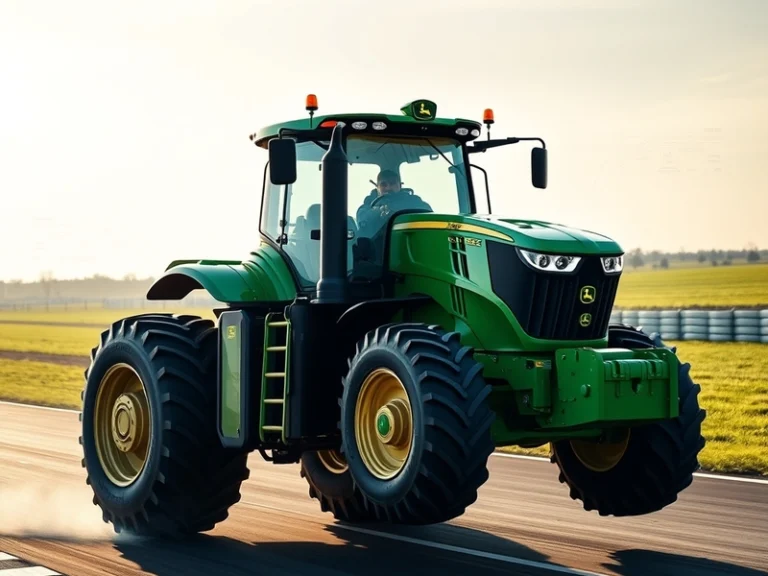
John Deere is pushing the envelope in agricultural automation, reportedly developing AI-powered tractors capable of executing complex maneuvers, including wheelies, safely, a capability attributed to advanced control systems developed with expertise from institutions like ETH Zurich. This innovation highlights a significant shift in how heavy machinery is engineered, moving beyond traditional mechanical and hydraulic controls towards highly intelligent, autonomous systems that can operate at the very limits of their physical capabilities.
While the image of a tractor performing a wheelie might conjure thoughts of a spectacle, the underlying engineering pursuit is profoundly serious. For John Deere, a global leader in agricultural machinery, these “stunts” are not about entertainment but about rigorously testing and validating the next generation of autonomous farm equipment. Performing extreme maneuvers in a controlled environment allows engineers to gather critical data on vehicle dynamics, stability, traction limits, and the responsiveness of AI-driven control systems far beyond typical operational parameters.
The goal is to develop tractors that can navigate challenging terrain, handle heavy implements, and operate efficiently and safely in unpredictable conditions. By pushing a vehicle to its physical limits during development, researchers can refine algorithms that predict and prevent instability, optimize power delivery, and ensure precise control, even when faced with steep inclines, uneven ground, or sudden shifts in load.
The AI at the Core: Mastering Dynamics and Safety
The ability of a multi-ton tractor to safely perform a wheelie, or any other dynamic stunt, is a testament to sophisticated AI and control engineering. This is not simply about programming a sequence of movements; it requires real-time understanding of the vehicle’s state, environmental conditions, and predictive modeling of its behavior.
- Predictive Control and Machine Learning: Advanced AI models, often leveraging machine learning techniques, can learn the complex dynamics of the tractor. They can predict how the vehicle will respond to various inputs and external forces, allowing the control system to make anticipatory adjustments. This is crucial for maintaining stability during highly dynamic actions, where a slight delay in response could lead to loss of control.
- Sensor Fusion and Real-time State Estimation: Tractors equipped with an array of sensors—including accelerometers, gyroscopes, GPS, and lidar—provide a constant stream of data. AI algorithms fuse this data to create a precise, real-time understanding of the tractor’s position, velocity, orientation, and even its internal stresses. This comprehensive “situational awareness” is fundamental for executing complex maneuvers safely and accurately.
- Robustness and Redundancy: Safety in such high-stakes testing environments is paramount. The AI systems are designed with multiple layers of robustness and redundancy. This means that even if one sensor or component fails, the system can still maintain control or safely bring the vehicle to a halt. The controlled environment of stunt testing allows for the systematic evaluation of these safety mechanisms under extreme stress.
ETH Zurich’s Contribution to Advanced Control
The involvement of institutions like ETH Zurich underscores the interdisciplinary nature of this innovation. ETH Zurich is renowned globally for its cutting-edge research in robotics, control theory, and autonomous systems. Their expertise in developing sophisticated algorithms for complex dynamic systems, often applied to aerial vehicles, mobile robots, and even humanoids, translates directly to the challenges of controlling large agricultural machinery.
Academic collaborations provide John Deere with access to foundational research and theoretical advancements that can be difficult to develop purely in an industrial setting. This partnership likely focuses on pushing the theoretical boundaries of vehicle control, exploring novel AI architectures, and validating advanced algorithms in simulation and real-world scenarios. The rigorous academic approach to problem-solving and safety validation aligns well with the high-stakes environment of heavy machinery operation.
From Test Track to Farm Field: Real-World Applications
While the “wheelie-popping” aspect captures attention, the true value of this research lies in its practical applications for agriculture. The insights gained from developing AI for extreme maneuvers will directly translate into more capable, safer, and efficient autonomous tractors for everyday farming tasks:
- Enhanced Stability and Safety: Tractors operating on uneven terrain, steep slopes, or carrying heavy, dynamic loads are prone to stability issues. AI systems refined through extreme testing can proactively manage weight distribution, traction, and steering to prevent rollovers and maintain control, significantly improving operator safety and reducing equipment damage.
- Optimized Performance: Precise control over vehicle dynamics allows for optimized performance in various field conditions. This could mean more efficient plowing with less slippage, faster and safer turns at headlands, or better fuel economy through smarter power management.
- Advanced Automation: The ability to perform complex, dynamic maneuvers autonomously is a cornerstone of fully self-driving farm equipment. This research pushes towards tractors that can navigate intricate field patterns, adapt to changing soil conditions, and execute tasks with minimal human intervention, freeing farmers to focus on strategic decisions.
- Durability and Longevity: By understanding and managing stress on components during extreme operations, engineers can design more durable machinery. AI systems can also monitor component health in real-time, predicting maintenance needs and extending the lifespan of expensive equipment.
John Deere’s exploration into AI-powered tractors capable of performing such demanding maneuvers represents a significant leap in agricultural technology. It showcases how pushing the limits in controlled research environments, often in collaboration with leading academic institutions, is essential for developing the robust, safe, and highly autonomous machinery that will define the future of farming.