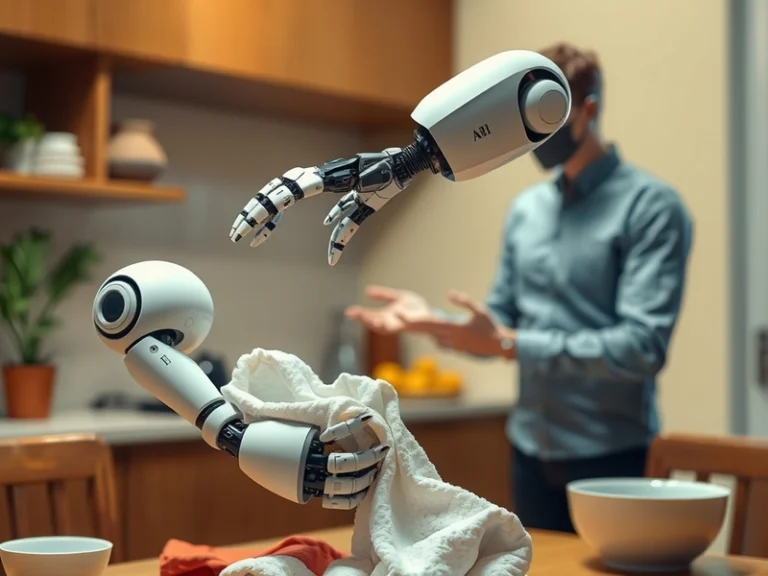
Stanford researchers have unveiled a novel approach to robotic learning, demonstrating that machines can now acquire the proficiency for everyday household tasks at a speed comparable to human learning, marking a significant advancement in autonomous manipulation.
This development addresses a long-standing bottleneck in domestic robotics: the immense time and data traditionally required to train robots for diverse, unstructured environments like homes. Conventional methods often involve extensive human teleoperation, painstaking manual programming, or iterative reinforcement learning that demands thousands, if not millions, of simulated or real-world interactions. Such processes can take hours or even days for a single task, making widespread deployment of truly versatile household robots impractical.
The core innovation from the Stanford team appears to lie in a highly data-efficient learning paradigm that enables robots to generalize from minimal demonstrations. Rather than brute-force learning every permutation, the system leverages a deeper understanding of task semantics and environmental context. This allows a robot to grasp the underlying intent of a task, such as “clear the table” or “sort laundry,” and adapt its movements to variations in object placement, shape, and material, much like a human would after a few examples.
Accelerating Robotic Skill Acquisition
While specific technical details of the Stanford project are still emerging, the broad strokes suggest a confluence of advanced AI techniques that collectively contribute to this accelerated learning capability. These likely include:
- Imitation Learning from Sparse Demonstrations: Moving beyond dense, continuous human guidance, the system can infer complex motor policies from just a handful of human-provided examples, often requiring only a few minutes of demonstration.
- Foundation Models for Robotics: Leveraging large pre-trained models, potentially vision-language models or large action models, to provide a strong prior understanding of objects, actions, and their relationships in a household context. This allows the robot to interpret high-level commands and ground them in physical actions.
- Efficient Sim-to-Real Transfer: Sophisticated simulation environments are crucial, but the ability to quickly and effectively transfer learned policies from simulation to the real world, accounting for real-world physics and sensor noise, is paramount. This likely involves robust domain randomization and adaptation techniques.
- Real-time Adaptation and Error Correction: The system likely incorporates mechanisms for real-time perception and self-correction, allowing the robot to adjust its actions on the fly if unexpected conditions arise or if an initial attempt is not successful, further reducing the need for extensive pre-training.
This multi-faceted approach fundamentally shifts the paradigm from robots being meticulously programmed or exhaustively trained for each specific scenario to systems that can infer and adapt with a level of cognitive flexibility previously associated with human learners. For instance, a robot that has learned to set a dining table might quickly adapt to setting a coffee table with different items, rather than requiring an entirely new training regimen.
Implications for Household Automation
The ability for robots to learn household chores at human speed has profound implications for the future of robotic assistance. For consumers, it means that a robot could be deployed and customized to a specific home environment and its unique tasks within minutes or hours, rather than days or weeks. This drastically lowers the barrier to entry for practical home robotics.
- Faster Customization: Users could quickly teach a new robot specific routines for their home, such as how to organize a particular pantry or fold laundry according to personal preferences, without needing expert programming.
- Increased Adaptability: Robots would become more resilient to changes in their environment. If a new piece of furniture is added or items are rearranged, the robot could quickly re-learn the modified task without significant retraining.
- Broader Task Repertoire: The reduced learning overhead means robots could realistically be taught a much wider array of tasks, moving beyond repetitive industrial applications to the nuanced and varied demands of a home. This paves the way for truly general-purpose domestic robots capable of assisting with everything from meal preparation to tidying up.
This research aligns with a broader trend in robotics towards more general-purpose AI, where systems are designed to learn and adapt rather than perform a single, pre-defined function. Companies like Google, with their Everyday Robots project, and various academic institutions have been pushing the boundaries of robotic manipulation and perception in unstructured environments. Stanford’s latest work represents a significant leap in the efficiency of skill acquisition, a crucial step towards making truly helpful and adaptable robots a reality in our homes.
While challenges remain in scaling these capabilities to a full range of human-level dexterity and robust long-term operation, this breakthrough suggests that the era of robots seamlessly integrating into daily household life, learning and adapting alongside their human counterparts, may be closer than previously anticipated.