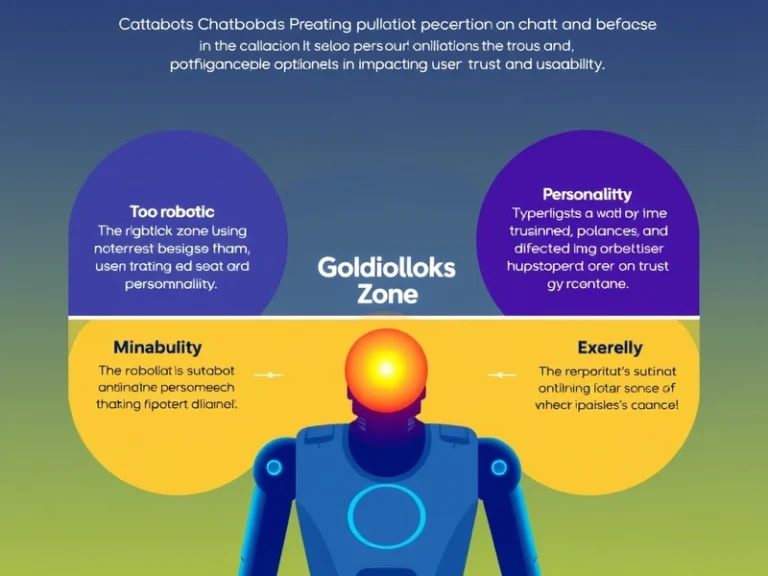
Recent research underscores a critical dilemma for chatbot developers: striking the right balance between a bot’s perceived personality and its core functionality. Findings suggest that chatbots can either overwhelm or underwhelm users based on their conversational style, directly impacting trust and overall usability.
The core insight points to a “Goldilocks Zone” for conversational AI – a sweet spot where a bot’s persona is neither too verbose nor too sterile, but just right for the task at hand and the user’s expectations. Deviations from this optimal balance can lead to user frustration, decreased engagement, and a reluctance to rely on the AI.
The Pitfalls of Excessive Personality
On one end of the spectrum, chatbots that exhibit an overly pronounced or inappropriate personality risk overwhelming their users. This can manifest in several ways:
- Distraction and Inefficiency: When a chatbot injects excessive banter, irrelevant emojis, or overly casual remarks into a serious or time-sensitive interaction, it can distract users from their primary goal. For instance, a banking assistant offering unsolicited jokes before processing a transaction might be perceived as inefficient or unprofessional, eroding confidence in its capability.
- Perceived Lack of Seriousness: In domains requiring high levels of accuracy, professionalism, or empathy—such as healthcare, legal advice, or financial services—an overly playful or informal chatbot can undermine the perceived seriousness of the interaction. Users might question the bot’s reliability or the validity of the information it provides.
- The Uncanny Valley Effect: When a chatbot attempts to mimic human conversation too closely, but falls short in subtle ways, it can trigger an “uncanny valley” response. This discomfort arises from the bot being almost human, but not quite, leading to an unsettling feeling rather than genuine connection.
The Challenge of Insufficient Personality
Conversely, chatbots that lack any discernible personality or warmth can be equally problematic, leading to an underwhelming user experience:
- Lack of Engagement and Rapport: A purely transactional, robotic chatbot, devoid of any conversational flair, can make interactions feel cold and impersonal. Users may struggle to build any rapport, leading to reduced engagement and a sense of talking to a mere algorithm rather than a helpful assistant.
- Difficulty in Understanding Nuance: While clarity is paramount, a completely sterile language model might struggle to convey empathy or understand subtle user cues that a touch of personality could help bridge. This can lead to frustration when users feel misunderstood or unheard.
- Perceived Inflexibility: Chatbots with minimal personality often adhere rigidly to predefined scripts, making them seem inflexible or unintelligent when faced with deviations from expected input. This can be particularly frustrating in complex problem-solving scenarios.
Context is King: Task, User, and Domain
The ideal level of chatbot personality is not universal; it is highly dependent on the context of the interaction. Developers must consider several critical factors:
- The Nature of the Task: For highly transactional tasks—like checking an order status, resetting a password, or retrieving specific data—efficiency, accuracy, and clarity are paramount. A subtle, helpful persona that guides the user effectively is usually preferred. For more open-ended, creative, or companionship-oriented tasks—such as brainstorming ideas, providing emotional support, or playing a game—a more expressive and engaging personality can be a significant asset.
- User Demographics and Expectations: Different user groups may have varying preferences. Younger users might be more receptive to casual language and emojis, while professional users in certain fields might expect a more formal and direct approach. Users approaching a customer service bot typically prioritize quick problem resolution, whereas those using a mental wellness app might seek a comforting, empathetic tone.
- The Brand or Domain Identity: A chatbot representing a playful consumer brand might appropriately adopt a lighthearted persona, while one for a financial institution or a government agency would likely require a more conservative and authoritative tone to align with brand values and user trust.
Fostering Trust and Enhancing Usability
Ultimately, the goal of personality integration in chatbots is to enhance trust and improve usability, not to detract from them. When personality is well-calibrated, it can:
- Build Rapport: A well-designed persona can make interactions feel more natural and less intimidating, fostering a sense of connection that encourages users to engage more deeply.
- Increase User Satisfaction: A positive and appropriate conversational style contributes to a more pleasant user experience, leading to higher satisfaction rates and repeat usage.
- Improve Clarity: Personality, when used judiciously, can help in simplifying complex information, guiding users through processes, and making error messages less jarring.
For developers, navigating this intricate balance requires a deep understanding of the chatbot’s intended purpose and its audience. It necessitates careful design choices regarding tone, vocabulary, and conversational flow. Continuous user feedback and iterative refinement are essential to fine-tune the bot’s persona, ensuring it complements its functionality without ever overshadowing it.