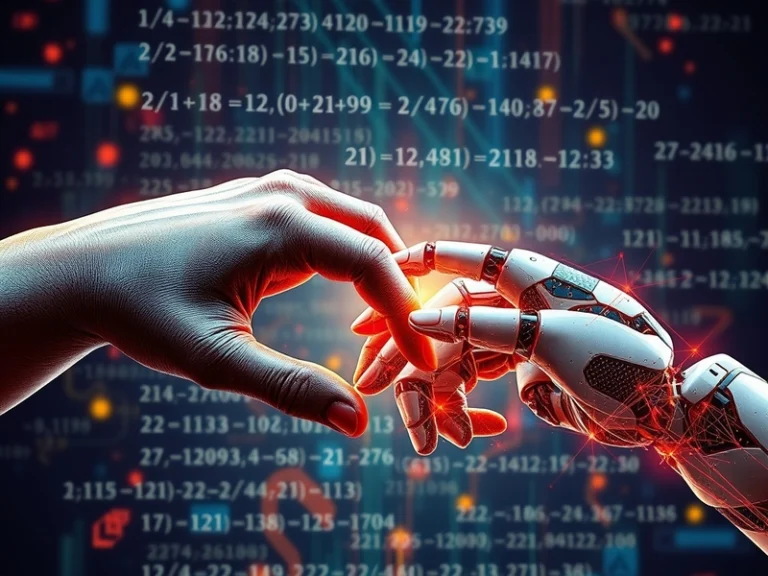
Mathematicians are increasingly exploring the capabilities of advanced AI models, including Anthropic’s Claude, in their ongoing efforts to address some of the most profound unsolved problems, notably the Riemann Hypothesis. This collaboration represents a significant frontier in both artificial intelligence and pure mathematics, where the strengths of symbolic reasoning and pattern recognition inherent in large language models are being tested against one of humanity’s most enduring intellectual challenges.
The Riemann Hypothesis, first proposed by Bernhard Riemann in 1859, is a conjecture about the distribution of prime numbers. Specifically, it states that all non-trivial zeros of the Riemann zeta function lie on the critical line with real part 1/2. Its proof or disproof would have profound implications across number theory, potentially unlocking solutions to other complex problems and providing deeper insights into the fundamental structure of numbers. It remains one of the seven Millennium Prize Problems, with a one-million-dollar prize offered by the Clay Mathematics Institute for its resolution.
AI’s Potential in Mathematical Exploration
The application of large language models (LLMs) like Claude to abstract mathematical problems hinges on their advanced capabilities in several key areas:
- Formal Language Understanding and Generation: LLMs can process and generate text in highly structured formal languages, which is critical for mathematical proofs and definitions. Claude’s extended context window, for example, allows it to retain and process lengthy mathematical arguments, definitions, and theorems.
- Pattern Recognition: Mathematics often involves identifying subtle patterns within large datasets or complex expressions. AI models excel at discerning relationships that might elude human observation, potentially leading to new conjectures or insights into existing ones.
- Automated Proof Assistance: While not yet capable of independently generating novel, complex proofs, AI can assist in various stages of the proof process. This includes verifying logical steps, checking for consistency, suggesting new avenues of exploration, or translating informal mathematical ideas into formal notation.
- Exploration of Parameter Spaces: For problems involving vast combinatorial possibilities or complex functions, AI can systematically explore different configurations, parameters, or cases far more quickly than a human.
In the context of the Riemann Hypothesis, a mathematician might leverage Claude to:
- Review and summarize vast bodies of existing literature and partial proofs related to the hypothesis.
- Generate variations of known mathematical objects or functions, searching for counterexamples or new relationships.
- Formalize intuitive arguments into rigorous symbolic logic, reducing the chance of human error in complex derivations.
- Explore numerical properties of the zeta function or related functions, potentially identifying patterns in the distribution of its zeros that could inform a proof strategy.
The Essential Role of Human-AI Collaboration
Despite the advanced capabilities of models like Claude, the resolution of a problem as profound and abstract as the Riemann Hypothesis is not envisioned as an autonomous AI endeavor. Instead, the paradigm is one of deep human-AI collaboration. The mathematician provides the high-level intuition, sets the strategic direction, formulates precise questions, and critically evaluates the AI’s output. The AI acts as an intelligent assistant, a tireless explorer, and a powerful computational tool.
This partnership is crucial because current AI models, while adept at language and pattern recognition, lack genuine mathematical intuition, creativity, and the ability to truly understand the underlying concepts in the way a human mathematician does. They operate based on statistical relationships learned from their training data. Therefore, the human expert remains indispensable for:
- Guiding the AI toward productive lines of inquiry.
- Interpreting the mathematical significance of AI-generated patterns or suggestions.
- Filtering out “hallucinations” or logically inconsistent outputs that can sometimes arise from LLMs.
- Providing the spark of genuine mathematical insight required for a breakthrough.
Challenges and the Road Ahead
The path to using AI to solve problems like the Riemann Hypothesis is fraught with challenges. LLMs can sometimes generate plausible-sounding but mathematically incorrect statements. Ensuring the rigor and correctness of AI-generated mathematical content is paramount. Furthermore, the sheer depth and abstract nature of such problems often require leaps of conceptual understanding that are far beyond current AI capabilities.
Nevertheless, the ongoing exploration of AI models like Claude in high-level mathematical research signifies a pivotal shift. It is a testament to the evolving relationship between human intellect and artificial intelligence, pushing the boundaries of what is possible in scientific discovery. While the Riemann Hypothesis remains unsolved, the collaboration between mathematicians and advanced AI offers a promising new avenue for tackling some of humanity’s most complex and enduring intellectual puzzles.