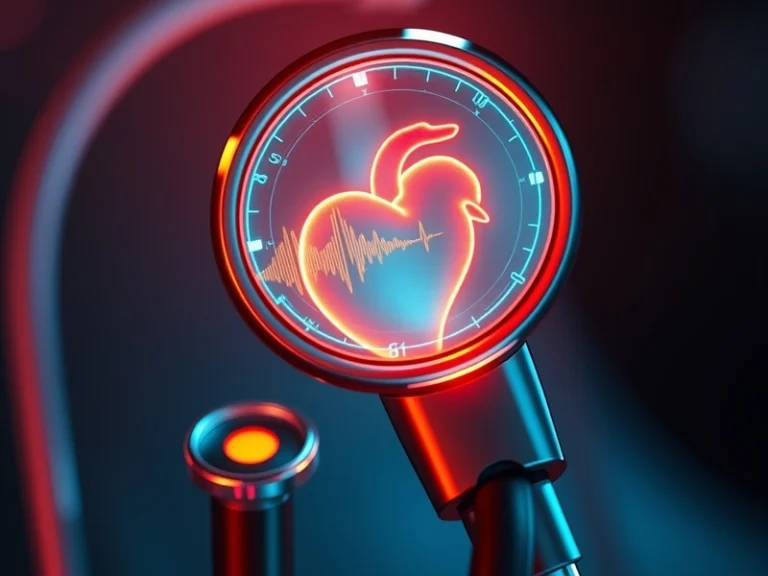
AI-enhanced stethoscopes are fundamentally transforming cardiac auscultation, significantly improving the accuracy of heart sound detection in clinical settings by leveraging advanced machine learning algorithms.
For centuries, the stethoscope has been an indispensable tool for clinicians, offering a direct auditory window into the body’s internal workings. However, the efficacy of traditional auscultation relies heavily on the clinician’s training, experience, and the highly subjective interpretation of sounds. Factors such as ambient noise, subtle variations in heart sounds, and clinician fatigue can lead to missed diagnoses or misinterpretations, particularly for less common or early-stage conditions like murmurs indicative of valvular heart disease or subtle arrhythmias.
The AI Advantage in Auscultation
The new generation of stethoscopes integrates high-fidelity digital audio capture with sophisticated artificial intelligence. These devices convert acoustic signals into digital data, which is then processed by algorithms trained on vast datasets of recorded heart sounds, often curated and labeled by expert cardiologists. This allows the AI to identify patterns and anomalies that might be imperceptible or ambiguous to the human ear.
Key technological advancements enabling this shift include:
- Digital Audio Capture: Unlike acoustic stethoscopes, digital versions amplify sounds and convert them into digital waveforms. This allows for noise reduction, volume adjustment, and the ability to record and store examinations.
- Machine Learning Algorithms: At the core of AI-enhanced stethoscopes are deep learning models, often convolutional neural networks (CNNs), specifically designed to analyze time-series audio data. These models learn to differentiate between normal and abnormal heart sounds, identifying specific characteristics associated with various cardiac conditions.
- Extensive Training Datasets: The accuracy of these AI models is directly proportional to the quality and diversity of their training data. Companies developing these technologies invest heavily in building large, clinically validated libraries of heart sounds, including healthy hearts and those with various pathologies.
Pioneering Companies and Products
Several companies are at the forefront of this innovation, bringing AI-powered auscultation to market. One prominent example is Eko Health, which offers a range of digital stethoscopes such as the Eko CORE and Eko DUO. These devices not only amplify and filter sounds but also connect to a software platform that employs AI algorithms to analyze heart rhythms and sounds. Eko’s algorithms have received regulatory clearances, including from the U.S. Food and Drug Administration (FDA), for detecting heart murmurs and identifying signs of atrial fibrillation (AFib) during a routine physical exam.
Other players are also contributing to this space. 3M Littmann, a long-standing name in stethoscopes, offers digital models that can integrate with third-party AI software, including Eko’s. StethoMe, a European company, focuses on AI-powered stethoscopes for home use, helping parents monitor children’s lung and heart sounds and share data with clinicians remotely.
Clinical Impact and Benefits
The integration of AI into stethoscopes offers several compelling benefits for clinical practice:
- Enhanced Diagnostic Accuracy: AI algorithms can detect subtle heart murmurs or irregular rhythms that might be missed by a less experienced clinician, or even an expert in a challenging environment. This leads to earlier detection of conditions like valvular heart disease or congenital heart defects.
- Reduced Variability: Human interpretation of auscultation can vary significantly between clinicians. AI provides a more objective, standardized analysis, reducing inter-observer variability and leading to more consistent diagnoses.
- Support for General Practitioners: Family doctors and general practitioners, who may not specialize in cardiology, can benefit significantly from AI assistance, empowering them to make more informed referral decisions.
- Improved Patient Outcomes: Earlier and more accurate diagnosis of cardiac conditions can lead to timely interventions, potentially preventing disease progression and improving long-term patient health.
- Telemedicine and Remote Monitoring: The digital nature of these devices, combined with AI analysis, facilitates remote auscultation and monitoring. Patients can record sounds at home and transmit them to clinicians, expanding access to care.
Challenges and Future Directions
While the promise of AI-enhanced stethoscopes is significant, challenges remain. Regulatory approval is a critical hurdle, requiring rigorous clinical validation of AI algorithms. Data privacy and security are paramount, given the sensitive nature of health data. Furthermore, seamless integration into existing electronic health record (EHR) systems is essential for widespread adoption.
Looking ahead, the development of these technologies is expected to continue rapidly. Future iterations may see even more sophisticated algorithms capable of detecting a wider array of cardiac and pulmonary conditions, further integrating with other diagnostic tools, and providing real-time decision support for clinicians. The goal is not to replace human expertise but to augment it, providing clinicians with a powerful new tool to enhance diagnostic precision and ultimately improve patient care.