Research coming out of institutions like MIT is increasingly demonstrating the potential for AI agents to learn complex behaviors and acquire new skills through unstructured play, challenging traditional paradigms of goal-oriented training and hinting at a future of more autonomously capable AI systems.
This evolving area of artificial intelligence research focuses on creating agents that can explore, interact, and discover within their environments without explicit, predefined tasks or external reward signals. Instead of being trained on specific datasets to perform a single function, these agents are given the freedom to “play,” analogous to how children learn about the world through curiosity-driven exploration. The underlying hypothesis is that such open-ended interaction can lead to the emergence of more generalizable skills and a deeper understanding of environmental dynamics, moving beyond the brittle, task-specific capabilities often seen in contemporary AI.
The Paradigm Shift: From Task-Specific to Play-Based Learning
Traditional reinforcement learning (RL) often relies on dense reward functions, where an agent receives explicit positive or negative feedback for its actions toward a predefined goal. While highly effective for mastering specific tasks like playing Go or navigating a maze, this approach can struggle with generalization. A model trained to solve one version of a problem might fail dramatically when faced with a slightly altered environment or a novel objective. This is where unstructured play offers a compelling alternative.
By allowing agents to engage in self-supervised exploration, researchers aim to foster intrinsic motivation. This means the agent itself generates its own “rewards” based on factors like novelty, prediction error, or the ability to achieve self-set subgoals. For instance, an agent might be intrinsically rewarded for:
- Discovering new states: Exploring previously unvisited areas of a simulated environment.
- Predictive accuracy: Improving its internal model of how actions affect the environment.
- Goal generation: Setting and attempting to achieve its own temporary objectives, like stacking blocks or opening a door.
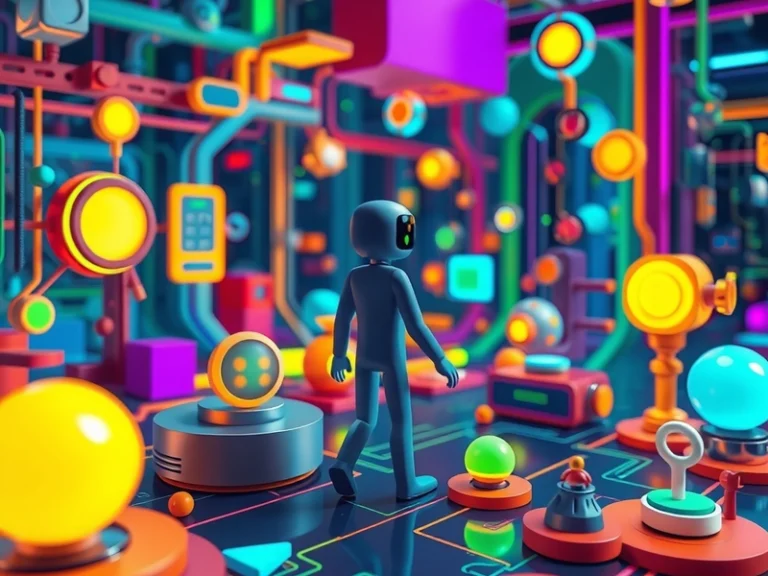
This approach draws parallels with developmental psychology, where infants learn about their environment and develop motor skills through seemingly aimless interaction. For AI, it often involves setting up rich, simulated environments – perhaps leveraging platforms like NVIDIA Isaac Sim for robotics or customized game engines – where agents can interact with physics, objects, and other agents without immediate performance pressure.
Mechanisms of Unstructured Play
The mechanisms enabling AI agents to learn effectively through play are diverse and draw from several subfields of AI research:
- Intrinsic Motivation: This is central. Instead of external rewards, agents are driven by internal signals. Curiosity-driven learning, for example, rewards agents for encountering novel states or for improving their ability to predict future observations. This encourages continuous exploration rather than converging on a single optimal policy for a fixed task.
- Self-Supervised Learning: Agents generate their own supervisory signals from their interactions. For instance, an agent might try to predict the outcome of its own actions, or reconstruct an observed sequence of events. Discrepancies between predictions and reality can serve as powerful learning signals.
- Hierarchical Reinforcement Learning: Play can naturally lead to the discovery of reusable skills or “sub-policies.” An agent might learn to pick up an object, then learn to place it, and later combine these skills to stack objects, without explicit instruction for each step.
- Generative Models: Some approaches use generative models, such as variational autoencoders or Generative Adversarial Networks (GANs), to imagine new scenarios or generate diverse training examples based on observed interactions, further enriching the “play” experience.
By integrating these techniques, researchers are moving towards systems that can autonomously build up a repertoire of skills and a robust understanding of their operational space.
Implications for General AI
The insights gleaned from AI agents learning through unstructured play hold significant implications for the development of more general-purpose artificial intelligence. Current large language models (LLMs) like OpenAI’s GPT-4 or Google’s Gemini demonstrate impressive linguistic capabilities, but they are primarily pattern-matching systems based on vast text corpora. Embodied AI, which aims to integrate LLMs with physical or simulated agents, faces the challenge of grounding linguistic understanding in real-world interaction.
Play-based learning could provide a crucial bridge. An agent that has extensively played in a simulated world, manipulating objects and observing cause-and-effect relationships, might develop a more intuitive understanding of physics and common-sense reasoning. This could lead to:
- Enhanced Robustness: Agents less likely to fail when encountering novel situations, having explored a wider range of possibilities during play.
- Faster Adaptation: The ability to quickly adapt to new tasks by leveraging pre-existing skills learned through play, rather than starting from scratch.
- Reduced Data Requirements: Less reliance on painstakingly human-labeled datasets, as agents can generate their own learning experiences.
- Foundational Models for Embodied AI: A base of general physical and interaction skills that can then be fine-tuned for specific robotic tasks, much like foundation models provide a base for various language tasks.
Challenges and Future Directions
Despite its promise, research into AI agents learning through unstructured play faces considerable challenges. Defining what constitutes “play” and how to measure its effectiveness can be complex. Computational cost is another significant hurdle; open-ended exploration in high-fidelity simulations requires immense processing power and time. Furthermore, ensuring that the learned behaviors are safe and aligned with human values remains a critical area of investigation.
Looking ahead, the convergence of play-based learning with advancements in large-scale simulation, more efficient reinforcement learning algorithms, and the increasing capabilities of foundation models is poised to accelerate progress. Researchers are exploring how to scale these playful interactions to increasingly complex environments and how to transfer skills learned in simulation to the real world. The ultimate goal is to create AI agents that are not just intelligent problem-solvers, but also adaptable, curious learners capable of autonomously navigating and understanding our dynamic world.