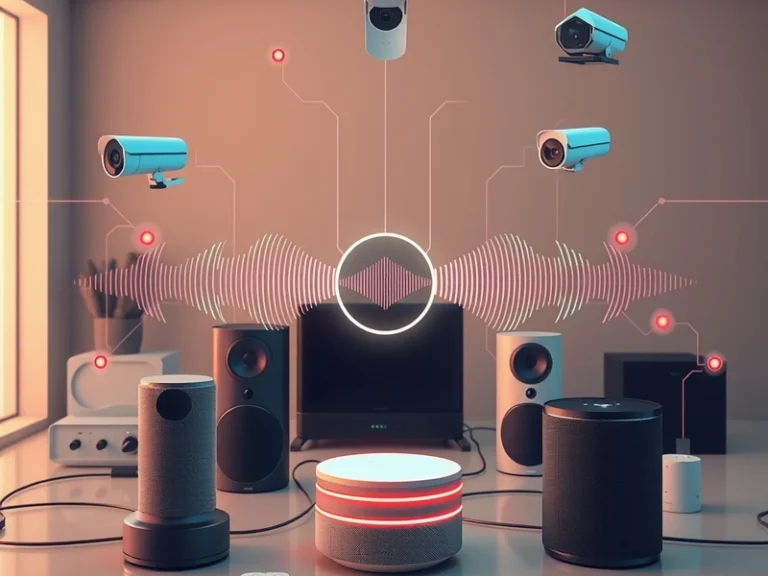
The increasing integration of artificial intelligence into interconnected smart devices is paving the way for advanced acoustic analysis, offering new capabilities in pinpointing elusive and anomalous sounds within our environments.
For decades, identifying the source of an unexplained hum, a sporadic drip, or a faint scratch has often been a frustrating exercise in trial and error. Human hearing, while remarkably adaptive, struggles with persistent background noise, precise localization, and the often transient nature of such auditory anomalies. This is where modern AI, coupled with the ubiquity of microphones in our homes and workplaces, begins to offer a compelling solution.
AI-Powered Acoustic Anomaly Detection
At its core, the application of AI to mystery sound detection relies on sophisticated machine learning models trained on vast datasets of audio. These models can discern patterns, classify specific sounds, and even differentiate them from ambient noise with a precision that surpasses human capabilities in many contexts. The process typically involves several key stages:
- Sound Classification: AI models, often deep neural networks, are trained to recognize a wide array of sounds, from the mundane (refrigerator hum, HVAC fan) to the potentially problematic (water dripping, rodent scurrying, electrical arcing, glass breaking, smoke alarms). This allows devices to identify what the sound is.
- Anomaly Detection: Beyond simple classification, AI can be trained to flag sounds that are unusual or unexpected within a given environment. For instance, a sudden metallic clanging in a quiet bedroom or an unfamiliar whirring sound from an appliance could be flagged for user attention.
- Noise Filtering and Enhancement: AI algorithms can effectively filter out background noise, isolating the target sound to improve its clarity and aid in classification, even in acoustically challenging environments.
The Role of Interconnected Devices
While a single device with a microphone can perform basic sound detection, the true power in pinpointing elusive sounds emerges when multiple interconnected devices work in concert. This distributed network of sensors provides the spatial data necessary for accurate localization.
Consider a smart home ecosystem featuring devices such as:
- Smart Speakers: Products like the Amazon Echo and Google Nest devices, already equipped with multiple microphones for voice command recognition, can passively monitor acoustic environments. Some models already offer security features, recognizing sounds like breaking glass or smoke alarms and alerting users.
- Security Cameras: Many modern smart security cameras, both indoor and outdoor, integrate microphones and often include sound detection capabilities alongside video analytics.
- Smart Doorbells: Devices like the Ring Video Doorbell or Google Nest Doorbell also contain microphones, expanding the acoustic surveillance perimeter to the exterior of a property.
- Dedicated IoT Sensors: Specialized acoustic sensors, sometimes integrated into environmental monitoring systems, can be deployed in specific areas to detect particular sound signatures.
When these devices are networked, their combined acoustic input can be processed by a central AI system, often cloud-based, to perform advanced spatial analysis. By comparing the timing and intensity of a sound as it reaches different microphones, the system can triangulate or multilaterate its origin point. This allows users to not only know what a mystery sound is, but also where it’s coming from—whether it’s a leaky pipe behind a specific wall or an unusual noise emanating from a particular appliance in the basement.
Challenges and Considerations
While promising, the deployment of AI for pervasive acoustic monitoring is not without its challenges. Privacy concerns are paramount, as continuous audio recording, even if processed locally on-device (edge computing) and only metadata is sent to the cloud, raises questions about data handling and potential misuse. False positives also remain a hurdle; an AI model might misinterpret benign sounds, leading to unnecessary alerts and user fatigue. Furthermore, the computational resources required for real-time, high-fidelity acoustic analysis across multiple devices can be substantial, impacting device battery life and network bandwidth.
Despite these considerations, the trajectory is clear. As AI models become more efficient and robust, and as smart home ecosystems mature, the ability to precisely identify and locate auditory anomalies will become an increasingly common and valuable feature. This evolution promises to transform how we detect potential maintenance issues, identify pest problems, or simply gain a better understanding of the subtle acoustic landscape of our daily lives.