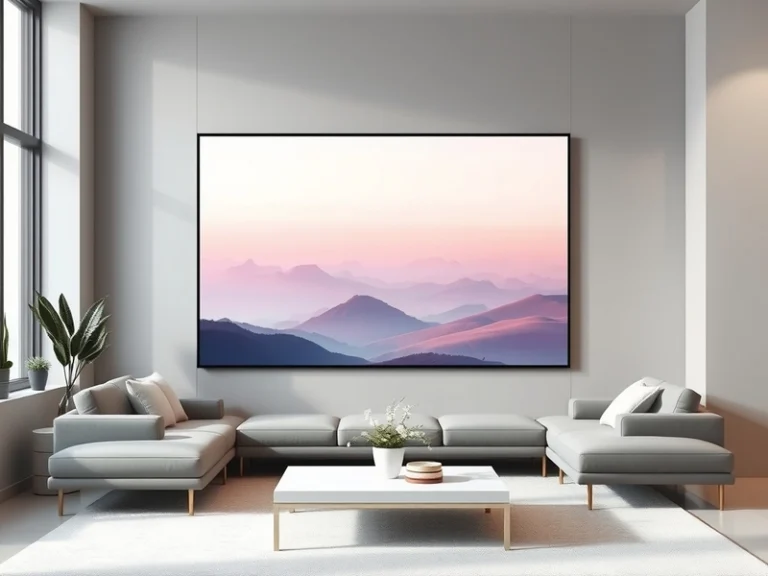
The consumer electronics market is seeing the emergence of innovative AI art frames capable of dynamically generating and displaying artwork based on user commands and predefined schedules, moving beyond the static display of pre-existing images.
These new devices represent a significant evolution from traditional digital photo frames, which primarily serve to cycle through a user’s collection of photographs or pre-loaded art. Instead, these AI-powered frames integrate generative artificial intelligence models directly or via cloud services, allowing them to create unique visual compositions on demand. Users can interact with the frame through various input methods, typically including text prompts entered via a companion app, and in some cases, voice commands, to articulate their desired aesthetic, subject matter, or mood.
Dynamic Art Generation in Practice
The core functionality revolves around the frame’s ability to interpret natural language prompts and translate them into novel visual art. For instance, a user might request “a serene forest scene at dawn in the style of Impressionism” or “an abstract geometric pattern with warm colors.” The underlying AI model, often a derivative of large-scale text-to-image architectures, then renders a unique image that adheres to these specifications. This process occurs in real-time or near real-time, depending on the computational resources available to the device and its connection to cloud-based AI services.
Beyond immediate, on-demand generation, a key differentiator is the capacity for scheduled and adaptive artwork. Users can program the frame to:
- Change artwork by time of day: Display vibrant, energetic pieces in the morning, calming landscapes in the evening, or darker, more contemplative art at night.
- Respond to external data: Potentially integrate with smart home ecosystems to reflect local weather conditions (e.g., a rainy city scene when it’s raining outside) or even calendar events.
- Cycle through themes: Automatically generate art within a specified thematic range (e.g., “seasonal landscapes,” “famous cityscapes,” “abstract expressionism”) over hours or days, ensuring a continuously fresh visual experience.
- Adapt to user presence: Employ proximity sensors or connected devices to alter art when a room is occupied or empty.
This level of dynamic customization allows the art displayed to become an integral, ambient part of a living or working space, constantly evolving to suit the environment or the user’s preferences without requiring manual intervention.
Technological Underpinnings and Considerations
The technical architecture of such a device typically involves a high-resolution display, often optimized for color accuracy and viewing angles, paired with processing hardware capable of running or communicating with generative AI models. There are generally two approaches to the AI processing:
- Cloud-based generation: The frame sends user prompts to a powerful server farm where the AI model resides. This allows for more complex models and faster updates but requires a consistent internet connection.
- Edge-based generation: Some processing, or even the entire generative model, runs directly on the device itself. This offers lower latency and less reliance on internet connectivity but necessitates more powerful, and thus potentially more expensive, on-board hardware.
Many devices likely adopt a hybrid approach, with simpler, faster generations handled locally and more complex requests offloaded to the cloud. Connectivity via Wi-Fi is standard, enabling both cloud communication and app-based control.
The quality of the generated art is directly tied to the sophistication of the underlying AI model and the specificity of the user’s prompt. While current generative models can produce remarkably coherent and aesthetically pleasing images, mastering prompt engineering remains a skill. Developers of these frames are working on intuitive interfaces and curated prompt libraries to simplify the process for mainstream users.
Market Position and Future Outlook
These AI art frames are carving out a niche in the burgeoning market for smart home devices and personalized digital experiences. They appeal to consumers interested in home decor, art enthusiasts looking for dynamic and customizable displays, and early adopters of AI technology. Companies like Samsung with their “The Frame” series have already popularized the concept of a TV that doubles as a digital art display, albeit one that shows pre-selected images. The generative AI frames take this concept further by enabling limitless, on-demand creation.
As generative AI models continue to advance in fidelity, speed, and controllability, the capabilities of these frames are expected to grow. Future iterations might include more sophisticated understanding of artistic styles, the ability to incorporate real-world elements via a built-in camera, or even collaborative features where multiple users can influence the artwork. The intersection of AI, art, and home technology is poised for continued innovation, offering new avenues for personal expression and ambient digital experiences.