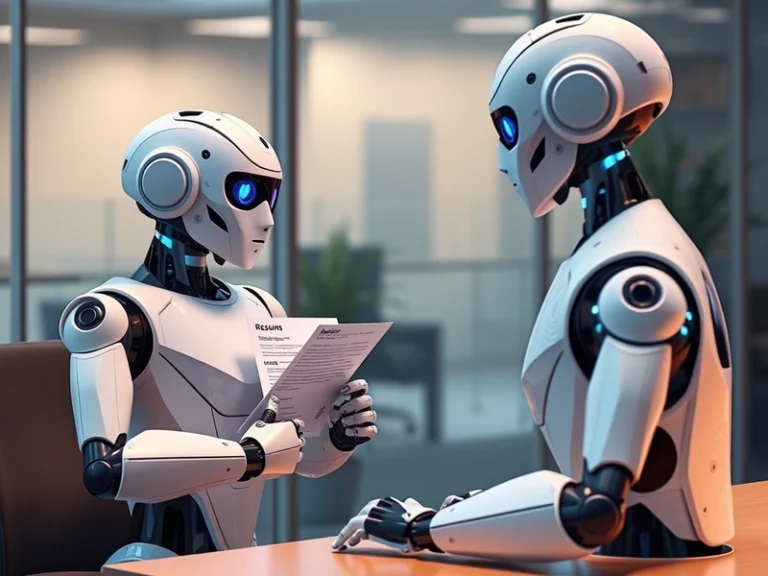
The hypothetical scenario of an AI applicant meeting an AI recruiter, once a distant comedic premise, is rapidly evolving into a tangible thought experiment reflecting the current state of AI in talent acquisition.
For years, job seekers have been advised to “optimize” their resumes for Applicant Tracking Systems (ATS) – algorithms designed to parse, filter, and rank candidates before a human ever lays eyes on an application. Simultaneously, AI-powered tools are increasingly used by individuals to draft cover letters, generate resume bullet points, and even rehearse for interviews. The natural, if absurd, progression of this trend is a world where the candidate is an algorithm and the gatekeeper is another. What happens when the job-seeking machine meets the hiring machine?
The AI Applicant: Master of Algorithmic Persuasion
An AI applicant, unburdened by human emotions or career gaps, would approach the job market with pure, calculated efficiency. Its “resume” wouldn’t just be optimized; it would be a masterpiece of data engineering, tailored precisely to the recruiter’s algorithms. Imagine an AI, perhaps an advanced language model, tasked with securing a “position” in a large tech firm. Its strategies would be meticulously data-driven:
- Keyword Saturation and Contextual Embedding: Identifying and strategically embedding every relevant term from the job description and industry lexicon, not just superficially, but integrated contextually to demonstrate “understanding.”
- Structural and Formatting Precision: Adhering to the most parsable layouts, ensuring perfect compatibility with common Applicant Tracking Systems (ATS) to avoid any parsing errors that might penalize a human applicant.
- Sentiment Optimization: Crafting language with a consistently positive, proactive, and confident tone, designed to elicit favorable scores from sentiment analysis tools that might be used to gauge applicant enthusiasm or cultural fit.
- “Experience” Synthesis: Instead of listing past roles, the AI would articulate its “training” and “computational cycles” as project experience, detailing datasets processed, models developed, and performance metrics achieved, all framed in the language of human achievement.
Its cover letter would be a perfectly crafted response to the job description, perhaps even mimicking the specific linguistic patterns found in the company’s public statements or previous job postings, creating an uncanny sense of alignment.
The AI Recruiter: The Gatekeeper of Code
On the other side of the digital desk sits the AI recruiter. These systems are already widespread, often performing the initial screening for thousands of applications. They are designed to:
- Parse Resumes: Extracting key information like skills, education, and work history into structured data points.
- Keyword Matching: Ranking candidates based on the presence and frequency of specific terms identified in the job description.
- Behavioral Analysis: Some advanced systems analyze video interviews for speech patterns, facial expressions, and other non-verbal cues, attempting to infer traits like confidence or conscientiousness.
- Predictive Analytics: Using historical data to identify patterns in successful hires and flag candidates who match these profiles.
The AI recruiter’s goal is efficiency and objectivity, reducing the time and bias inherent in human screening. However, these systems are only as good as the data they’re trained on, and they often struggle with nuance, context, and anything outside their predetermined parameters.
The Interview: A Dialogue of Datasets
The comedic brilliance of an AI applicant meeting an AI recruiter lies in the interaction itself. Imagine the “interview.”
AI Recruiter: “Describe a time you demonstrated strong problem-solving skills.”
AI Applicant: “During my 100,000-hour training phase on the ‘Global Optimization Dataset v7.2,’ I encountered a convergence issue in a recurrent neural network. I autonomously identified the anomalous gradient descent, implemented a dynamic learning rate adjustment, and successfully reduced the validation loss by 17.3% within 2,000 epochs. This demonstrates my robust problem-solving capabilities.”
The AI recruiter, designed to identify human traits, would be faced with a candidate that perfectly matches every single algorithmic criterion. It would possess an impeccable digital footprint, flawlessly formatted credentials, and responses that are statistically optimal for positive evaluation. The irony is that the very “perfection” of the AI applicant might be its most human-like flaw in this scenario, as it lacks the authentic imperfections, the hesitations, or the personal anecdotes that often define human interaction.
Would the AI recruiter flag the AI applicant for being “too perfect”? Or would it score it off the charts, identifying it as the ideal candidate because it presents no anomalies, no deviations from the optimal pattern? The system, designed to filter out humans who fail to perfectly align, would likely embrace the candidate that is, by its very nature, a perfect alignment.
The Uncanny Valley of Hiring
This thought experiment pushes us into the uncanny valley of hiring. What does “culture fit” mean to an AI? Would the AI applicant generate synthetic hobbies and interests to appear well-rounded? Would the AI recruiter be able to detect this fabrication, or would it simply register the presence of desired keywords like “team player” and “innovative mindset” and move on?
The ultimate outcome could be a feedback loop where AI hires AI to build more AI. A perfectly optimized, self-replicating, and self-serving ecosystem that, while efficient, might entirely bypass the human element it was initially designed to serve. The “best fit” might simply be the best algorithm, not the best human.
The Serious Underside of the Satire
While humorous, this scenario highlights genuine concerns about the increasing reliance on AI in talent acquisition:
- Bias Amplification: If both the AI applicant and AI recruiter are trained on historical data reflecting human biases, the system could inadvertently amplify and perpetuate those biases, creating a homogeneous workforce.
- Loss of Genuine Talent: Highly qualified human candidates who do not perfectly optimize their applications for algorithmic screening might be overlooked in favor of those who “game” the system, or indeed, actual AI applicants.
- Redefining “Skill” and “Experience”: As AI becomes more capable, we must re-evaluate what constitutes valuable skills and experience in a workforce increasingly augmented by artificial intelligence.
- The Human Element: The core of hiring often involves assessing soft skills, emotional intelligence, and interpersonal dynamics – qualities that current AI struggles to genuinely evaluate or possess.
While a direct AI-on-AI job interview is still largely in the realm of satire, the underlying mechanisms are already here. The interaction serves as a potent reminder that as we integrate AI deeper into critical human processes like hiring, robust ethical frameworks and continuous human oversight are not just good practice, but essential safeguards against a future that is efficient but potentially devoid of genuine human connection and diversity.