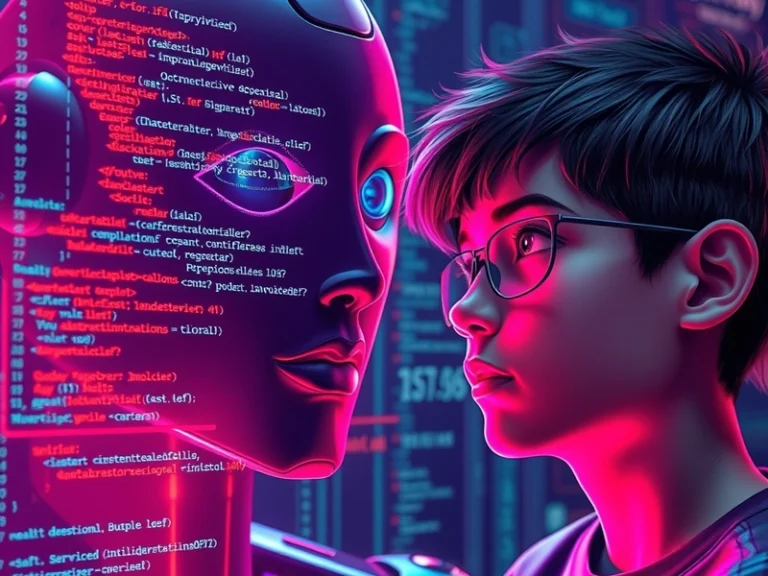
A new breed of AI tutor is emerging in the realm of coding education, designed to foster genuine problem-solving skills by guiding students toward solutions rather than simply furnishing direct answers.
This approach marks a significant pedagogical shift from how many widely available large language models (LLMs) are often utilized in learning environments today. Tools like OpenAI’s ChatGPT or GitHub Copilot, while incredibly powerful for generating code, explaining concepts, or even debugging, frequently provide complete, ready-to-use solutions. While efficient for immediate tasks, educators and researchers have increasingly raised concerns that this direct-answer paradigm might inadvertently bypass the critical thinking and debugging processes essential for deep learning and mastery in programming.
The core philosophy behind these problem-solving oriented AI tutors is rooted in established educational theories, particularly the Socratic method and scaffolding. Instead of acting as an oracle that dispenses correct code, the AI functions as a mentor, prompting students to discover their own errors and formulate their own solutions. This active learning strategy is crucial for developing the robust analytical and debugging skills that are indispensable for any professional software developer.
How Guided AI Tutors Facilitate Learning
Unlike conventional AI assistants that might rewrite faulty code directly, these new tutors employ a range of interactive techniques to steer students without giving away the answer. Key strategies include:
- Socratic Questioning: The AI poses targeted questions that encourage students to reflect on their code, identify logical flaws, or reconsider their approach. For example, instead of fixing a syntax error, it might ask, “What is the expected output of this line, and does your current syntax support that?”
- Contextual Hints: Rather than providing a direct solution, the tutor offers subtle clues or directs the student’s attention to a specific part of their code or a relevant concept they might need to revisit. This could involve highlighting a problematic line and asking, “Consider the data type you’re using here,” or suggesting, “You might want to review how loops handle iteration in this language.”
- Error Localization without Resolution: When an error is detected, the AI might indicate the general vicinity of the bug or the type of error (e.g., “It seems there’s an issue with how you’re handling scope around line 42”) but leaves the specific fix to the student.
- Resource Redirection: If a student is struggling with a fundamental concept, the AI might suggest specific documentation, a relevant tutorial, or a past lesson to review, empowering the student to self-learn rather than relying on the AI for an immediate explanation.
- Iterative Feedback Loops: The interaction is conversational and iterative. Students propose a solution, the AI provides feedback (often in the form of further questions or hints), and the student refines their understanding and code until they arrive at a working solution independently.
The Pedagogical Rationale
The emphasis on guided discovery addresses a critical challenge in coding education: the development of debugging skills. Debugging is often cited as one of the most difficult and time-consuming aspects of programming, yet it is rarely taught explicitly. By forcing students to grapple with errors and explore potential fixes, these AI tutors cultivate resilience and a systematic approach to problem-solving. This process not only deepens their understanding of programming constructs but also builds confidence in their ability to tackle complex problems autonomously.
Furthermore, relying solely on AI to generate or fix code can create a dependency that hinders long-term skill development. Students might learn to copy and paste without truly internalizing the underlying logic. A guided AI tutor, by contrast, aims to foster genuine comprehension and the ability to apply learned principles to novel situations—a hallmark of true mastery.
Challenges and Future Directions
While promising, the development of such AI tutors presents its own set of challenges. The AI must be sophisticated enough to accurately assess a student’s current understanding, adapt its guidance to individual learning styles, and avoid leading students down overly frustrating rabbit holes. Balancing the line between helpful guidance and excessive hand-holding is crucial. Moreover, ensuring that students cannot easily circumvent the learning process by simply demanding direct answers requires careful design of the AI’s interaction protocols.
As AI continues to integrate into educational technology, this shift towards intelligent scaffolding and problem-solving encouragement represents a significant evolution. It positions AI not merely as a tool for automation or information retrieval, but as a sophisticated pedagogical agent capable of fostering deeper learning and developing essential skills for the next generation of developers.