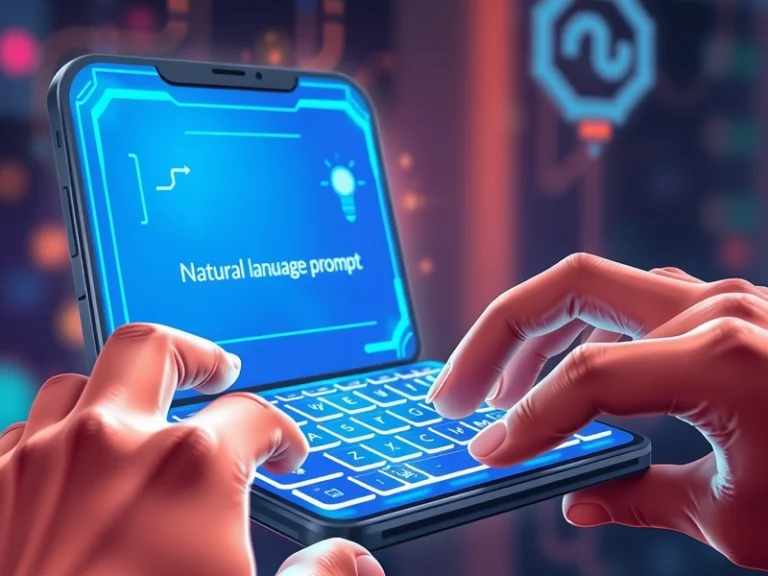
Artificial intelligence is fundamentally reshaping the app development paradigm, enabling the creation of customized applications from simple, natural language descriptions and ushering in an era of unprecedented accessibility and speed.
This evolving capability, powered primarily by advancements in large language models (LLMs) and natural language processing (NLP), represents a significant shift from traditional hand-coding or even graphical low-code/no-code interfaces. Developers and even non-technical users can now articulate their application requirements in plain English, and AI systems can translate that intent into functional code, user interfaces, and backend logic.
The AI-Driven Development Workflow
At its core, the process involves an LLM interpreting a user’s textual prompt, which can range from a high-level goal like “create an inventory management app for a small retail store” to more detailed specifications about features, data structures, and user roles. The AI then leverages its vast training data, which includes billions of lines of code and documentation, to generate the necessary components. This typically involves:
- Interpreting Intent: The LLM parses the natural language description, identifying key entities, actions, and relationships to understand the user’s underlying application requirements.
- Code Generation: Based on the interpreted intent, the AI generates code snippets, functions, and even entire modules in various programming languages (e.g., Python, JavaScript, C#, Java) for both front-end and back-end components.
- UI/UX Scaffolding: Many AI-powered platforms can also generate initial user interface layouts, forms, and navigation flows, often leveraging pre-built component libraries or design systems.
- Database Schema Design: For data-driven applications, the AI can propose and even generate initial database schemas based on the described data entities and their relationships.
- Integration Assistance: While full, complex integrations are still challenging, AI can assist by generating boilerplate code for API calls or suggesting relevant integration patterns.
This iterative process allows users to refine their descriptions, provide feedback, and guide the AI toward the desired outcome, essentially turning a conversational interface into a powerful development tool.
Key Players and Emerging Tools
Major technology companies are actively integrating these capabilities into their development ecosystems, augmenting existing low-code/no-code platforms and developer tools:
- Microsoft Power Apps + Copilot: Microsoft has been at the forefront, embedding Copilot AI capabilities across its Power Platform. Users can describe the app they want to build in natural language within Power Apps, and the AI can generate a functional application, including data tables, screens, and basic logic. This significantly lowers the barrier to entry for business users to create custom solutions.
- Google Duet AI: Google’s AI assistant, Duet AI, extends its reach into Google Cloud and Workspace, offering code generation, debugging assistance, and intelligent suggestions for developers working within Google’s ecosystem. While not always generating full apps from a single prompt, it provides substantial scaffolding and support for various development tasks.
- GitHub Copilot: While primarily an AI pair programmer that suggests code and functions based on context and comments, GitHub Copilot represents a foundational step in AI-assisted code generation. It demonstrates the power of LLMs in understanding developer intent and producing relevant code snippets, accelerating development significantly.
- Specialized AI Development Platforms: A growing number of startups and niche platforms are focusing specifically on generating entire applications or significant components from natural language, often targeting specific domains like internal tools, mobile apps, or web applications. These platforms aim to abstract away even more technical details, focusing purely on user intent.
Benefits and Transformative Potential
The ability to generate apps from descriptions offers several compelling advantages:
- Accelerated Development: AI can rapidly prototype and generate significant portions of an application, drastically reducing the time from concept to a working model. This allows for quicker iteration and faster time-to-market.
- Democratization of Development: By lowering the technical barrier, AI empowers a broader range of individuals, including business analysts, product managers, and entrepreneurs, to create custom software solutions without needing extensive coding expertise.
- Cost Reduction: Reduced development time and the potential need for fewer highly specialized developers can lead to significant cost savings in software projects.
- Increased Accessibility: For developers, AI acts as a powerful assistant, handling repetitive coding tasks, suggesting optimal solutions, and enabling them to focus on higher-level architectural design and complex problem-solving.
Challenges and Considerations
While promising, AI-driven app generation is not without its limitations and challenges:
- Prompt Engineering Complexity: While “simple descriptions” are the goal, achieving optimal results often requires detailed and well-structured prompts. Ambiguous or incomplete descriptions can lead to suboptimal or incorrect outputs.
- Complexity and Nuance: AI currently excels at generating boilerplate code and common application patterns. Highly complex business logic, unique integrations, nuanced user experience requirements, and specific performance optimizations often still require human intervention and refinement.
- Debugging and Maintenance: AI-generated code, like any code, can contain bugs or inefficiencies. Understanding, debugging, and maintaining such code still requires developer expertise.
- Security and Compliance: Ensuring that AI-generated code adheres to security best practices and regulatory compliance standards is a critical concern that requires careful oversight.
- “Hallucinations” and Errors: LLMs can sometimes generate plausible-sounding but functionally incorrect or nonsensical code (“hallucinations”), necessitating rigorous testing and validation.
- Customization Depth: While AI can create a functional app, achieving highly specific branding, unique UI/UX elements, or deeply integrated custom features often requires manual customization beyond the initial AI generation.
The emergence of AI-powered app generation marks a pivotal moment in software development. It’s not about replacing human developers but augmenting their capabilities, democratizing access to custom software, and accelerating innovation. As LLMs continue to advance, their ability to understand intent, generate robust code, and integrate seamlessly into development workflows will only grow, further revolutionizing how we conceive, build, and deploy applications.