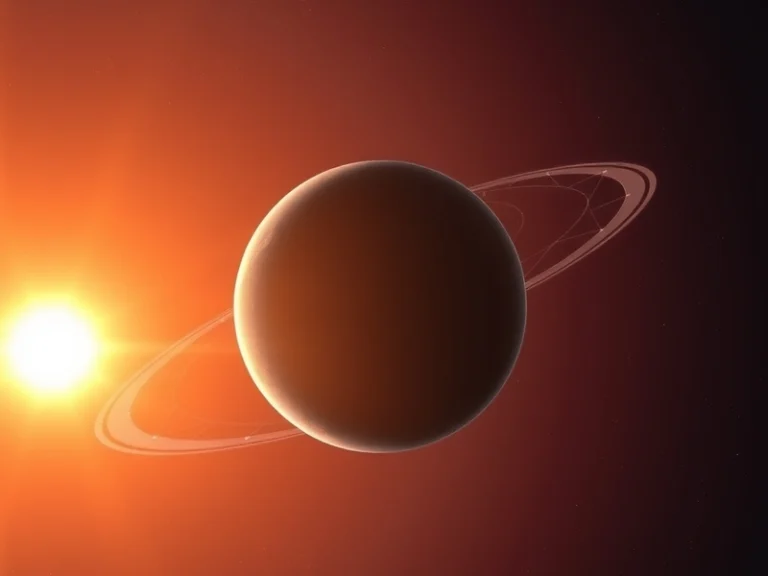
The James Webb Space Telescope (JWST) is leveraging artificial intelligence to overcome one of the most significant challenges in exoplanet discovery: detecting faint planetary signals hidden within the overwhelming glare of their host stars.
For decades, astronomers have grappled with the immense brightness contrast between a star and its orbiting planets. A star can be billions of times brighter than its exoplanets, making direct imaging akin to trying to spot a firefly next to a lighthouse from a great distance. While instruments like JWST are equipped with advanced coronagraphs and spectrographs designed to block starlight and analyze planetary atmospheres, the residual starlight, instrumental noise, and complex data patterns still pose a formidable challenge to extracting definitive planetary signatures.
The Data Deluge and the Signal-to-Noise Problem
JWST collects prodigious amounts of data across its instruments, including NIRCam, MIRI, and NIRSpec, offering unprecedented resolution and sensitivity in infrared wavelengths. This wealth of data, however, is not always straightforward. It often contains subtle, complex signals that are difficult for traditional algorithmic methods or even the human eye to consistently identify. The problem is exacerbated by:
- Extreme Contrast Ratios: Even with coronagraphs, residual scattered starlight can mimic or mask planetary signals.
- Instrumental Artifacts: Imperfections in optics, detector noise, and cosmic ray hits introduce spurious signals.
- Dynamic Data: Planetary signals might be transient or vary subtly over time, requiring sophisticated temporal analysis.
- Complex Signatures: Exoplanets don’t just appear as simple dots; their spectral and photometric signatures can be intricate, varying with wavelength, atmospheric composition, and orbital phase.
This is where AI, particularly machine learning and deep learning techniques, provides a powerful solution, transforming raw, noisy data into actionable insights.
AI’s Role in Unveiling Hidden Worlds
AI algorithms are proving instrumental in several key areas, allowing astronomers to push the boundaries of exoplanet detection and characterization:
Advanced Noise Reduction and Starlight Subtraction
Traditional methods for subtracting starlight often rely on static models or reference stars, which may not perfectly account for the dynamic nature of instrumental responses or the precise point spread function (PSF) of the target star. Machine learning models, particularly neural networks, can be trained on vast datasets comprising both real JWST observations and synthetic data. These models learn to distinguish between genuine planetary signals and the complex, often non-linear patterns of residual starlight and instrumental noise. By identifying and effectively removing these confounding elements, AI can dramatically improve the signal-to-noise ratio, making faint exoplanet signals stand out.
Automated Pattern Recognition and Anomaly Detection
Exoplanet detection often involves searching for specific, subtle patterns in light curves or spectral data that indicate the presence of an orbiting body. These patterns can be incredibly nuanced, especially for smaller planets or those with unusual orbital characteristics. Deep learning models excel at identifying such intricate patterns across large datasets, far surpassing human capabilities in speed and consistency. They can spot anomalies that might represent a new planet, even if the signal is partially obscured or deviates from expected models, thereby reducing the chance of overlooking potential discoveries.
Enhanced Image Reconstruction and Data Analysis
AI algorithms can be used for sophisticated image processing and reconstruction. For instance, techniques like principal component analysis (PCA) or more advanced autoencoders, when powered by machine learning, can decompose complex image cubes into their constituent parts – separating the dominant starlight component from the much fainter planetary component. This allows for a more robust extraction of planetary light, even when direct imaging is challenging due to proximity to the star or limited angular separation. Furthermore, AI can help analyze time-series data from transit observations, refining the detection of subtle dips in starlight that indicate a planet passing in front of its star, or identifying subtle radial velocity shifts from spectroscopic data.
Pushing the Limits of Discovery
By integrating AI into the data processing pipelines for JWST, astronomers are significantly enhancing the telescope’s ability to detect and characterize exoplanets. This innovation is particularly impactful for:
- Closer-in Exoplanets: AI’s ability to better subtract starlight means it can help uncover planets orbiting closer to their host stars, regions previously obscured by glare.
- Smaller, Cooler Worlds: Faint signals from smaller, potentially rocky planets or cooler gas giants become more discernible.
- Atmospheric Characterization: By improving the detection of planetary light, AI indirectly aids in the spectroscopic analysis of exoplanet atmospheres, helping to identify key molecules that could indicate habitability.
The combination of JWST’s unparalleled observational power and advanced AI techniques marks a new era in exoplanetology, accelerating the pace of discovery and bringing us closer to understanding the diversity of planetary systems beyond our own.