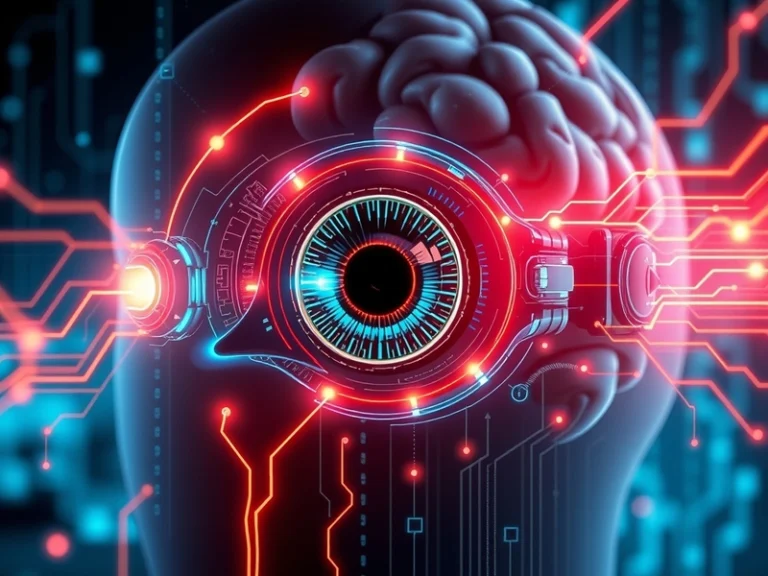
Artificial intelligence is increasingly being integrated into bionic eye systems, ushering in a new era of personalized visual prosthetics that can adapt to individual user needs and environmental conditions.
For individuals living with severe vision impairment or blindness due to retinal degeneration or other conditions, visual prosthetics offer a pathway to restored light perception, object recognition, and even limited form perception. These devices typically consist of an external camera that captures visual information, a processing unit that translates this information into electrical signals, and an implanted array of electrodes that stimulate remaining retinal cells or the visual cortex directly. While groundbreaking, early generations of these technologies, such as the Argus II retinal prosthesis, often provided vision that was rudimentary, characterized by phosphenes (spots of light), a limited field of view, and a need for significant user training to interpret the signals.
The core challenge has always been translating complex visual scenes into a simplified set of electrical pulses that the brain can interpret meaningfully. This translation process is inherently personal; what works for one individual may not be optimal for another, given variations in neural architecture, the cause of vision loss, and individual perception. This is where AI is proving transformative, moving beyond a one-size-fits-all approach to deliver highly customized and adaptive visual experiences.
AI’s Role in Personalizing Visual Prosthetics
AI algorithms are being deployed across several critical stages of bionic eye operation, primarily focused on enhancing the quality and interpretability of the visual input for each unique user. These applications can be broadly categorized into:
- Individualized Calibration and Learning: No two brains interpret electrical stimulation in precisely the same way. AI models can learn an individual’s specific neural responses to various stimulation patterns. Through iterative feedback, where users describe what they perceive (e.g., “brighter,” “sharper,” “left,” “right”), or even through monitoring brain activity directly, AI can fine-tune the parameters of stimulation. This includes adjusting electrode activation patterns, pulse amplitudes, and frequencies to create more coherent and natural-feeling visual percepts over time. The system essentially learns the user’s personal “visual language.”
- Advanced Image Processing and Scene Understanding: The raw video feed from a bionic eye’s camera is rich in data but often noisy and overwhelming for a simple processor to convert effectively. AI, particularly deep learning models like convolutional neural networks (CNNs), can perform sophisticated real-time analysis of the visual scene. This allows the system to:
- Highlight Salient Features: Focus on edges, outlines, faces, text, or obstacles relevant to the user, rather than presenting a jumble of undifferentiated light.
- Reduce Noise and Enhance Contrast: Improve the clarity of the visual information, especially in challenging lighting conditions.
- Semantic Segmentation: Understand the different objects and regions within a scene (e.g., identifying a door, a chair, or a person), providing a more structured and interpretable representation to the user.
- Depth Perception Assistance: While true stereoscopic vision remains a challenge, AI can infer depth cues from monocular video, providing critical information for navigation and avoiding collisions.
- Real-time Environmental Adaptation: Visual environments are dynamic, with lighting, movement, and object configurations constantly changing. AI enables bionic eyes to adapt on the fly. For instance, in low-light conditions, the AI can automatically adjust sensitivity and contrast enhancement. In a crowded environment, it might prioritize detecting moving obstacles or identifying specific individuals. This dynamic adaptation reduces cognitive load on the user and provides a more consistent visual experience across diverse situations.
Impact and Future Outlook
The integration of AI is moving bionic eye technology beyond basic light detection towards more functional and intuitive vision. Users report improvements in their ability to navigate unfamiliar environments, recognize familiar faces, read large text, and perform daily tasks with greater independence. The personalized nature of AI-enhanced systems means that the visual output is not just “better” in a general sense, but specifically optimized for the individual’s brain and their unique interpretation of electrical stimuli.
As AI models become more sophisticated and computational power continues to increase, the potential for further advancements is significant. Research is exploring how AI could facilitate even higher resolution perception, more natural color interpretation, and potentially even integrate with augmented reality overlays to provide supplementary information (e.g., object labels, navigation cues) directly into the visual field. While challenges remain in areas such as long-term neural plasticity, power consumption for compact devices, and the ethical considerations surrounding advanced prosthetics, the current trajectory suggests a future where AI-driven customization will be a cornerstone of truly effective bionic vision.