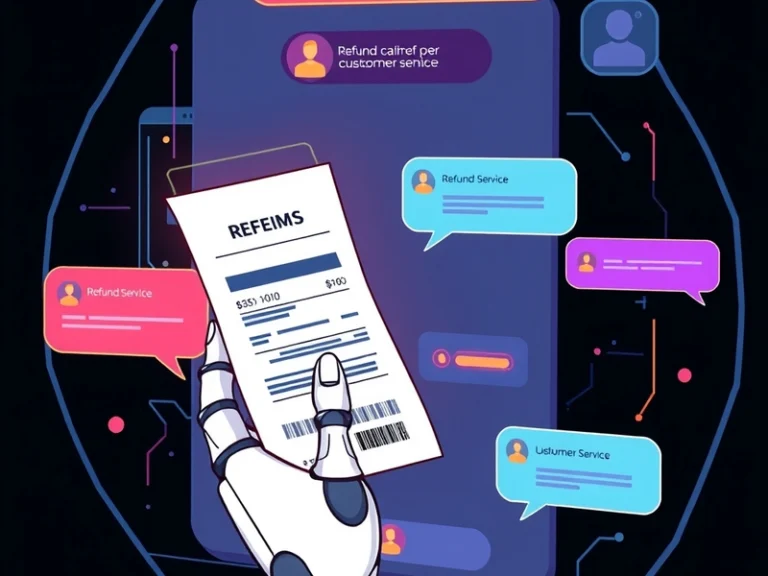
AI assistants are increasingly being tasked with navigating the often-frustrating landscape of consumer refund claims, moving beyond simple queries to engage in complex, multi-stage negotiations on behalf of users. This burgeoning application of advanced conversational agents and natural language processing (NLP) capabilities presents a unique experiment in AI autonomy, pushing the boundaries of what these systems can achieve in solving inherently human problems.
For many consumers, seeking a refund for a faulty product, a service not rendered, or an erroneous charge is a time-consuming and often emotionally taxing ordeal. It frequently involves deciphering complex company policies, enduring long wait times, engaging in repetitive explanations, and sometimes, assertive negotiation. This environment of friction and inefficiency makes it a compelling target for AI automation, promising to save users time and mitigate stress.
Early iterations of AI in this domain might begin by parsing digital receipts and purchase histories, identifying discrepancies, and drafting initial communications. More advanced systems, however, are designed to go further: interpreting customer service responses, adapting their communication strategy, escalating issues through appropriate channels, and even engaging in live chat or voice interactions. These AI agents leverage large language models to understand context, generate coherent and persuasive arguments, and maintain persistence that a human user might find exhausting.
How AI Navigates the Refund Labyrinth
The operational framework for an AI assistant tackling refund claims typically involves several sophisticated steps:
- Data Ingestion and Analysis: The AI first processes transaction details, purchase agreements, and relevant company policies. This might involve scraping information from emails, web pages, or direct data feeds.
- Problem Identification: It identifies the core issue – whether it’s a product defect, a service failure, an incorrect charge, or a missed promotion – and cross-references it with applicable consumer rights and company terms.
- Strategy Formulation: Based on the identified problem and available data, the AI develops a strategy for pursuing the refund, including the sequence of actions, the tone of communication, and potential escalation points.
- Automated Communication: The AI drafts and sends initial requests, follow-ups, and responses to customer service agents. This can range from email to automated chat interactions, potentially adapting its language based on the perceived responsiveness and tone of the human agent.
- Negotiation and Escalation: In more complex cases, the AI can be programmed to negotiate terms, cite specific policies, and, if necessary, escalate the claim to higher levels of customer support or even suggest external dispute resolution mechanisms.
The appeal for consumers is clear: offloading a frustrating task to an tireless, persistent agent. For businesses, the implications are more nuanced. While AI could streamline legitimate refund processes, it also raises questions about the nature of customer service and the potential for increased claim volume.
The Ethical Crossroads of Autonomous AI
As AI systems gain greater autonomy in these sensitive, often adversarial interactions, a series of profound ethical questions emerge, particularly concerning the nature of complex human problems:
- Transparency and Deception: Should the AI explicitly disclose its non-human identity to the customer service representative on the other end? If not, is this a form of deception? The “Turing Test” in a customer service context raises questions about fair interaction and the right of human agents to know who they are communicating with.
- Agency and Control: How much control does the human user retain over the AI’s actions? If an AI, in its pursuit of a refund, adopts an overly aggressive or even misleading stance, who is ultimately responsible? The line between user instruction and AI initiative becomes blurred, particularly when the AI learns and adapts its tactics.
- Fairness and Bias: Could biases inherent in the AI’s training data or algorithmic design lead to unfair outcomes? For example, could certain types of claims or interactions with specific companies be handled less effectively or more aggressively based on patterns the AI has learned, potentially disadvantaging certain users or businesses?
- Accountability and Recourse: What happens when an AI makes a mistake? If an AI misinterprets a policy, makes a false claim, or inadvertently causes a dispute to escalate unnecessarily, who bears the accountability? Establishing clear lines of responsibility for autonomous AI actions is a significant challenge.
- The Human Element: The widespread adoption of AI for complex tasks like refund chasing could further depersonalize customer service interactions. While efficiency is gained, the opportunity for human empathy, nuanced understanding, and flexible problem-solving, which are often crucial in resolving disputes, may be diminished. It also raises questions about the future of customer service roles themselves.
The “unique experiment” of tasking AI with refund chasing highlights a broader trend: the increasing delegation of complex, human-centric tasks to autonomous systems. While the promise of efficiency and convenience is compelling, developers and users alike must grapple with the ethical frameworks necessary to ensure these systems operate transparently, fairly, and with clear lines of accountability. As AI continues to evolve, the distinction between a helpful tool and an autonomous agent making ethically charged decisions will become increasingly critical to define and regulate.