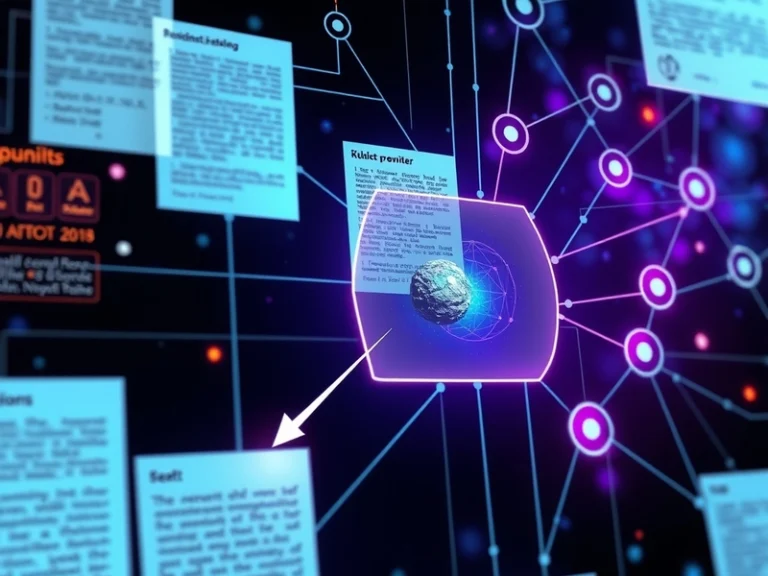
An artificial intelligence system has successfully identified and led to the rediscovery of a historical meteorite, previously lost to time within vast archival records. This achievement underscores the growing capability of AI in extracting critical insights from unstructured historical data, bridging gaps in scientific understanding.
The challenge of unearthing forgotten scientific events, such as meteorite falls, from historical archives is immense. Researchers traditionally face a daunting task: sifting through millions of pages of documents – including handwritten letters, faded newspaper clippings, scientific journals, and local government records – often spanning centuries and written in various languages and archaic styles. These records are not cataloged for meteorite-specific information, meaning a human researcher might spend years on a single archive without guaranteed success, or miss subtle connections scattered across disparate sources. The sheer volume and heterogeneity of this data make comprehensive manual analysis practically impossible.
AI’s Multi-faceted Approach to Archival Discovery
The breakthrough hinged on a sophisticated application of several AI technologies, working in concert to process and interpret the vast historical corpus.
- Advanced Digitization and Optical Character Recognition (OCR): The foundational step involved digitizing physical documents and converting images of text into machine-readable formats. Modern OCR engines, significantly enhanced by deep learning, can now handle a wider array of historical fonts, handwriting styles, and damaged documents with remarkable accuracy, a crucial improvement over older systems that struggled with anything less than pristine printed text.
- Natural Language Processing (NLP) and Semantic Search: Once digitized, the textual data was subjected to advanced NLP techniques. Unlike simple keyword searches, which can miss context or synonyms, these models were trained to understand the semantic meaning of words and phrases. They could identify descriptions related to celestial phenomena, unusual geological formations, impact events, and witness accounts, even when expressed in varied or metaphorical language common in historical texts. Named Entity Recognition (NER) models were instrumental in extracting specific locations, dates, and names of individuals who might have observed or recorded such events.
- Machine Learning for Pattern Recognition and Anomaly Detection: Perhaps the most critical AI contribution was its ability to identify subtle patterns and anomalies across the entire dataset. Machine learning algorithms were deployed to detect correlations between seemingly unrelated fragments of information. For instance, a vague mention of “stones from the sky” in a local diary might be cross-referenced with a meteorological report noting an unusual atmospheric event on a specific date, and further linked to a newspaper article describing a localized seismic tremor. The AI could piece together these disparate clues, identifying clusters of information that collectively pointed towards a probable, yet unconfirmed, meteorite fall.
Piecing Together a Forgotten History
In this specific instance, the AI system analyzed a diverse range of archives, including 18th and 19th-century scientific society proceedings, regional governmental reports, and local historical newspaper collections. The system flagged a series of fragmented accounts that, individually, offered little conclusive evidence. However, when aggregated and analyzed by the AI, these fragments formed a compelling narrative.
For example, the AI identified a series of brief, seemingly inconsequential entries: a dated account of a “fiery streak” in the sky from a rural almanac, a description of unusually dense, dark stones found by farmers in a specific locale, and a later, almost dismissive mention in a geological survey of an “unidentified metallic inclusion” in a soil sample from the same region, decades after the initial sighting. Human researchers, guided by the AI’s flagged connections, then revisited physical collections. They discovered a small, mislabeled rock specimen in a university’s natural history collection that, upon detailed re-examination and geochemical analysis, proved to be a genuine meteorite. Its characteristics matched the AI-generated profile derived from the historical descriptions, confirming its origin and validating the AI’s findings.
Implications for Science and History
The rediscovery of this meteorite is more than just an isolated scientific curiosity. It serves as a powerful demonstration of AI’s transformative potential in historical and scientific research. It illustrates how AI can act as an invaluable assistant, not replacing human expertise but augmenting it, allowing researchers to uncover insights that would otherwise remain buried in the sheer volume and complexity of historical data.
This methodology opens doors for similar applications across various disciplines. Archaeologists could use AI to identify overlooked settlement patterns or artifact clusters in ancient texts. Paleontologists might uncover forgotten fossil discoveries or historical climate data. The ability to connect disparate pieces of information across vast, unstructured datasets promises to accelerate discovery and provide new perspectives on our past, enriching our understanding of both natural phenomena and human history.