Deep learning models are increasingly identifying previously overlooked geological features near Earth’s core, offering new insights into our planet’s deepest structures by processing vast datasets of seismic information.
For decades, our understanding of Earth’s interior, particularly the intricate region surrounding its molten outer and solid inner core, has relied heavily on seismology. Scientists analyze how seismic waves generated by earthquakes travel through and reflect off different layers of the Earth, inferring properties like density, temperature, and composition. However, the sheer volume and complexity of global seismic data, often obscured by noise and requiring sophisticated interpretation, have presented significant challenges to uncovering subtle anomalies.
The Seismological Frontier and AI’s Role
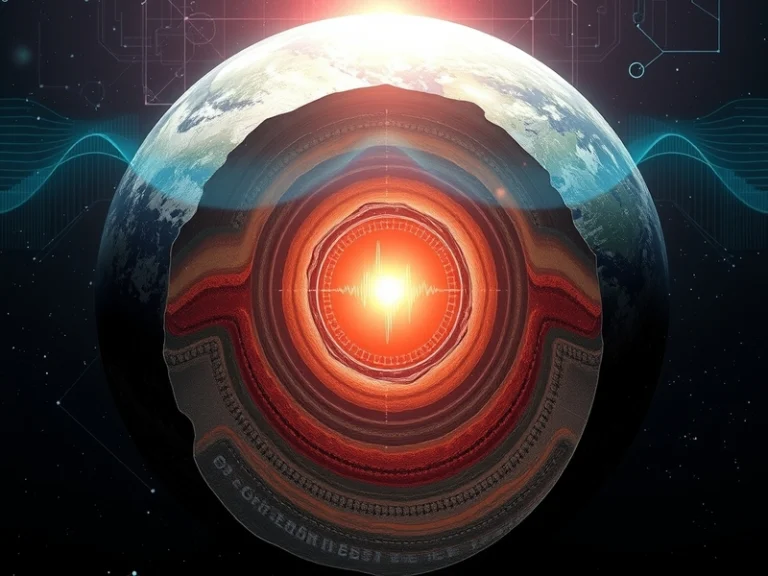
The region approximately 2,900 kilometers beneath the surface, where the mantle meets the outer core, is known as the core-mantle boundary (CMB). This dynamic interface is critical for understanding processes like mantle convection, plate tectonics, and the generation of Earth’s magnetic field. Within this boundary zone, seismologists have identified enigmatic structures such as Ultra-Low Velocity Zones (ULVZs), characterized by significant drops in seismic wave speeds, and large low-shear-velocity provinces (LLSVPs). These anomalies are thought to represent areas of unusual chemistry, temperature, or even partial melt, but their precise morphology and distribution remain subjects of intense study.
Artificial intelligence, particularly deep learning, is now providing powerful new tools to probe these depths with unprecedented resolution. By training on extensive libraries of seismic waveforms, AI models can learn to identify patterns indicative of specific geological structures far more efficiently and comprehensively than traditional methods.
How Deep Learning Enhances Seismic Analysis
- Automated Feature Extraction: Convolutional Neural Networks (CNNs) are adept at recognizing complex patterns in raw seismic data, such as faint reflections or diffractions that might be missed by human observers or simplified algorithms. These models can pinpoint arrival times of seismic phases with greater precision, crucial for mapping subsurface interfaces.
- Noise Reduction and Signal Enhancement: Deep learning techniques, including autoencoders and generative adversarial networks (GANs), can effectively filter out ambient noise and enhance weak signals, revealing subtle seismic anomalies that were previously obscured. This is particularly vital when analyzing data from distant earthquakes or from regions with complex crustal structures.
- Anomaly Detection: Unsupervised learning methods can identify patterns that deviate significantly from expected seismic wave behavior, flagging potential “hidden zones” that don’t conform to standard Earth models. These could be small-scale heterogeneities, localized melt pockets, or unusual mineral phases near the core.
- Data Integration and Interpretation: AI can integrate seismic data from various sources and types (e.g., body waves, surface waves, free oscillations) and even combine it with other geophysical data (e.g., gravity, magnetic fields) to construct more coherent and detailed 3D models of Earth’s interior.
Uncovering Deeper Secrets
The application of these models allows researchers to re-examine decades of archived seismic data, often uncovering subtle signatures that were previously overlooked. For instance, deep learning algorithms have been employed to re-analyze global seismic networks like the Global Seismographic Network (GSN), processing petabytes of waveform data to identify minute variations in seismic wave travel times and amplitudes. This meticulous re-analysis is revealing finer details within known structures, and potentially entirely new, smaller-scale features in the D” layer – the lowermost part of the mantle just above the core – and along the core-mantle boundary itself.
These discoveries are not about finding a completely new, discrete “layer” that fundamentally redefines Earth’s structure, but rather about refining our understanding of the heterogeneous and dynamic nature of the deep Earth. AI-driven analysis is helping to map the precise geometries and material properties of ULVZs, for example, suggesting they might be more widespread or complexly shaped than previously thought. Such insights are crucial for understanding the processes that govern heat transfer from the core to the mantle, which in turn drives plate tectonics and influences the Earth’s geodynamo.
The ability of deep learning to discern these intricate patterns from noisy and voluminous datasets represents a significant leap forward in solid Earth geophysics. As AI models continue to evolve and are trained on ever-growing datasets, they promise to unlock further secrets from the deepest, least accessible parts of our planet, fundamentally altering our understanding of Earth’s internal engine.