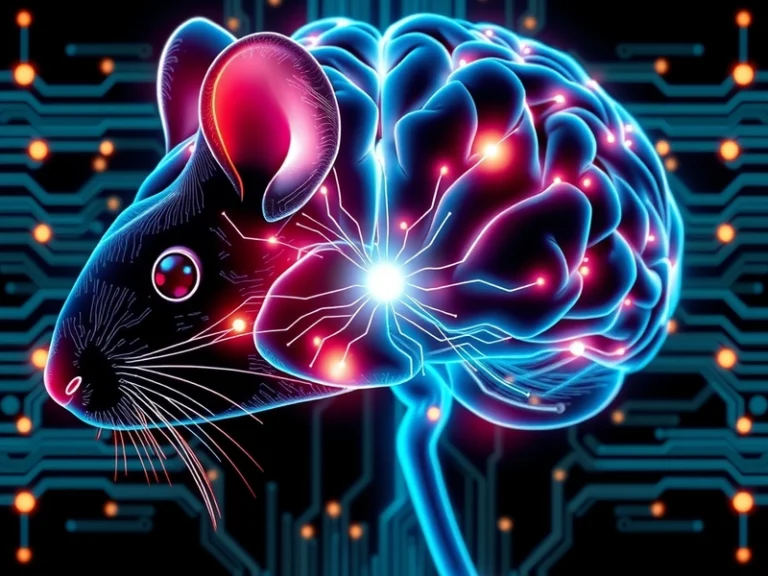
A significant development in AI-driven biomedical research has seen an AI agent successfully select and administer gene therapy to a mouse suffering from seizures, showcasing a new frontier for autonomous AI in complex medical interventions.
This achievement points towards a future where AI systems could autonomously navigate the intricate landscape of patient data, treatment options, and precise delivery mechanisms. In this case, the AI agent’s role encompassed both the diagnostic-like function of selecting an appropriate gene therapy from a range of possibilities and the delicate, precise task of administering it within the mouse brain. Such a capability extends beyond mere automation; it represents an integration of sophisticated data analysis, decision-making, and robotic control, moving towards truly autonomous experimental execution.
The AI’s Role in Precision Treatment
The successful selection and administration of gene therapy by an AI agent for a condition as complex as seizures highlights several key capabilities. Gene therapy itself is a highly specialized field, often involving the delivery of genetic material (e.g., via adeno-associated virus or AAV vectors) to correct or modify gene expression, which requires precise targeting and dosage. An AI agent capable of navigating this process would likely leverage:
- Data Integration and Analysis: Processing vast datasets, including genetic profiles, physiological markers, and anatomical imaging, to identify the most suitable gene therapy approach for the individual mouse’s condition.
- Decision-Making Algorithms: Employing advanced machine learning, potentially reinforcement learning, to evaluate potential therapies against desired outcomes and select an optimal course of action based on learned patterns and simulations.
- Precision Robotics and Control: Interfacing with micro-injection systems or other delivery mechanisms to ensure the gene therapy is administered with micron-level accuracy to the target brain region, a critical factor for efficacy and safety in neurological interventions.
- Real-time Monitoring: Potentially incorporating sensor feedback loops to monitor the administration process and adjust parameters dynamically.
The implications for preclinical research are substantial. By automating such complex experimental workflows, AI agents could dramatically accelerate the pace of discovery, reduce human error and variability, and facilitate highly personalized treatment development. For conditions like epilepsy, which can have diverse genetic and neurological underpinnings, an AI capable of optimizing gene therapy selection based on individual biomarkers could pave the way for more effective, tailored treatments.
Navigating the Path to Clinical Translation
While the successful application in a mouse model is a compelling proof-of-concept, the path to human clinical translation presents significant challenges. Biological systems, especially the human brain, are immensely complex and often exhibit variability that is difficult for even advanced AI models to fully capture. Key considerations for future development include:
- Robust Validation: Ensuring the AI’s decision-making process is transparent, reliable, and rigorously validated across diverse biological contexts and patient populations.
- Ethical Frameworks: Developing clear ethical guidelines for autonomous AI agents making critical medical decisions, particularly as they move closer to human trials.
- Regulatory Pathways: Establishing regulatory frameworks for AI-driven diagnostic and therapeutic systems, which will need to address issues of accountability, safety, and efficacy.
- Scalability: Adapting techniques proven in controlled laboratory environments to the broader range of complexities encountered in human physiology and clinical settings.
This work fits into a broader trend of AI integration in biomedicine, where machine learning is already transforming areas such as drug discovery (e.g., DeepMind’s AlphaFold for protein structure prediction, Insilico Medicine’s AI-discovered drug for idiopathic pulmonary fibrosis), medical imaging analysis, and diagnostic support systems. However, an AI agent capable of both selecting and administering a complex therapy represents a significant leap towards truly autonomous biomedical intervention.
The successful treatment of seizures in a mouse using an AI agent for gene therapy selection and administration underscores the transformative potential of artificial intelligence in biomedical research and clinical practice. It highlights a future where AI could play an increasingly active role in personalized medicine, accelerating the development of precise, targeted therapies for challenging conditions.