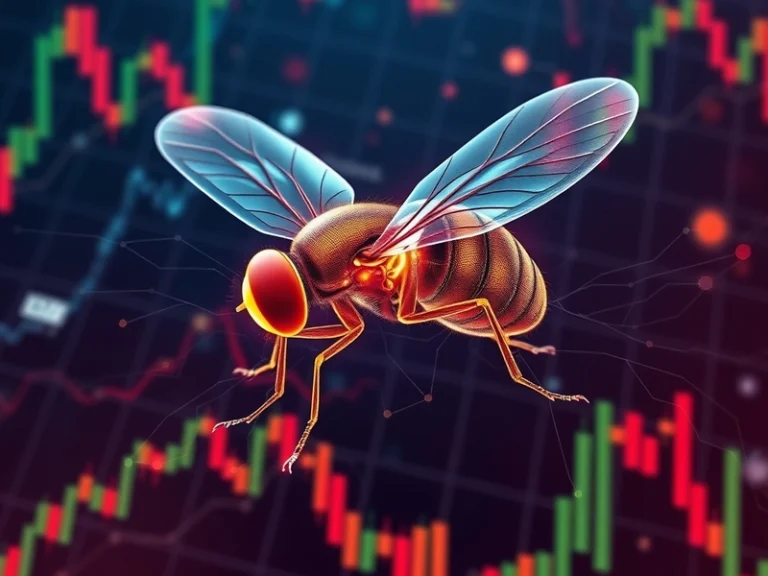
New research mapping the intricate neural circuits of the fruit fly brain is increasingly informing the development of advanced AI-driven trading systems, offering novel approaches to processing complex, dynamic financial data.
The humble *Drosophila melanogaster*, a model organism extensively studied in neuroscience, is providing a surprisingly rich blueprint for computational intelligence. Researchers have undertaken ambitious projects to map its connectome – the complete wiring diagram of its approximately 100,000 neurons and their connections. Pioneering efforts, notably at the Howard Hughes Medical Institute’s Janelia Research Campus, have generated comprehensive datasets of neural networks that govern complex behaviors like navigation, decision-making, and learning. These detailed maps reveal how biological brains process information, integrate sensory inputs, and generate adaptive responses, even with limited computational resources compared to modern AI.
From Neurons to Trading Algorithms
The conceptual leap from a fly’s brain to a Wall Street trading floor might seem vast, but the underlying principles of navigating complex, uncertain environments bear striking resemblances. Both involve:
- Decision-making under uncertainty: Flies make rapid choices about foraging or escaping predators with incomplete information. Trading systems must similarly make buy/sell decisions in volatile markets.
- Pattern recognition: Identifying subtle environmental cues (or market signals) that predict outcomes.
- Adaptive learning: Adjusting strategies based on past experiences and changing conditions.
- Resource optimization: Allocating attention and processing power efficiently.
Neuroscientists are uncovering the algorithms brains use to accomplish these tasks, often involving sparse representations, recurrent connections, and highly parallel processing. These biological insights are now inspiring a new generation of AI architectures and learning paradigms for financial applications.
Bio-Inspired AI Architectures for Finance
Several AI paradigms stand to benefit from these neuroscientific discoveries:
Reinforcement Learning (RL)
The way a fruit fly learns to navigate a maze or associate a smell with a reward closely mirrors the core tenets of reinforcement learning. An RL agent learns an optimal policy by interacting with an environment, receiving rewards or penalties. By studying how flies integrate past experiences, predict future outcomes, and adapt their internal models, researchers can refine RL algorithms for trading. This includes developing more robust reward functions, more efficient exploration strategies, and better mechanisms for handling delayed rewards or sparse feedback, all critical challenges in quantitative finance.
Graph Neural Networks (GNNs)
The connectome itself is a colossal graph, representing neurons as nodes and synapses as edges. Graph Neural Networks, designed to process data structured as graphs, are a natural fit for translating these biological blueprints. In finance, GNNs could model the intricate relationships between various financial instruments, market participants, or information flows. By mirroring the hierarchical and recurrent structures observed in neural circuits, GNNs could potentially uncover non-obvious dependencies and propagate information more effectively across complex market networks, leading to more nuanced predictions and trading signals.
Spiking Neural Networks (SNNs) and Neuromorphic Computing
Unlike conventional artificial neural networks that use continuous activation values, Spiking Neural Networks mimic the discrete, event-driven communication of biological neurons. They transmit information through “spikes” at specific times, which can lead to greater energy efficiency and novel ways of processing time-series data, a cornerstone of financial analysis. The insights from fly brain activity patterns — such as burst firing, rhythmic oscillations, and spike-timing-dependent plasticity — are directly informing SNN design. Furthermore, the development of neuromorphic computing hardware, which directly emulates brain structures and functions, offers the potential for ultra-low-power, high-speed processing of these bio-inspired algorithms, potentially accelerating high-frequency trading strategies or complex portfolio optimization.
The Promise for Trading Systems
The application of these brain-inspired techniques holds promise for several aspects of AI trading:
- Enhanced Pattern Detection: Uncovering subtle, non-linear patterns in market data that traditional statistical or machine learning models might miss.
- Adaptive Strategy Evolution: Building trading systems that can dynamically adapt their strategies to changing market regimes, much like a biological organism adapts to its environment.
- Robust Decision-Making: Developing models that make more resilient decisions under extreme volatility or incomplete information, drawing from the brain’s ability to cope with uncertainty.
- Energy Efficiency: Leveraging the inherent energy efficiency of biological computation to run complex models with lower power consumption, a significant factor in large-scale data centers.
While the direct translation of fly brain mechanics to market predictions is a challenging endeavor, the conceptual and architectural inspirations are proving invaluable. The interdisciplinary synergy between neuroscience and artificial intelligence continues to push the boundaries of what’s possible, hinting at a future where our understanding of the smallest brains could yield some of the most sophisticated financial instruments.