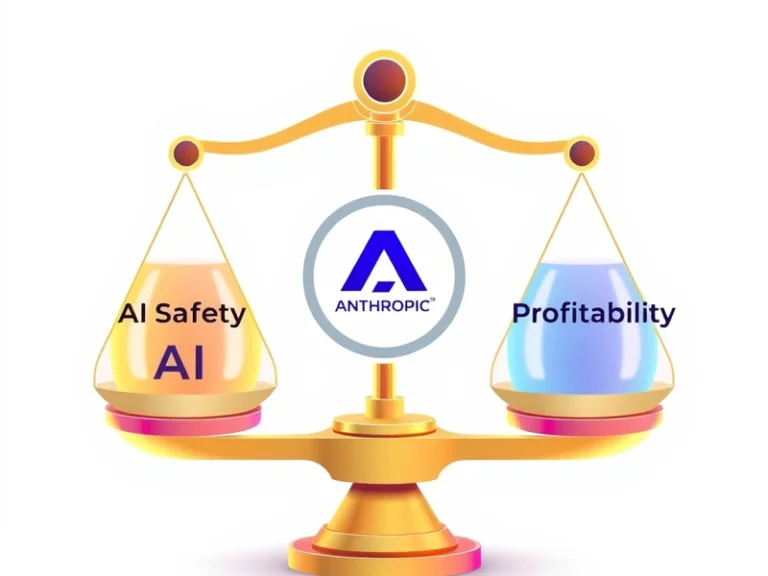
As Anthropic reportedly moves closer to a potential initial public offering (IPO), the company faces increasing pressure to balance its foundational commitment to AI safety with the market’s demand for rapid innovation and profitability in its upcoming AI models.
Anthropic was founded by former OpenAI researchers motivated by a desire to prioritize AI safety and alignment, establishing itself with a distinct mission to develop advanced AI systems responsibly. This ethos is embodied in their work on “Constitutional AI,” a method designed to align large language models like their flagship Claude series with human values through a set of principles, rather than solely relying on extensive human feedback. This approach aims to make AI models more helpful, harmless, and honest by design, a significant differentiator in a competitive landscape.
The prospect of an IPO, however, introduces a new dynamic. Public companies operate under intense scrutiny from shareholders and the broader financial market, which typically prioritizes consistent growth, expanding market share, and a clear path to substantial revenue. For Anthropic, this means demonstrating not only its technical prowess in developing cutting-edge models but also its ability to translate its safety-first philosophy into a commercially viable and rapidly scaling business model.
The Safety-Profitability Nexus
Anthropic’s dedication to safety, while a core part of its brand identity and a significant draw for certain enterprise clients, also presents unique challenges when viewed through a profitability lens:
- Resource Intensive Development: Developing and rigorously testing AI models for safety and alignment, employing techniques like Constitutional AI and extensive red-teaming, is time-consuming and expensive. This can potentially slow down release cycles compared to competitors who might prioritize raw capability or speed to market over exhaustive safety evaluations.
- Capability Constraints: A strong emphasis on safety might lead to models that are intentionally constrained in certain domains to prevent misuse or harmful outputs. While beneficial for responsible deployment, these constraints could, in some specific niche applications, be perceived as limiting compared to more open-ended models from rivals.
- Market Expectations: The broader AI market, especially enterprise customers, increasingly demands not just safe but also highly performant, versatile, and cost-effective models. Anthropic must ensure its safety measures do not unduly hinder the development of models that can compete effectively on these fronts.
Conversely, Anthropic’s safety-centric approach could also be a significant market advantage. As concerns about AI ethics, misinformation, and misuse grow, a reputation for building demonstrably safer and more aligned models could attract enterprise customers in regulated industries or those with high-stakes applications. Companies like Google, Amazon, and Salesforce have already invested in Anthropic, signaling confidence in their technology and approach.
Navigating the Trade-Offs
As Anthropic plans its next generation of AI models, a crucial consideration will be how to strategically balance these factors. Potential avenues include:
- Tiered Model Offerings: Developing a spectrum of models, from highly constrained and robustly safe versions for critical applications to more performant, slightly less-constrained models for general use cases, each with appropriate pricing and support levels.
- Safety as a Premium Feature: Marketing advanced safety and alignment features as a unique selling proposition, justifying a premium for enterprise clients who require strong guarantees against harmful outputs or bias.
- Efficient Safety Research: Investing heavily in research that makes safety and alignment techniques more scalable and less resource-intensive, allowing for faster iteration without compromising core principles.
- Strategic Partnerships: Collaborating with companies that explicitly value and are willing to pay for highly aligned AI systems, integrating their safety features directly into industry-specific solutions.
The upcoming models will likely reflect Anthropic’s attempt to thread this needle: demonstrating continued advancements in AI capabilities—such as larger context windows, improved reasoning, and multimodal understanding—while maintaining and clearly articulating their commitment to responsible development. The success of their IPO, whenever it materializes, will in part hinge on their ability to convince investors that their safety-first strategy is not a hindrance to growth, but rather a sustainable and valuable long-term differentiator in the rapidly evolving AI ecosystem.