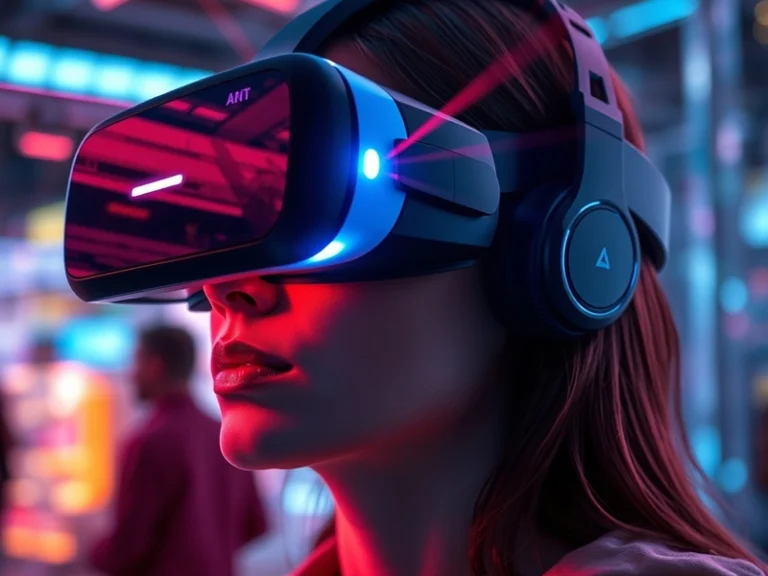
A significant leap in human-computer interaction is emerging, promising to transform how users navigate virtual environments by simply observing their surroundings, as highlighted by technologies like the one attributed to “Frameboy” in recent discussions.
This innovative approach moves beyond traditional controllers and hand gestures, enabling exploration and interaction within virtual worlds through natural eye and head movements. The core idea is to translate a user’s gaze and head orientation directly into navigational commands and interactive selections, creating a more intuitive and immersive experience that closely mirrors how humans perceive and interact with the real world.
The AI Core of Gaze-Driven Interaction
At the heart of this paradigm shift is sophisticated artificial intelligence. AI models are crucial for several key functions:
- Precise Gaze Tracking: High-fidelity eye-tracking systems, often employing infrared cameras and advanced computer vision algorithms, accurately determine where a user is looking. AI refines this data, distinguishing between casual glances and intentional focus points, even predicting saccadic movements for smoother interaction.
- Head Pose Estimation: AI-powered sensor fusion combines data from accelerometers, gyroscopes, and magnetometers to precisely track head orientation and position in 3D space. This allows for seamless spatial navigation as the user physically turns their head.
- Intent Recognition: Beyond raw gaze data, AI interprets patterns of eye movement, dwell time, and contextual information to infer user intent. For example, a sustained gaze on a virtual object might trigger a selection, while a quick glance might simply highlight it. This reduces the need for explicit input, making interactions feel more natural.
- Foveated Rendering: A significant application of eye-tracking AI in virtual reality is foveated rendering. This technique renders the area where the user is looking (the fovea) in high resolution, while peripheral areas are rendered at a lower resolution. AI dynamically adjusts rendering based on real-time gaze data, drastically reducing computational load and improving graphical fidelity where it matters most, without sacrificing perceived quality.
- Adaptive Environments: In more advanced scenarios, AI could dynamically adjust the virtual environment based on user gaze patterns, highlighting relevant information, revealing hidden pathways, or even generating new content in response to a user’s curiosity.
Current Landscape and Precedents
While the concept of exploring virtual worlds purely by looking around represents a significant stride, many established virtual and augmented reality platforms already incorporate elements of eye and head tracking:
- Meta Quest Pro: Features integrated eye tracking and natural facial expressions, allowing for more realistic avatar representation and enabling foveated rendering.
- Apple Vision Pro: Heavily relies on eye tracking and hand gestures as primary input methods, allowing users to select elements by looking at them and tapping fingers.
- Varjo Aero/XR-3: Known for their high-resolution displays and advanced eye-tracking capabilities, crucial for professional applications where precision and visual fidelity are paramount.
These devices demonstrate the foundational technologies that make gaze-driven interaction possible. The innovation lies in pushing these capabilities further, making “simply looking around” the primary, seamless mode of interaction, minimizing reliance on supplementary controllers.
Potential Advantages and Use Cases
The implications of this technology extend across various sectors:
- Enhanced Immersion: Removing physical controllers and making interaction purely gaze-based can significantly deepen the sense of presence and immersion within virtual worlds.
- Improved Accessibility: For users with limited mobility or those who struggle with traditional controllers, gaze-based interaction offers a highly accessible alternative, opening up virtual experiences to a broader audience.
- Intuitive Navigation: Navigating complex virtual spaces becomes as natural as exploring a physical room. Users can effortlessly move through environments, select options, and gather information without breaking their focus.
- Training and Simulation: In fields like medicine, aviation, or engineering, gaze tracking can provide valuable insights into a trainee’s attention and decision-making process, while offering a more realistic training environment.
- Product Design and Retail: Consumers could virtually “try on” products or explore digital showrooms, simply by looking at items of interest, with the system providing contextual information or customization options.
Technical Hurdles and Future Outlook
Despite its promise, the widespread adoption of purely gaze-driven interaction faces several technical challenges. Achieving extremely low latency and high accuracy in eye and head tracking is critical to prevent user discomfort or motion sickness. Calibration processes must be seamless and adaptable to different users and environments. Furthermore, the computational demands for real-time AI processing of high-resolution eye-tracking data, especially when coupled with foveated rendering and complex virtual environments, are substantial.
As AI models become more efficient and hardware capabilities advance, these hurdles are gradually being overcome. The integration of advanced neural networks for predictive tracking and intent recognition will continue to refine the responsiveness and naturalness of these systems. The trajectory suggests a future where our eyes become powerful input devices, making virtual exploration as effortless as looking around in the real world.