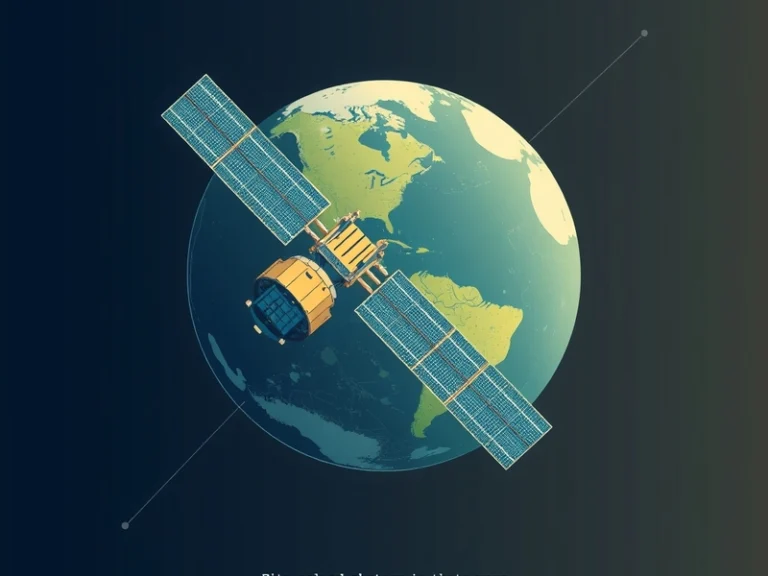
An AI chip developed by Google recently generated a haiku while operating in Earth orbit, marking a notable step for artificial intelligence capabilities in space and demonstrating the expanding reach of autonomous creative tasks beyond Earth.
This event signals a growing trend of deploying sophisticated AI hardware and software directly into space environments. While the specific content of the generated haiku was not the primary focus, the act itself serves as a proof-of-concept for AI systems performing complex, non-analytical tasks in the challenging conditions of space. It moves beyond traditional onboard processing, which often focuses on data compression or simple anomaly detection, into the realm of generative AI.
The Technology Behind Orbital AI
Google has been a prominent developer of specialized AI accelerators, most notably its Tensor Processing Units (TPUs), designed to efficiently handle machine learning workloads. For deployment in space, such chips often require significant modifications to withstand radiation, extreme temperature fluctuations, and vacuum conditions. These “space-hardened” versions integrate robust error correction, redundant systems, and materials designed to endure the harsh radiation environment of orbit.
The motivation for putting AI capabilities directly onto satellites and other spacecraft is multifaceted:
- Reduced Latency: Processing data on board eliminates the time delay associated with sending raw data to Earth for analysis and then transmitting commands back. This is crucial for time-sensitive operations, such as autonomous navigation, anomaly response, or real-time scientific observation.
- Bandwidth Efficiency: Satellites generate vast amounts of data, particularly from high-resolution Earth observation sensors. Onboard AI can process this data, extracting only relevant insights or compressing it significantly before downlink, thereby conserving precious bandwidth.
- Increased Autonomy: For deep space missions or scenarios where communication with Earth is intermittent or delayed, onboard AI enables spacecraft to make independent decisions, adapt to unforeseen circumstances, and perform complex tasks without constant human intervention.
- Edge Computing in Space: This orbital AI chip exemplifies edge computing, where computation happens closer to the data source rather than relying solely on centralized cloud infrastructure. In space, this paradigm shift is particularly impactful due to the inherent communication challenges.
Beyond Poetry: The Broader Implications
While generating a haiku might seem like a whimsical application, it effectively showcases the chip’s ability to execute generative AI models. This capability has far-reaching implications for future space missions:
- Autonomous Scientific Discovery: AI could analyze sensor data from distant planets or moons in real-time, identifying features of interest, prioritizing observations, and even formulating hypotheses without waiting for human input.
- Enhanced Earth Observation: Onboard AI can filter out cloud cover, identify specific objects or events (like wildfires or floods), and track dynamic phenomena with greater precision and speed, delivering actionable intelligence faster.
- Resilient Space Systems: AI could be used for advanced fault detection, diagnosis, and even autonomous repair or reconfiguration of spacecraft systems, increasing mission longevity and reliability.
- Advanced Robotics and Exploration: For rovers on other planets or complex robotic arms, AI can enable more sophisticated pathfinding, object manipulation, and interaction with unknown environments.
This milestone with Google’s AI chip underscores a significant shift in how space missions are conceived and executed. Rather than simply being data collectors, spacecraft are evolving into intelligent, autonomous agents capable of complex reasoning and creative output. The ability to perform generative tasks on orbit opens doors for a new generation of space exploration, where AI not only processes information but also contributes to discovery and adaptation in ways previously confined to science fiction.