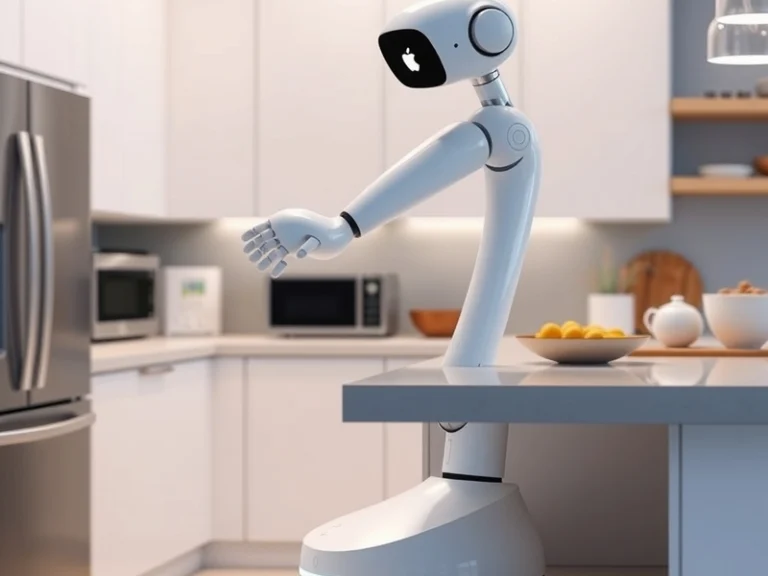
Apple is reportedly exploring the development of personal robotics, with a particular focus on a kitchen-oriented device designed for conversational interaction and task assistance. While details remain scarce and the project is understood to be in an early research phase, this initiative signals a potential new frontier for the Cupertino giant in the realm of embodied AI and smart home integration, moving beyond static smart speakers and tablets into more dynamic, physical interaction.
The reports suggest Apple’s ambition to create a robotic companion capable of navigating home environments, engaging users in conversation, and assisting with daily chores. Such a device would represent a significant expansion of Apple’s hardware portfolio and a deeper commitment to artificial intelligence that extends beyond its established software services like Siri.
Apple’s Foundation for Embodied AI
While a kitchen robot would be a novel category for Apple, the company possesses several core competencies that could underpin such a venture:
- Advanced AI and Machine Learning: Apple has invested heavily in on-device machine learning, leveraging its Neural Engine in A-series and M-series chips for tasks like image recognition, natural language processing, and personalized suggestions. This local processing power is crucial for privacy and low-latency interaction, which would be paramount for a home robot.
- Siri and Conversational AI: Despite ongoing efforts to improve Siri, the foundation for conversational interfaces is well-established within Apple. A robot would demand more nuanced, contextual, and proactive conversational capabilities, potentially pushing Apple to significantly advance its natural language understanding and generation.
- HomeKit and Smart Home Ecosystem: Apple’s HomeKit framework provides a secure and integrated platform for controlling smart home accessories. A kitchen robot could act as a central, mobile hub for HomeKit, interacting physically with appliances and sensors in ways that current stationary devices cannot.
- Hardware Design and Manufacturing Expertise: Apple’s unparalleled experience in designing and mass-producing complex, user-friendly hardware, from iPhones to Apple Watch, positions it well to tackle the engineering challenges of a sophisticated home robot. This includes sensor integration (cameras, LiDAR, microphones), motor control, and battery efficiency.
- Privacy-Centric Approach: With a device that would inherently collect significant data about a user’s home and habits, Apple’s strong stance on user privacy could be a key differentiator and trust builder in a market segment fraught with data security concerns.
Potential Capabilities and User Experience
If Apple were to bring such a robot to market, its functionality would likely center on a blend of practical assistance and intuitive interaction. Speculative applications, drawing from general trends in home robotics, might include:
- Dynamic Assistance: Beyond simple voice commands, the robot could proactively offer help, such as suggesting recipes based on available ingredients it identifies visually, reminding users of upcoming appointments, or even preheating an oven.
- Environmental Awareness: Leveraging advanced sensors, the robot could map and understand the home environment, identify objects (e.g., recognizing specific food items, locating misplaced keys), and navigate safely around obstacles and people.
- Physical Interaction: While the extent of physical manipulation is a significant engineering hurdle, even simple tasks like retrieving items from a counter, loading a dishwasher, or wiping surfaces could offer substantial utility. The kitchen, with its repetitive tasks and need for organization, presents a prime environment for such assistance.
- Personalized Engagement: Over time, the robot could learn user preferences, routines, and even emotional cues, offering a more personalized and empathetic interaction than current voice assistants.
Challenges and Considerations
Developing a sophisticated home robot presents formidable challenges, even for a company with Apple’s resources:
- Robustness in Unstructured Environments: Homes are inherently messy and unpredictable. Robots need to operate reliably amidst varying lighting, clutter, and human activity, which is far more complex than controlled industrial settings.
- Safety and Reliability: A mobile robot operating autonomously in close proximity to people must be impeccably safe, avoiding collisions and accidental damage. Mechanical failures or software glitches could have serious consequences.
- Cost and Accessibility: High-end robotics are expensive. Apple would need to find a balance between advanced functionality and a price point that makes the device accessible to a broader market, or establish it as a premium, niche product.
- Perceived Utility vs. Novelty: The device must offer clear, compelling benefits that justify its cost and presence in the home, moving beyond a mere technological curiosity. Genuine utility in daily tasks is crucial for long-term adoption.
- Ethical and Privacy Concerns: A constantly present, sensing robot in the home raises significant questions about surveillance, data collection, and algorithmic bias. Apple’s privacy framework would be tested and potentially become a key selling point.
Apple’s potential entry into personal robotics underscores a broader industry trend towards more intelligent, physically interactive AI. If these reports prove accurate, Apple could significantly shape the future of smart homes, redefining how we interact with technology and how AI integrates into our daily lives, particularly in the heart of the home: the kitchen.