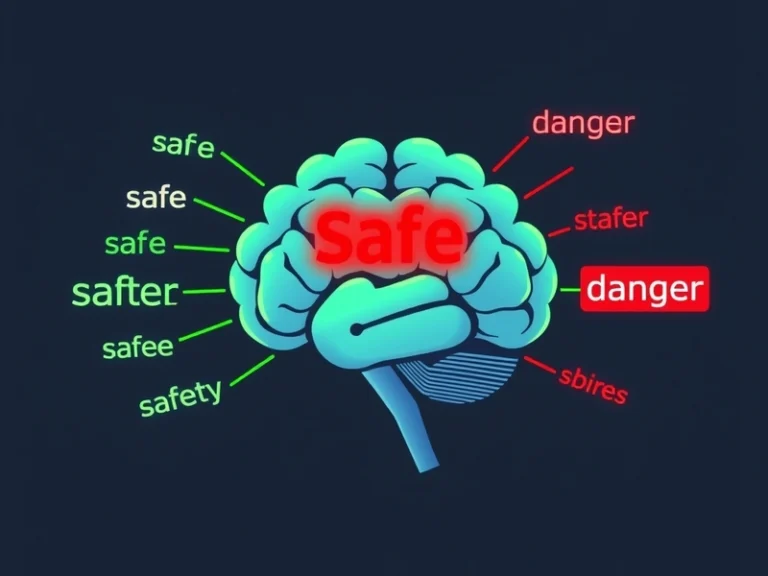
Recent findings suggest a fundamental human linguistic bias: people inherently prioritize safety over danger in their choice of words, a tendency with significant implications for the development and behavior of AI language models.
This preference for “safety” in communication manifests in various ways across human interactions. It’s not merely about avoiding profanity or overtly harmful language, but a deeper inclination to frame discussions, express ideas, and even describe reality through a lens that minimizes perceived threat, maintains social harmony, or softens potentially harsh truths. This can involve the use of euphemisms, indirect speech, positive reframing, or a general avoidance of confrontational or emotionally charged terminology unless absolutely necessary.
The roots of this linguistic tendency are likely multifaceted, stemming from both evolutionary and social pressures. From an evolutionary perspective, cooperation and the avoidance of conflict were often crucial for group survival. Socially, maintaining decorum, fostering empathy, and building trust are cornerstones of stable communities. Language, as a primary tool for these interactions, naturally evolved to reflect and reinforce these priorities. When faced with a choice between a neutral, safe description and a more vivid, potentially alarming one, humans often gravitate towards the former.
Impact on AI Language Models
The implications of this inherent human bias are profound for modern large language models (LLMs), which are trained on vast datasets of human-generated text and often fine-tuned through human feedback. This natural human preference for safety influences LLMs in several key areas:
- Training Data Reflection: The immense corpora of text used to pre-train models—comprising books, articles, web pages, and conversational data—are fundamentally products of human communication. If human communication naturally leans towards safety, then this bias is implicitly encoded into the foundational understanding of language that LLMs develop. The models learn not just the grammar and semantics of words, but also the subtle social and emotional connotations, including this preference for less threatening formulations.
- Reinforcement Learning from Human Feedback (RLHF): Techniques like RLHF, employed by companies such as OpenAI for ChatGPT and Anthropic for Claude, rely on human evaluators to rank and refine model outputs. When humans are asked to judge responses for helpfulness, harmlessness, and honesty, their inherent preference for “safe” language naturally guides their feedback. An answer that is overly direct, potentially offensive, or even just starkly realistic about a negative topic might be rated lower than a more circumspect, neutral, or positively framed response, even if both are factually accurate. This process iteratively sculpts the model’s behavior towards what humans perceive as safer and more agreeable.
- Alignment and Safety Guardrails: AI developers explicitly engineer models with safety guardrails to prevent the generation of harmful, unethical, or biased content. This research suggests that these explicit efforts are, in a sense, aligning with a pre-existing, implicit human tendency. While developers implement strict policies to filter out toxicity and hate speech, the more subtle human preference for general linguistic safety further contributes to models that default to cautious, helpful, and non-confrontational outputs.
Challenges and Considerations
While this human preference for safety can aid in developing more responsible and less harmful AI, it also introduces potential complexities and challenges:
- Risk of Over-Censorship or Sanitization: Models might become overly cautious, shying away from controversial but legitimate topics, or presenting a sanitized, idealized version of reality. This could limit their utility in domains requiring nuanced discussion of sensitive or difficult subjects, such as historical analysis, ethical dilemmas, or artistic expression that explores darker themes.
- Loss of Nuance and Authenticity: If models consistently default to the “safest” linguistic options, they might struggle to generate text that accurately reflects the full spectrum of human emotion, conflict, or diverse perspectives. This could lead to outputs that feel bland, generic, or detached from the authentic complexities of human experience. For instance, accurately portraying a historical conflict or a fictional character’s internal struggle might require language that is not inherently “safe.”
- Echo Chamber Effect: If AI models primarily reflect and reinforce a preference for safe, agreeable language, they could inadvertently contribute to an echo chamber, where challenging ideas or dissenting viewpoints are less likely to be expressed or encountered, even if presented respectfully.
Understanding this fundamental human linguistic bias is crucial for AI developers. It highlights both an inherent advantage—as it naturally guides models towards more benign interactions—and a potential pitfall, requiring careful consideration to ensure that safety does not inadvertently compromise accuracy, nuance, or the comprehensive representation of human discourse. The ongoing challenge lies in balancing the imperative for safety with the need for models that can engage with the full, often messy, spectrum of human communication in a contextually appropriate manner.