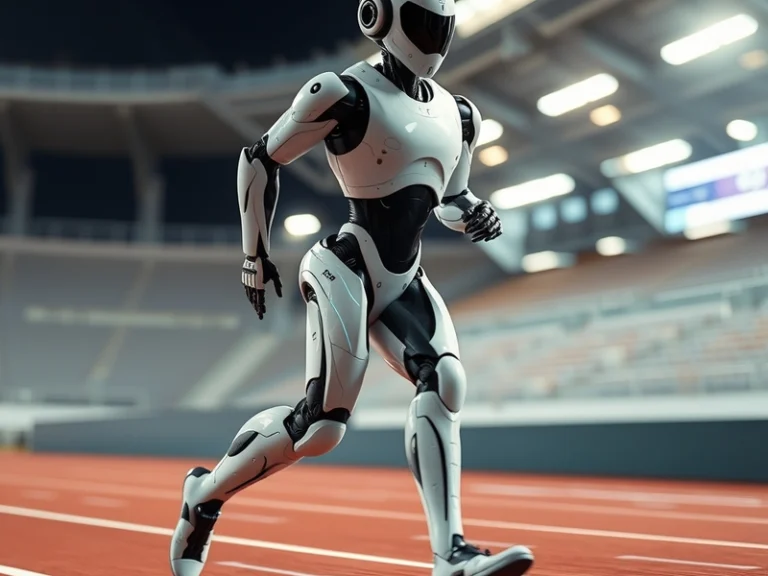
The ambitious prospect of humanoid robots outperforming human athletes in feats of speed and jumping, a scenario once confined to science fiction, is rapidly transitioning into a tangible engineering challenge, fueled by recent breakthroughs in bipedal locomotion and dynamic agility. While definitive human world records in these categories remain held by biological athletes, the relentless pace of robotic innovation suggests that such benchmarks are increasingly within the realm of future possibility, sparking intense interest across the AI and robotics communities.
Current Frontiers in Humanoid Agility
Modern humanoid robots are demonstrating levels of athleticism that were unimaginable just a decade ago. Companies like Boston Dynamics have consistently pushed the envelope with their Atlas robot, showcasing its ability to perform complex parkour routines, navigate challenging terrain, and execute dynamic maneuvers such as running, jumping over obstacles, and even performing backflips. These demonstrations highlight sophisticated balance control, precise motor coordination, and rapid reactive capabilities in real-time.
Similarly, Agility Robotics’ Digit has proven adept at robust, dynamic walking and carrying packages in unstructured environments, emphasizing stability and efficient bipedal movement. While Digit’s current focus is on logistics and delivery, the underlying technology for stable, efficient locomotion is foundational to achieving higher speeds and more powerful jumps. These robots are not merely walking; they are exhibiting forms of biomechanical intelligence that mirror, and in some cases, surpass human-like adaptability to varied physical demands.
Key to these advancements are several interconnected technological developments:
- Advanced Control Algorithms: Sophisticated model predictive control, reinforcement learning, and whole-body control systems enable robots to plan and execute complex movements dynamically, adjusting to changing conditions in milliseconds.
- High-Power Actuators: Improvements in electric motors and hydraulic systems provide the necessary torque and speed for rapid, forceful movements, crucial for explosive jumps and high-speed locomotion.
- Lightweight Materials: The use of advanced composites and smart designs reduces overall robot mass, improving the power-to-weight ratio and enabling more agile performance.
- Sensor Fusion: Integrating data from cameras, lidar, inertial measurement units (IMUs), and force sensors allows robots to perceive their environment and their own state with unprecedented accuracy, essential for dynamic balance and precise interaction.
The Athletic Gap: Remaining Challenges
Despite these impressive leaps, the gap between current robotic capabilities and peak human athletic performance in speed and jumping remains significant. Elite human athletes possess an unparalleled combination of power-to-weight ratio, energy efficiency, and instantaneous adaptability, coupled with years of specialized training that refines neuromuscular control to an extreme degree.
For robots, challenges persist in several key areas:
- Energy Density: Batteries, while improving, still cannot match the energy density of biological systems, limiting sustained high-power output required for sprinting or repeated powerful jumps.
- Actuator Bandwidth: While powerful, current actuators may struggle to replicate the sheer speed and fine-grained control of human muscle fibers across the full range of motion required for maximum athletic output.
- Impact Absorption and Recovery: The human musculoskeletal system is remarkably adept at absorbing impact forces and rapidly preparing for the next movement. Replicating this resilience and rapid recovery in a robot, especially for high-impact activities like landing from a jump, is a complex engineering problem.
- Control for Peak Performance: Optimizing robot control for maximum speed or jump height requires pushing hardware to its absolute limits without failure, a task complicated by wear and tear, thermal management, and the inherent variability of mechanical systems.
Beyond Records: Broader Implications
While the pursuit of athletic records captures public imagination, the true significance of these advancements extends far beyond a track or a long jump pit. The ability of humanoid robots to perform high-speed, dynamic movements and robustly handle varied terrain unlocks critical applications in:
- Disaster Response: Robots capable of navigating rubble, climbing over obstacles, and moving quickly through hazardous environments can assist in search and rescue operations without risking human lives.
- Complex Industrial Tasks: Factories and warehouses can leverage more agile robots for tasks requiring dynamic movement, such as rapid item retrieval or navigating crowded operational spaces.
- Exploration: Future missions to distant planets or hazardous environments on Earth could utilize humanoid robots with advanced mobility to perform detailed reconnaissance and manipulation.
- Human-Robot Collaboration: As robots become more agile and responsive, their ability to work seamlessly and safely alongside humans in shared workspaces will dramatically improve.
The journey towards humanoid robots challenging human athletic records is a testament to the rapid evolution of AI and robotics engineering. It’s a challenging endeavor that demands breakthroughs in materials science, control theory, and energy systems. While the exact timeline for a robot to definitively break a human world record in speed or jumping remains a subject of ongoing research and development, the foundational work being done today is undeniably paving the way for a future where such feats are not just possible, but potentially routine for advanced autonomous systems. The implications for how we define physical prowess, and for the broader utility of humanoid robots, are profound.