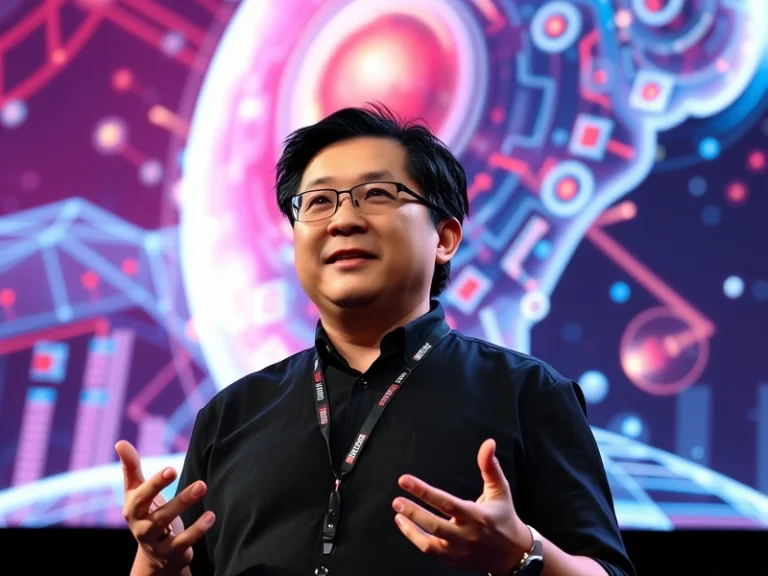
Jensen Huang, CEO of NVIDIA, has consistently articulated a compelling vision for artificial intelligence as the driving force behind the next industrial revolution, fundamentally reshaping industries and empowering innovation across the global economy.
Huang’s perspective posits that AI is not merely a technological advancement but a new computing platform, akin to the internet or electricity in its transformative potential. This revolution is powered by accelerated computing, where specialized processors, primarily GPUs, are designed to handle the massive parallel computations required for training and deploying complex AI models.
The Engine of Revolution: Accelerated Computing
At the core of this vision is NVIDIA’s long-standing investment in accelerated computing. The company’s CUDA platform, introduced in 2006, laid the groundwork for developers to harness the parallel processing power of GPUs for general-purpose computation, extending far beyond traditional graphics rendering. This ecosystem has become foundational for modern AI development, from deep learning research to large-scale inference.
Huang emphasizes that the efficiency gains from accelerated computing are crucial for scaling AI. As models grow in complexity and data volumes expand, traditional CPU-centric architectures struggle to keep pace. GPUs, like NVIDIA’s Hopper (e.g., H100) and Blackwell architectures, are engineered to deliver orders of magnitude greater performance for AI workloads, enabling the training of models with billions or even trillions of parameters.
From Data to Intelligence: The New Factories
In Huang’s view, the data centers of today are the “AI factories” of tomorrow. These facilities, equipped with powerful GPU clusters, are no longer just processing information; they are actively producing intelligence. This intelligence takes various forms, from highly accurate predictive models to generative AI systems capable of creating new content, code, or designs.
This shift represents a fundamental change in how value is created. Instead of simply analyzing existing data, these AI factories are generating new capabilities and insights that can be directly applied to real-world problems. The output of these factories—the trained AI models—becomes an invaluable asset, driving efficiency, discovery, and innovation across diverse sectors.
Transforming Industries: A Broad Impact
Huang’s vision extends to how AI will permeate and revolutionize virtually every industry. He frequently highlights several key sectors poised for significant transformation:
- Manufacturing and Robotics: AI is enabling smarter factories with predictive maintenance, optimized supply chains, and advanced robotics that can learn and adapt. Digital twins, virtual replicas of physical systems or environments, powered by platforms like NVIDIA Omniverse, allow for simulation and optimization before physical deployment, reducing costs and accelerating innovation.
- Healthcare and Life Sciences: From accelerating drug discovery and development through AI-powered simulations (e.g., in genomics and molecular dynamics) to enhancing medical imaging analysis and personalized treatment plans, AI promises to redefine healthcare outcomes.
- Logistics and Transportation: AI optimizes routes, manages complex fleets, and powers autonomous vehicles, leading to increased efficiency, reduced emissions, and enhanced safety.
- Software Development: Generative AI models are assisting developers by writing code, identifying bugs, and automating repetitive tasks, potentially ushering in an era of significantly faster software creation and innovation.
- Creative Industries: AI tools are empowering artists, designers, and content creators with new capabilities for generating ideas, synthesizing media, and personalizing experiences.
The common thread across these applications is the ability of AI to automate complex cognitive tasks, optimize processes that were previously intractable, and unlock new possibilities for innovation.
Empowering Innovation in the Workplace
Beyond industrial transformation, Huang envisions AI as a tool that empowers individuals and augments human capabilities. Rather than simply replacing jobs, AI can become an intelligent co-pilot, enhancing productivity and allowing humans to focus on higher-level creative and strategic tasks. This empowerment manifests in several ways:
- Democratization of Expertise: AI tools can make specialized knowledge and skills more accessible, allowing individuals without deep technical backgrounds to leverage complex AI models for their work.
- Augmented Creativity: For designers, engineers, and researchers, AI can generate design variations, simulate outcomes, and provide data-driven insights, accelerating the creative process.
- Enhanced Productivity: AI assistants can handle routine tasks, manage information overload, and provide real-time support, freeing up human workers to engage in more complex problem-solving and strategic thinking.
Huang’s narrative consistently emphasizes that AI is a tool for human progress, enabling us to tackle previously unsolvable challenges and unlock new frontiers of discovery and economic growth. The ongoing expansion of AI capabilities, driven by advancements in accelerated computing and the increasing sophistication of models, is set to solidify its role as the definitive technology of this new industrial era.