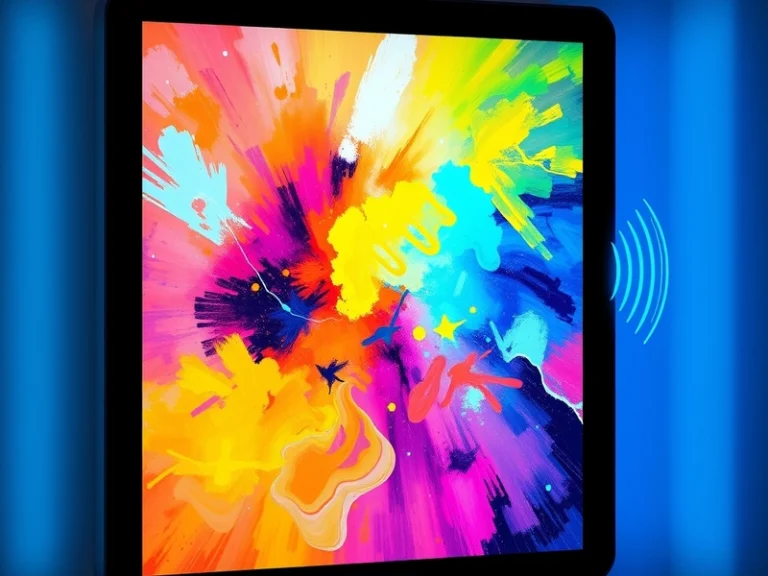
Jitrainno is introducing its latest innovation, Canvas, a smart digital art frame designed to allow users to generate unique wall decor with simple voice commands, aiming to transform how individuals interact with art in their homes. This new offering taps into the burgeoning field of generative AI, bringing its creative power directly into the realm of personalized interior design.
Generative AI at the Core
At its heart, Jitrainno’s Canvas leverages sophisticated generative AI models, akin to those that power widely recognized platforms such as DALL-E 3, Midjourney, and Stable Diffusion. These models are trained on extensive datasets comprising billions of images paired with descriptive text. This training enables them to understand complex visual concepts and artistic styles, synthesizing entirely new images from textual prompts. When a user issues a voice command, the system translates that natural language input into a structured prompt that the generative AI can interpret, producing a unique piece of digital art.
The process typically involves several key AI components:
- Automatic Speech Recognition (ASR): This technology accurately transcribes spoken words into text, converting the user’s voice command into a digital input.
- Natural Language Processing (NLP): Once transcribed, NLP algorithms parse the text to understand the user’s intent, identify keywords related to style, subject matter, and mood, and formulate an effective prompt for the image generation model.
- Text-to-Image Generation: The core generative AI model then takes this refined prompt and, through a diffusion process or similar architecture, constructs an image pixel by pixel, reflecting the requested aesthetics.
This intricate interplay of AI allows for a seamless transition from a spoken idea to a visual reality, displayed directly on the device.
Transforming the Home Decor Experience
The promise of Jitrainno’s Canvas lies in its ability to democratize art creation and personalization. Historically, acquiring unique art has involved significant cost, time, or artistic skill. Digital art frames have offered flexibility by displaying a rotating gallery of pre-existing works, but Canvas pushes this further by enabling on-demand creation.
Consider the typical user interaction:
- A user might say, “Canvas, show me a minimalist abstract painting with deep blues and gold accents.”
- The ASR and NLP components process this, formulating a prompt like “minimalist abstract painting, deep blue, gold accents, clean lines.”
- The generative AI then creates several variations based on this prompt.
- These options are displayed, and the user can select their favorite or refine the command, perhaps saying, “Make it more textural” or “Change the gold to silver.”
This iterative process empowers users to fine-tune outputs until they achieve a piece that perfectly complements their living space or current mood. The ability to generate art on a whim means that home decor can evolve dynamically, reflecting seasonal changes, personal preferences, or even specific occasions without the need to physically replace framed art.
Beyond Static Displays: A Dynamic Artistic Companion
While existing digital art frames, such as Samsung’s The Frame TV or Netgear’s Meural Canvas, offer high-resolution displays for showcasing digital art collections, Jitrainno’s Canvas distinguishes itself with its *generative* capability. Instead of merely displaying existing images, it creates them. This shift introduces a new paradigm: the art device becomes an active participant in the creative process rather than a passive display.
The integration of voice commands further aligns Canvas with smart home ecosystems, where voice interfaces from Amazon Alexa and Google Assistant have become commonplace for controlling lighting, thermostats, and entertainment. By adding art creation to the suite of voice-controlled functionalities, Canvas positions itself as a natural extension of the smart home, offering not just utility but also aesthetic enrichment.
Challenges and Considerations
As with any emerging AI-powered product, Jitrainno’s Canvas will navigate certain challenges. Prompt engineering, the skill of crafting effective text prompts to achieve desired AI outputs, remains a learning curve for many users. While voice interfaces aim to simplify this, the nuances of generating specific artistic styles or compositions can still require some experimentation.
Furthermore, discussions around AI-generated art continue to evolve, particularly concerning artistic intent, originality, and potential copyright implications if the models draw heavily from existing copyrighted works. For a product like Canvas, ensuring that the generated output is truly unique and ethically sound will be an ongoing consideration, likely managed through careful model training and output filtering.
Despite these considerations, Jitrainno’s Canvas represents a compelling step forward in merging AI creativity with everyday living. By making the power of generative art accessible through intuitive voice commands, it offers a glimpse into a future where personalized, dynamic art is an integral part of the modern home.