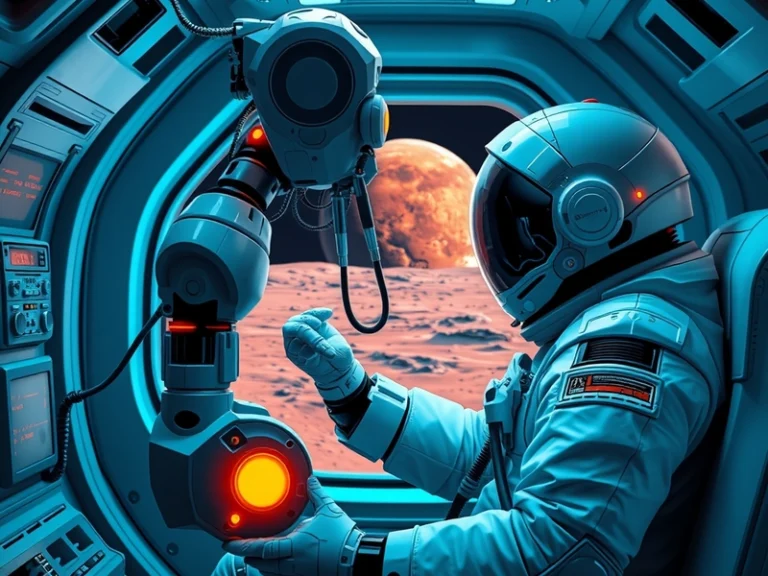
NASA is actively developing and training AI-powered robotic systems designed to serve as autonomous medical assistants for astronauts on future deep space missions, particularly those venturing to Mars. These initiatives aim to mitigate the significant medical challenges posed by long-duration space travel, where immediate human medical intervention or real-time support from Earth is often impossible.
The concept of a robotic medic addresses several critical constraints inherent in missions beyond low Earth orbit. On a journey to Mars, communication delays can stretch to over 20 minutes one-way, making real-time telemedicine impractical for urgent situations. Furthermore, crew sizes are inherently small, meaning a single medical emergency could incapacitate a significant portion of the team, or the designated medical officer could be the one requiring aid. Robotic medical assistants, equipped with advanced AI, are envisioned to provide on-the-spot diagnosis, procedural guidance, and even direct physical intervention, ensuring crew health and mission success.
The Imperative for Autonomous Medical Care
Deep space missions present a unique confluence of medical risks:
- Radiation Exposure: Beyond Earth’s protective magnetosphere, astronauts are exposed to higher levels of galactic cosmic rays and solar particle events, increasing risks for cancer, central nervous system damage, and acute radiation sickness.
- Microgravity Effects: Prolonged exposure to microgravity leads to bone density loss, muscle atrophy, cardiovascular deconditioning, fluid shifts, and impaired immune function.
- Psychological Stress: Isolation, confinement, and the high-stakes nature of the mission can lead to psychological strain, which can manifest in physical symptoms or impair judgment.
- Limited Resources: Spacecraft have finite medical supplies, equipment, and diagnostic tools, necessitating efficient and precise use.
- Communication Latency: The significant time delay for communications with Earth makes real-time expert consultation impossible for critical situations.
In this challenging environment, an autonomous medical system is not merely a convenience but a necessity, acting as a force multiplier for the crew and a crucial safety net.
AI at the Core: Capabilities of a Robotic Medic
The intelligence driving these robotic systems relies heavily on sophisticated artificial intelligence and machine learning algorithms. NASA’s research focuses on endowing these systems with capabilities that mimic and extend human medical expertise:
- Diagnostic AI: Leveraging vast datasets of medical images, patient histories, and physiological data, AI models are trained to identify symptoms, diagnose conditions, and suggest treatment protocols. This includes processing sensor data from wearable devices, environmental monitors, and even internal diagnostic tools.
- Procedural Guidance and Assistance: For complex medical procedures, the AI can guide astronauts step-by-step through tasks, display critical information, and monitor their progress. More advanced robots could potentially perform delicate manipulations, such as suturing wounds or administering injections, under human supervision or autonomously in emergencies.
- Physiological Monitoring and Anomaly Detection: Continuous monitoring of astronaut vital signs, sleep patterns, stress levels, and other biomarkers allows AI to detect subtle changes that might indicate a developing health issue before it becomes critical.
- Medical Logistics and Resource Management: AI can track medical supply inventories, predict consumption rates, and suggest optimal usage strategies, crucial for missions with finite resources.
- Natural Language Processing (NLP): Future iterations may incorporate NLP for intuitive voice interaction, allowing astronauts to communicate symptoms and receive instructions naturally.
Training Regimens for Deep Space Autonomy
Training these AI-powered robots for the unpredictable environment of deep space is a monumental task. The methodologies employed draw heavily from advanced machine learning techniques:
- Simulated Environments: Robots and their AI brains are trained extensively in highly realistic digital simulations that replicate the physiological stresses of space, potential medical emergencies, and the limited resources of a spacecraft. This allows for exposure to millions of hypothetical scenarios without risk.
- Vast Medical Datasets: The AI systems are fed enormous quantities of anonymized medical records, textbooks, diagnostic images (X-rays, MRIs), and surgical videos. This data forms the foundation of their medical knowledge.
- Human-in-the-Loop Learning: Medical professionals and astronauts provide continuous feedback during training, refining the AI’s diagnostic accuracy and procedural efficacy. This iterative process is vital for building trust and reliability.
- Reinforcement Learning: For tasks requiring decision-making and adaptation, reinforcement learning algorithms allow the robots to learn optimal strategies through trial and error within simulated environments, receiving “rewards” for correct diagnoses or successful interventions.
- Robotics and Dexterity Training: For physical tasks, robotic manipulators are trained using techniques like imitation learning, observing human medical procedures and replicating them in controlled settings, gradually improving precision and dexterity.
These training paradigms aim to build robust, adaptable systems capable of operating with high levels of autonomy, even when faced with novel or unforeseen medical situations far from Earth.
Challenges and Ethical Considerations
While the promise of robotic medics is immense, significant challenges remain. Ensuring the AI’s absolute reliability and accuracy in life-or-death situations is paramount. Issues such as potential algorithmic bias, the ability to adapt to truly novel medical conditions not present in training data, and the power/computational requirements for such complex systems in space are active areas of research.
Ethical considerations also play a crucial role. Defining the level of autonomy a robotic medic should possess, particularly in invasive procedures or critical decision-making, requires careful deliberation. The psychological impact on astronauts of relying on non-human medical care, especially during moments of extreme vulnerability, is another factor that needs to be addressed through design and training.
NASA’s ongoing work on AI-powered robotic medics represents a critical step towards enabling humanity’s long-term presence beyond Earth. By combining cutting-edge AI with advanced robotics, these systems promise to extend the reach of human capability, transforming the medical landscape for future generations of space explorers.