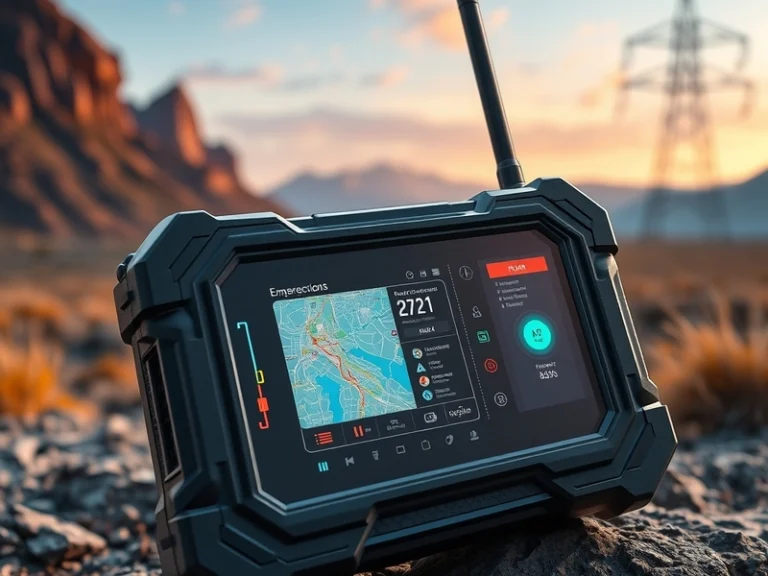
A new initiative, dubbed Project NOMAD, aims to develop a self-sufficient AI assistant specifically designed to provide critical resources and support during emergencies, operating entirely without internet access.
The concept behind Project NOMAD addresses a critical vulnerability in our increasingly connected world: the reliance on internet infrastructure for information and communication. In scenarios ranging from natural disasters like hurricanes, earthquakes, and widespread wildfires to large-scale power grid failures or cyberattacks, internet connectivity can be severely disrupted or entirely lost. In such moments, access to vital information—medical guidance, survival instructions, navigation, or basic communication—becomes paramount, yet traditional digital resources are rendered inaccessible.
Project NOMAD envisions an autonomous AI system capable of running locally on dedicated hardware, providing actionable intelligence and assistance when conventional networks fail. This represents a significant shift from cloud-dependent AI models, emphasizing resilience and independence over constant connectivity.
The Imperative for Offline Resilience
Modern society’s reliance on the internet extends beyond mere convenience; it underpins critical infrastructure, emergency services, and personal safety. When this infrastructure falters, the consequences can be severe. Emergency responders may struggle with communication, individuals may lack access to up-to-date information on shelters or aid, and basic needs like power and water can become difficult to manage without digital guidance.
An offline AI assistant would serve as a localized knowledge hub and decision-support system, designed to bridge these information gaps. It would not replace human responders but augment individual and community resilience by providing immediate, on-demand information and analytical capabilities that are insulated from external network disruptions.
Technical Foundations of Autonomous AI
Achieving true offline AI functionality for emergency use requires overcoming several technical hurdles. Projects like NOMAD would likely leverage advancements in edge computing, efficient AI model design, and robust hardware solutions.
Edge AI and Model Optimization
For an AI to operate without an internet connection, its models must be small enough to run effectively on local, often resource-constrained, hardware. This typically involves:
- Model Quantization: Reducing the precision of the numerical representations within a neural network (e.g., from 32-bit floating point to 8-bit integers) to decrease model size and computational demands with minimal impact on accuracy.
- Model Pruning: Removing redundant or less important connections and neurons from a network without significantly degrading performance.
- Knowledge Distillation: Training a smaller “student” model to replicate the behavior of a larger, more complex “teacher” model, making the student model more efficient for deployment on edge devices.
- Specialized Hardware: Utilizing energy-efficient AI accelerators or optimized processors designed for inference tasks at the edge, such as those found in modern smartphones or dedicated IoT devices.
These techniques allow complex language models, image recognition systems, and decision-making algorithms to execute locally, responding to user queries and analyzing local data in real-time without relying on remote servers.
Curated Local Knowledge Bases
An offline AI’s utility is directly tied to the quality and breadth of its pre-loaded data. Project NOMAD would require comprehensive, localized datasets covering:
- Survival and First Aid Manuals: Detailed instructions for treating injuries, managing illnesses, and basic survival skills (e.g., shelter building, water purification).
- Geospatial Data: Detailed maps, including topological information, local points of interest (hospitals, police stations, shelters), and potential hazard zones, accessible without GPS satellite signals or cellular triangulation.
- Communication Protocols: Information on emergency radio frequencies, signal flag codes, and basic communication techniques for when electronic methods fail.
- Resource Management: Guides on rationing supplies, identifying edible plants, and managing local power generation (e.g., solar, hand-crank).
- Local Emergency Contacts: Pre-programmed numbers and information for local authorities, even if direct dialing isn’t possible, providing context for manual communication.
The challenge lies in curating and compressing this vast amount of information while ensuring its accuracy and relevance in a crisis.
Resilient Hardware and Power Solutions
The physical device housing Project NOMAD’s AI would need to be robust enough to withstand harsh conditions. This implies:
- Ruggedization: Designed to resist impacts, water, dust, and extreme temperatures.
- Low Power Consumption: Maximizing operational time on limited power sources.
- Independent Power Generation: Integration with solar panels, hand-crank generators, or other portable power solutions to ensure long-term autonomy.
- Local Networking Capabilities: Potentially incorporating mesh networking protocols (like those used by some satellite communication devices or specialized radios) to allow multiple NOMAD devices, or NOMAD devices and other local systems, to communicate over short distances without external infrastructure.
Core Capabilities in Crisis
In a real-world emergency, a Project NOMAD device could provide a range of critical assistance:
- Medical Guidance: Step-by-step instructions for administering first aid, identifying symptoms, and managing chronic conditions based on pre-loaded medical databases.
- Navigation and Resource Location: Using offline maps and pre-programmed data to guide users to the nearest shelter, water source, or safe zone, even without GPS signals.
- Survival Instruction: Offering advice on rationing food and water, constructing temporary shelters, purifying water, and signaling for help.
- Communication Facilitation: Assisting in composing emergency messages, understanding local radio protocols, or even translating basic phrases for cross-cultural aid efforts.
- Psychological Support: Potentially offering basic calming techniques or factual information to reduce anxiety and stress during prolonged crises.
The system would operate through intuitive interfaces, likely voice-activated or with simple touch controls, minimizing the need for complex interactions during stressful situations.
Challenges and Ethical Considerations
While the potential benefits are significant, projects like NOMAD face ongoing challenges. Ensuring the freshness and accuracy of pre-loaded data is crucial; outdated information could be dangerous. The trade-off between model size and capability is constant, as more powerful models often require more resources. Ethical considerations also arise, such as preventing the spread of misinformation if data sources are compromised, and managing user expectations about the AI’s capabilities.
Project NOMAD represents a compelling vision for leveraging AI not just for convenience, but for fundamental human resilience. By creating intelligent systems that can function independently of fragile global networks, such initiatives contribute to a more robust and prepared future.