Elon Musk’s vision for an interplanetary future is increasingly reliant on advanced artificial intelligence, particularly within SpaceX’s efforts to revolutionize rocket design and operational safety across its Falcon and Starship programs.
From the initial design phase to the intricate dance of autonomous landings, AI and machine learning (ML) are deeply integrated into the lifecycle of SpaceX’s rockets and spacecraft. This integration is not merely about automation, but about pushing the boundaries of what’s possible in aerospace engineering, enabling rapid iteration, enhanced reliability, and unprecedented reusability.
AI in Design, Simulation, and Manufacturing
The development of both the Falcon series and the ambitious Starship relies heavily on data-driven design and iterative testing. AI and ML algorithms contribute significantly to:
- Component Optimization: Engineers leverage ML to analyze vast datasets from past tests and simulations, identifying optimal material compositions, structural geometries, and aerodynamic profiles for various rocket components. This can include anything from engine nozzles to fairing designs, aiming for maximum performance with minimum mass.
- Computational Simulations: Advanced computational fluid dynamics (CFD) and finite element analysis (FEA) are fundamental to rocket design. AI enhances these simulations by accelerating complex calculations, refining models based on real-world test data, and even exploring novel designs that human engineers might not initially conceive.
- Manufacturing Efficiency and Quality Control: In SpaceX’s Hawthorne and Starbase facilities, AI-powered computer vision systems monitor production lines, inspecting welds, components, and assemblies for micro-fractures or anomalies with precision beyond human capability. This proactive quality assurance is critical for maintaining the high reliability required for spaceflight.
Autonomous Flight Operations and Anomaly Detection
Once a SpaceX rocket leaves the launchpad, its journey is largely autonomous, guided by sophisticated software where AI plays an increasingly critical role. The sheer volume of telemetry data generated during a flight—thousands of sensors monitoring everything from engine thrust and temperature to navigation and structural integrity—necessitates advanced analytical tools.
Key applications in flight operations include:
- Guidance, Navigation, and Control (GNC): While core GNC algorithms are deterministic, AI/ML can augment these systems by optimizing trajectories in real-time based on environmental conditions, fine-tuning thrust vectoring, and enhancing precision for rendezvous and docking maneuvers for the Dragon spacecraft.
- Real-time Anomaly Detection: AI models continuously process sensor data during flight, looking for patterns that deviate from expected performance. These models can identify subtle precursors to potential failures—such as minor pressure fluctuations in a fuel line or unexpected vibrations in an engine—much faster than traditional monitoring systems. Early detection allows for potential mitigation strategies or proactive abort decisions, significantly enhancing safety.
- Predictive Maintenance: Post-flight analysis of component wear and performance data, aided by ML, informs predictive maintenance schedules for reusable boosters and spacecraft. This ensures components are serviced or replaced before they fail, optimizing turnaround times and reliability for Falcon 9 and Falcon Heavy.
The Precision of Reusability: Landing and Recovery
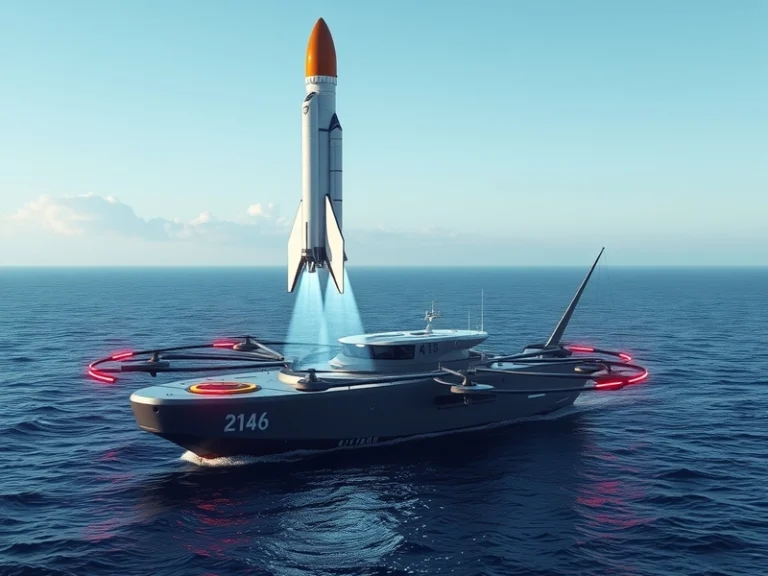
SpaceX’s groundbreaking ability to land and reuse its Falcon 9 first stages, either on land at Landing Zone 1 or on autonomous drone ships like “Of Course I Still Love You,” is a testament to highly sophisticated autonomous control systems heavily reliant on advanced algorithms. The precision required to guide a 15-story-tall booster back to a pinpoint landing, often in challenging sea conditions, involves:
- Dynamic Trajectory Optimization: AI/ML algorithms can dynamically adjust the booster’s descent trajectory, optimizing burn profiles, fin movements, and engine relights to compensate for real-time atmospheric conditions, wind shear, and drone ship movement.
- Sensor Fusion and State Estimation: Integrating data from GPS, inertial measurement units (IMUs), radar altimeters, and other sensors, AI helps create an accurate real-time estimate of the booster’s position, velocity, and attitude, crucial for a successful landing burn.
For Starship, the challenge is even greater, with its “belly flop” maneuver and propulsive landing requiring extraordinary control and adaptive algorithms to manage its complex aerodynamics and engine firings.
Enhancing Safety for Human Spaceflight
While AI’s role in design and operations enhances efficiency, its contribution to safety is paramount, especially for crewed missions aboard the Crew Dragon capsule. By providing robust anomaly detection, predictive capabilities, and highly precise autonomous control, AI helps to:
- Reduce Human Error: Automating complex procedures and continuously monitoring systems reduces the potential for human error during critical flight phases.
- Improve Situational Awareness: AI-powered diagnostics can present flight controllers and astronauts with clearer, faster insights into the vehicle’s health and performance.
- Enable Redundancy and Resilience: The ability of AI to adapt to unexpected conditions and optimize performance in real-time adds another layer of resilience to SpaceX’s systems.
Elon Musk has often expressed both his optimism for AI’s potential and his concerns about its unfettered development. Within SpaceX, however, AI is deployed as a critical engineering tool, meticulously integrated to solve some of the most complex challenges in aerospace, ultimately advancing the company’s ambitious goals of making humanity a multi-planetary species by making space travel more reliable, cost-effective, and safe.