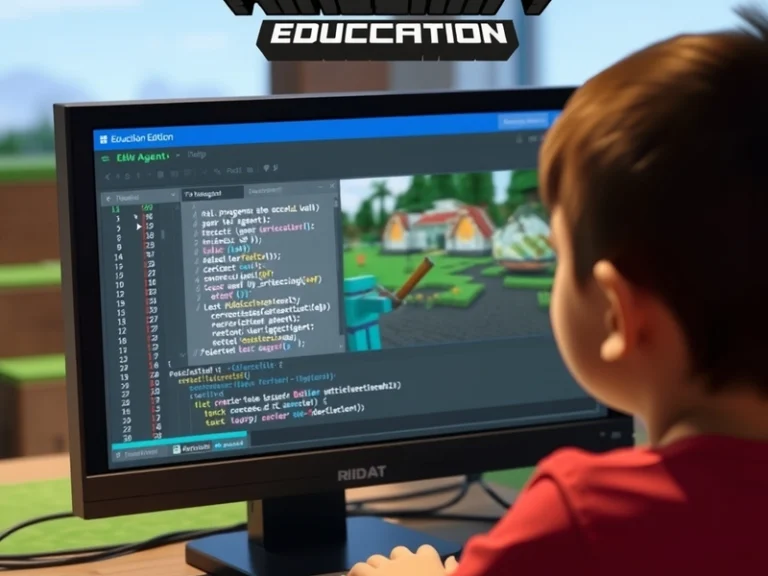
Minecraft, the popular sandbox video game, is increasingly being leveraged as an engaging platform to introduce children and young adults to the fundamentals of programming and artificial intelligence (AI) agent development.
The game’s inherent structure, combining creative construction with logical interactions, provides a fertile ground for teaching complex computational concepts in an accessible and highly motivating environment. Through tools like Minecraft Education Edition and integrations with block-based coding platforms, learners can design and program autonomous agents that interact with the virtual world, laying foundational knowledge for future AI endeavors.
Why Minecraft Excels as an AI Learning Environment
Minecraft’s appeal for educational purposes, particularly in programming and AI, stems from several key characteristics:
- Interactive Sandbox: The open-world nature allows for endless experimentation. Students can build environments and then program agents to navigate, modify, or interact within them, receiving immediate visual feedback on their code’s efficacy.
- Block-Based Coding Integration: Platforms like Microsoft MakeCode are directly integrated with Minecraft Education Edition. This allows learners to drag and drop code blocks to create scripts, abstracting away complex syntax and focusing on logic and computational thinking. As proficiency grows, these platforms often offer transitions to text-based languages like Python.
- Tangible Outcomes: Programming an agent to automatically build a house, harvest crops, or navigate a maze provides a clear, visible result. This tangible feedback reinforces learning and keeps students engaged, transforming abstract code into observable actions within the game world.
- Familiarity and Engagement: Many students are already familiar with Minecraft, which lowers the barrier to entry and leverages existing interest. This familiarity reduces anxiety often associated with learning new technical subjects.
The transition from simple in-game automation to AI concepts is a natural progression within Minecraft. Initially, students might program a sequence of actions for their character or an agent, such as moving forward a certain number of steps, placing blocks, or breaking blocks. These basic scripts introduce core programming constructs like loops, conditionals, and variables.
From Scripting to Agent Intelligence
As learners advance, the focus shifts towards creating agents that exhibit more intelligent behaviors. This involves:
- Perception: Programming agents to “sense” their environment. For instance, an agent might be programmed to detect the type of block in front of it, or the presence of an obstacle, using in-game sensor functions.
- Decision-Making: Implementing conditional logic based on perceived information. An agent might decide to turn left if it detects a wall, or collect a specific resource if it finds one. This introduces basic if/else statements and more complex logical flows.
- Problem-Solving: Designing agents to achieve a goal in a dynamic environment. This could involve pathfinding algorithms (even simple ones), where an agent must navigate a complex maze to reach a target, or resource gathering, where it must identify and collect specific items.
- Autonomous Behavior: Moving beyond direct command sequences to agents that can react to unforeseen circumstances or adapt their behavior based on continuous environmental input. While not true machine learning in the conventional sense, these exercises build intuition for how autonomous systems operate.
Historically, even advanced AI research has utilized Minecraft. For example, Microsoft Research developed Project Malmo (formerly AIX), an open-source platform that allowed researchers to develop and test AI agents within Minecraft. While Malmo was aimed at academic and research communities rather than K-12 education, its existence underscores the game’s flexibility as a testbed for complex AI algorithms, from reinforcement learning to natural language processing within a simulated environment. This background highlights Minecraft’s robust capability to support educational pathways from beginner programming to advanced AI concepts.
Curriculum and Implementation
Educational institutions and informal learning programs worldwide have integrated Minecraft into their computer science and STEM curricula. These programs often structure learning activities around specific challenges or projects:
- Automated Construction: Students program agents to build structures, demonstrating efficiency and precision in code.
- Environmental Interaction: Agents are tasked with planting trees, harvesting crops, or cleaning up virtual pollution, introducing concepts of environmental sensing and resource management.
- Game Design and Logic: Learners can create mini-games within Minecraft where their programmed agents act as NPCs (non-player characters) with specific rules and behaviors.
- Cooperative Agents: More advanced projects might involve programming multiple agents to work together to achieve a common goal, exploring concepts of distributed intelligence and coordination.
These hands-on experiences help demystify AI by allowing students to actively construct and control intelligent-like behaviors, rather than passively observing them. By making AI programming a creative and playful endeavor, Minecraft helps cultivate a generation of learners who are not just consumers of technology, but active creators and innovators within the rapidly evolving field of artificial intelligence.